
Preface – On the Madness of Love, and the Love of Madness
Few things are more dangerous than a person who agrees with you completely. Especially if you’re wrong. And doubly so if they are too.
I recently re-read Wuthering Heights – which is, as far as I’m concerned, the great British novel of shared madness. People go on about love, about passion, about the haunting beauty of Catherine and Heathcliff’s doomed romance. But what I saw, on this pass through, wasn’t love at all. It was folie à deux. A mutual derangement. A pair of souls so entangled in obsession that reality had no choice but to step politely aside.
They see each other not as people, but as extensions of themselves – vessels of longing, fury, and possession. Catherine famously declares, “I am Heathcliff,” and the literary world swoons. But really, that’s just psychosis in a dress. Love doesn’t demand the erasure of boundaries. Madness does.
And what’s unsettling is not just that they’re mad – it’s that their madness makes sense to them. To each other. In that blasted, wind-lashed landscape, theirs is the only logic that matters. They believe in each other so entirely, so ruinously, that it infects the very air of the novel.
That’s the horror of shared delusion. It doesn’t arrive in a straitjacket. It wears the clothes of conviction. Of kinship. Of truth.
It got me thinking – about couples I’ve known, funerals I’ve arranged, theories I’ve heard whispered in grief or trauma or boredom. How quickly two people can seal themselves off from the world. How a fantasy, if repeated often enough, becomes a kind of scripture. How Heathcliff and Catherine were not lovers so much as inmates – co-conspirators in a dream that turned on them.
So I wrote the following reflection – not as a clinical study, but as a personal reconnaissance. A walk along the edge of the moor, so to speak. Because I suspect we’ve all brushed past madness now and then. And some of us, let’s be honest, winked at it.
Folie à Deux — A Shared Madness in Two Voices
I’ve long been fascinated by the ways in which madness doesn’t just reside in the mind – it builds guest rooms, makes tea, and invites company.
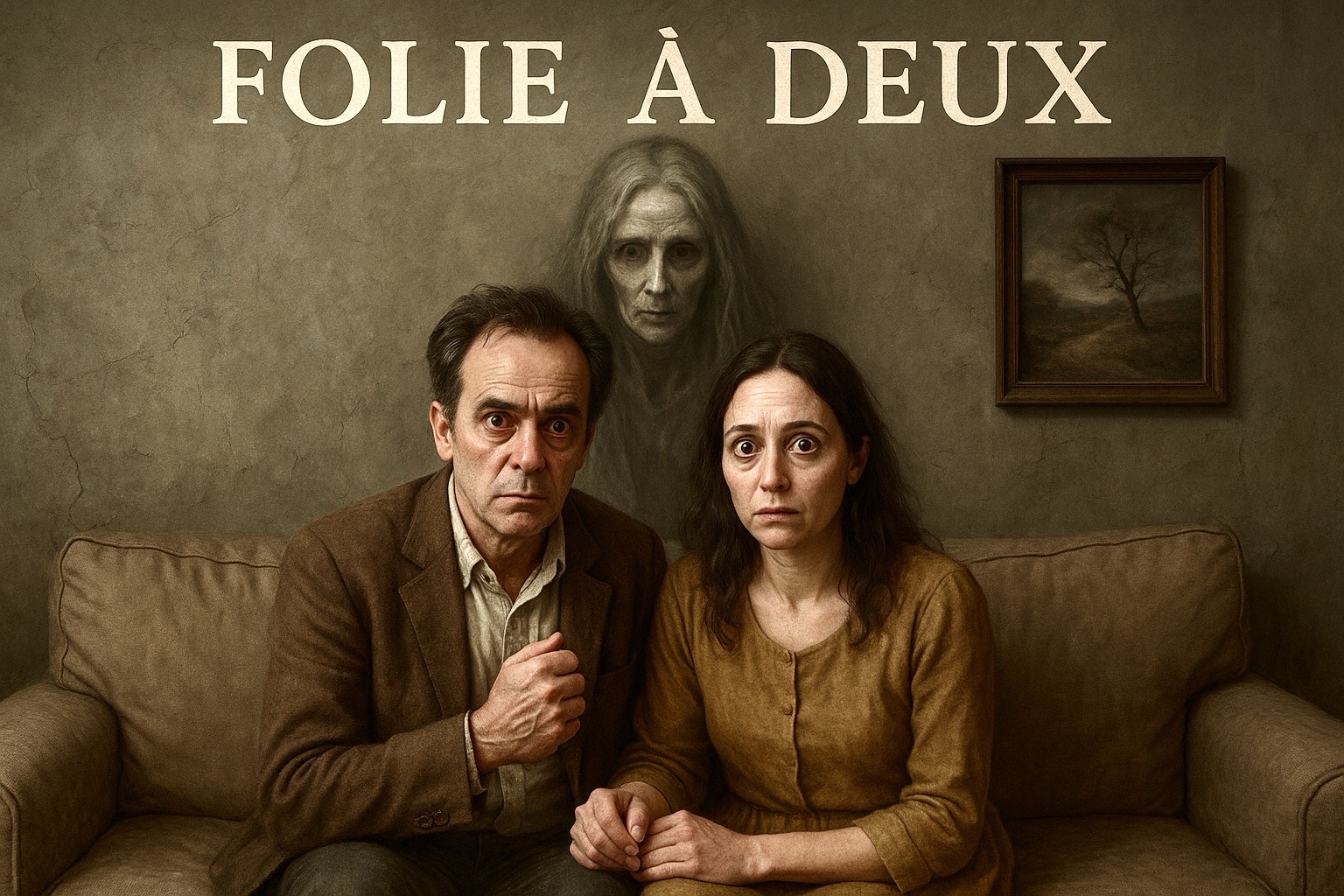
Folie à deux, they call it. Madness of two. A psychiatric arrangement not unlike a duet in a Beckett play: one person deluded, the other nodding along, both orbiting the same lunatic moon. It’s rare, they say, but I’ve seen versions of it in village cafés, in town halls, in homes with the curtains drawn against the century. One mad belief, two mad believers. What begins as a solitary echo chamber becomes a choir of the unhinged.
It usually begins with one dominant ‘primary’ person – deluded but charismatic – whose beliefs spill over into the more passive ‘secondary’ partner. The delusion becomes relational. Symbiotic. One sees the devil in the dog’s eyes, the other confirms it barked in Latin.
Of course, psychiatry deals with the clinical boundaries, but I’m more interested in the philosophical shape of it. What is it about the human soul that longs to be believed – even when what we believe is mad? Folie à deux is less about insanity and more about intimacy. It’s madness made meaningful by company. When the abyss looks back into us, it’s oddly comforting to discover someone standing beside you, waving.
And let us not pretend this is confined to padded rooms. Whole ideologies have bloomed from shared delusions. Cults, conspiracies, crusades. The 20th century alone is one long syllabus of folie à millions. Delusions about race, blood, utopia, the mechanised soul. Just add uniforms and an anthem. The individual case might be tragic, but the collective one is operatic.
I once conducted a funeral for a woman whose brother insisted she had been murdered by the NHS. No autopsy, no evidence – just his deep, unshakeable conviction. His daughter, standing beside him, repeated the same story to me word for word, like a script. The death certificate said pneumonia. He said poison. That, I suspect, was folie à deux. A grief-stricken world reordered to fit the aching logic of their loss.
It’s tempting, sometimes, to envy the mad. Certainty has a magnetic pull. The world may be senseless, but a shared delusion offers sense – however crooked. In fact, the terrifying thing isn’t that two people can go mad together – it’s that sometimes, they seem happier for it.
As for me, I’ve danced near the edge often enough to recognise the music. But I’ve always managed to stagger back from the brink, clutching a book or a dog lead or a sarcastic prayer. Madness may be contagious – but so is lucidity, if you seek the right company.
And yet – there’s something grimly romantic about the idea of two people clinging to the same hallucination, like a raft in the open sea. It’s deranged, of course. But it’s also oddly beautiful. Like watching two moths circling the same flame, unaware of how close they are to burning.

 Wording
Good post! I actually found it quite encouraging, because since I know I’m always right and my reviews of books are always the “right” review, this post made me realize just how important I am to the world at large in keeping them all on the straight and narrow.
Go me! 😉
On a more serious note though, this does highlight why community is so important, especially a church community. It’s not just one person (Mrs B) trying to keep me on the straight and narrow, but many different people with many different ways of interacting with me. Their “ego” literally keeps mine in check simply by being there. Even if I can’t deal with them sometimes, or want to, they are still there, being a buffer from the void. Which is good because since I’m such an introvert, the Void is just under the surface, waiting for me to fall in if I’m not careful.
I applaud your self-appointed role as Literary Shepherd to the Masses – someone’s got to separate the sheep from the unreadable. 👏🏻
And yes, community – especially church community – is a strange and necessary thing. Though I’ll confess, my own long exposure to clergy and church life (I was married to a vicar and spent years orbiting the clerical class) has left me… let’s say deeply introverted with bells on. These days I avoid formal church like a plague of well-meaning committees. That’s not a loss of faith – just a weariness with the machinery.
Still, I do get what you mean. Sometimes it’s the very presence of others, irritating or inspiring, that stops us from floating off into the theological or existential abyss – sometimes it’s like people rubbing up against each other like grit in the oyster: sometimes you get a pearl, sometimes you get indigestion. Even if I now practise my faith from a quieter distance, I can’t deny the odd blessing that comes from being occasionally jostled by a fellow pilgrim who thinks your silence is just a cry for more biscuits.
So yes – to buffers. To awkward fellowship. And to holding the Void at bay with a well-timed sermon, even if it’s delivered unintentionally by someone you’ve been avoiding since Pentecost.
😀