I sometimes wonder how many of our modern idols would survive without their filters. Strip away the stage-managed profiles, the publicists, the polished platitudes – and what are we left with? Often, very little. But every now and then, we encounter a figure whose inner world shines even brighter than their public image. Helen Keller is one of them.
Her story is one I thought I knew. The blind and deaf girl at the water pump; the miracle moment of language breaking through the void; the rise from silent shadows into literary and intellectual prominence. It’s a narrative that tugs at every heartstring – just the sort of thing school assemblies used to wheel out before we were all told inspiration was offensive. But dig deeper, and Helen Keller becomes something far more interesting than a motivational poster. She becomes human – complicated, radical, incandescently alive.
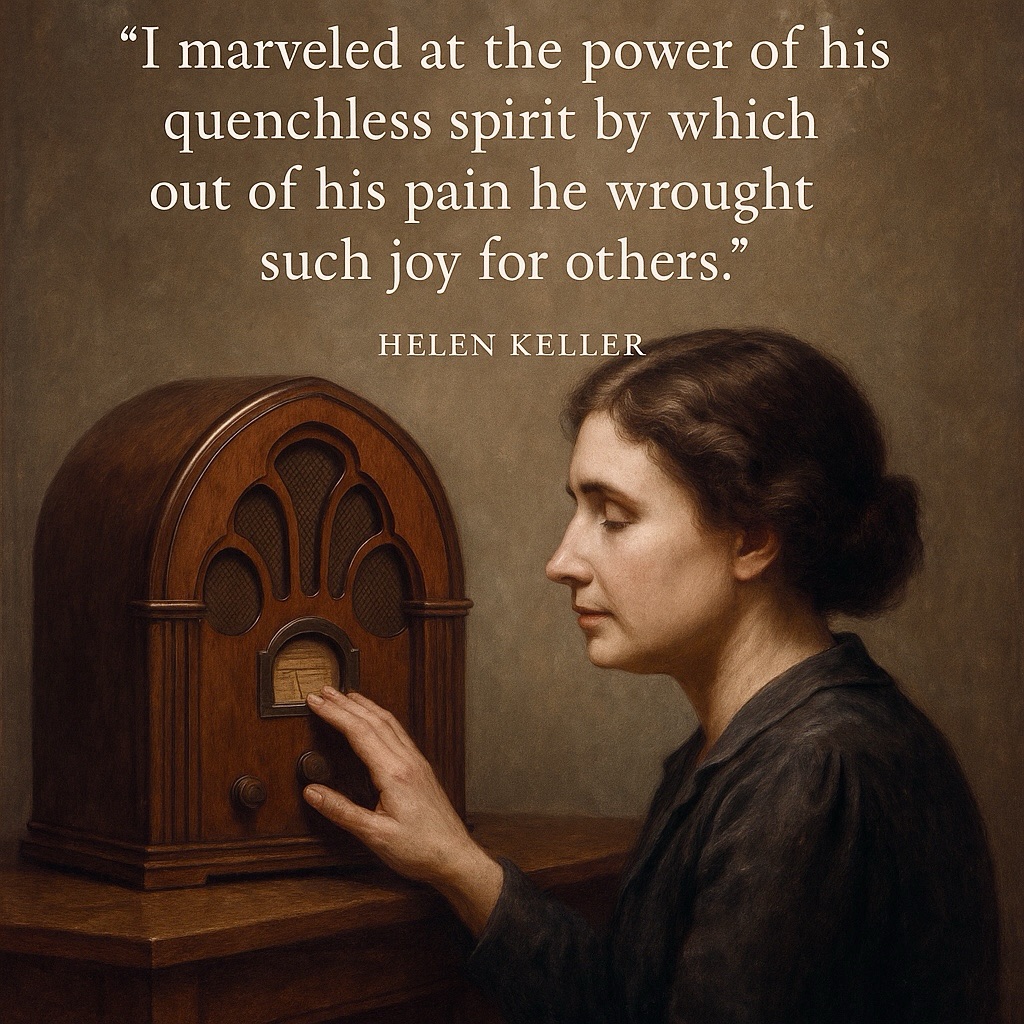
I came across her again recently, not in a textbook, but in a letter she wrote in 1924. She described, with aching beauty, the experience of feeling Beethoven’s Ninth Symphony through the vibrations of a radio receiver. “A sea of sound breaking against the silent shores of my soul,” she wrote. I had to stop and read the line twice. This wasn’t some passive receiver of pity. This was a woman of poetry and perception, whose soul – far from being dulled by her affliction – seemed sharpened to an otherworldly point. Like a tuning fork of the divine.
But as I sat in admiration, I felt that familiar modern reflex rise up – the desire to dig, to unearth contradiction. And sure enough, I found it. Helen Keller, the icon of perseverance and spirit, was also a devout socialist. A self-professed follower of Marx. A woman who wrote for The Masses, supported the working man, and railed against capitalism like a revolutionary in sensible shoes.
And I’ll be honest – it gave me pause. Like many, I find socialism, especially of the Marxist variety, intellectually dubious and historically bloodstained. I’ve watched it do to nations what fire does to libraries. So what do we do, I wondered, when a soul we so deeply admire aligns herself with ideas we so deeply mistrust?
The answer, I think, lies in how Keller arrived at those ideas. She wasn’t, as the modern phrase goes, ‘radicalised.’ Nor was she used as a mascot by the fashionable Left of her day. Her political views weren’t party-line slogans or attention-seeking virtue signals. They were, as with all things in her life, born from experience and empathy.
Having lived in darkness and silence, Keller understood something most of us do not: what it means to be voiceless, to be unseen, to be shut out of a world that moves on without you. She witnessed poverty, disability, and despair, and saw in them not statistics or causes – but people, like herself, locked behind invisible doors. Her socialism, then, wasn’t about ideology. It was about pain. Not class war, but compassion.
She herself acknowledged that she had lived a privileged life – educated, supported, loved. And that same awareness led her to recognise that the vast majority of those with disabilities, or those born into poverty, had none of those advantages. Her heart reached for justice, and she followed the signposts she saw. It just so happened that those signposts were red.
If her socialism was misjudged, it was also untainted by malice. There was no bloodlust in her politics, no smug utopianism, no disdain for her country. Unlike the armchair revolutionaries of today, Keller wasn’t interested in tearing down monuments or cancelling her cultural forebears. She read Shakespeare and Milton with reverence. She praised Beethoven and Christ in equal measure. Hers was a radicalism of spirit, not destruction.
And besides, who among us can claim a faultless canon? Dostoevsky was a monarchist. Yeats flirted with mystic nationalism. T. S. Eliot harboured snobbery and shadows of antisemitism. Yet I read all three, and feel no shame in doing so. If we demand ideological perfection from our heroes, we will be left with no heroes at all.
Keller’s life remains, to my mind, one of the most extraordinary ever lived. Not because she ‘overcame’ her disabilities, as if they were hurdles in a race – but because she redefined the race entirely. She proved that perception is not confined to the eyes, nor insight to the ears. She made a world of vibration and silence speak – eloquently, fearlessly, and with startling grace.
More than that, she reminded us that suffering doesn’t always harden – it can deepen. That silence doesn’t equal submission. And that joy, however elusive, can still break through the prison bars of flesh.
I may never agree with her politics. But I’ll always stand in awe of her soul.
Postscript – A Quenchless Spirit
It’s often noted, and rightly so, that Helen Keller admired Beethoven – another soul for whom silence became a sanctuary of creation. In her letter about the symphony, she wrote, “I marveled at the power of his quenchless spirit by which out of his pain he wrought such joy for others.”
That line echoes, doesn’t it?
Because it was her own story, too. A quenchless spirit. A defiance of darkness. And a joy, not found in easy answers, but in hard-won beauty.
Let those of us with all our senses beware: for Helen Keller lived more deeply, more fully, than most of us ever dare.


