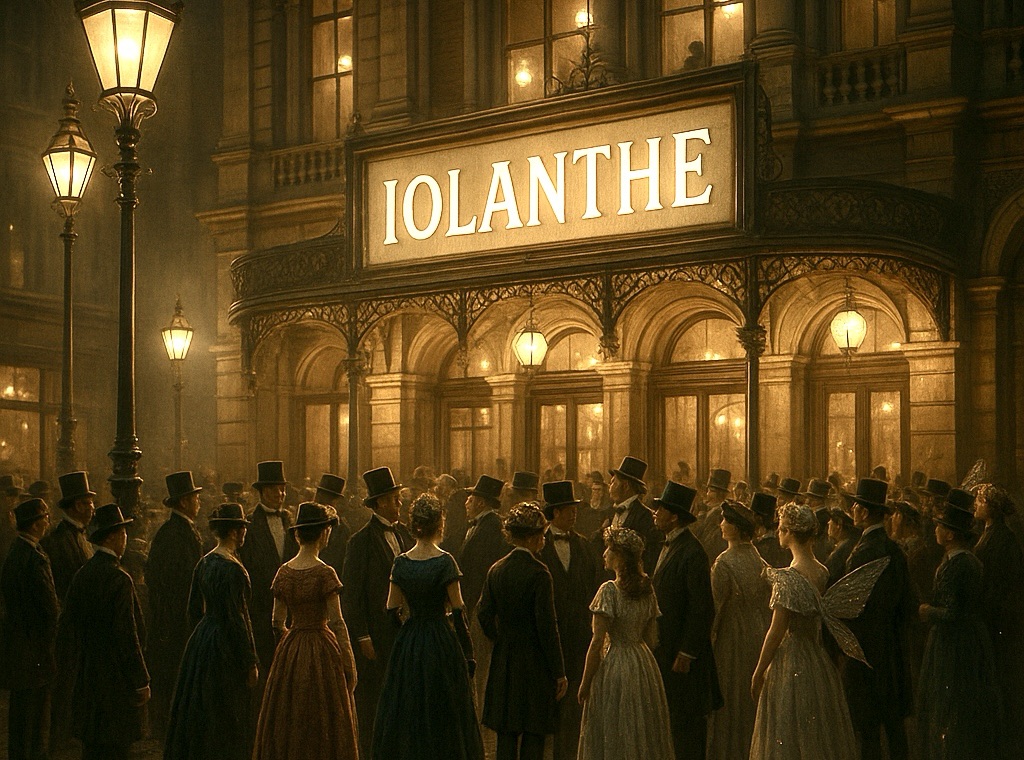
There’s something deliciously subversive about walking into a Victorian comic opera knowing full well that you are about to be lampooned, along with everyone else in the room. Iolanthe has always struck me as a peculiar miracle – one of those rare works of art that wears its mischief lightly, yet rests on a foundation of social philosophy as firm as granite.
I’ve often thought that W. S. Gilbert’s real subject was never fairies, peers, or lovers in improbable predicaments, but rather the great human comedy: our frailties, our posturings, our solemn absurdities. If Shakespeare’s Twelfth Night and Jonathan Swift’s The Battle of the Books were to sit down over a sherry with Jane Austen’s Northanger Abbey, I suspect Iolanthe might be the resulting child – sprightly, a touch irreverent, yet never losing sight of the moral anatomy it dissects.
What elevates it beyond mere amusement is the way its humour is paired with Arthur Sullivan’s music, which is far cleverer than it pretends to be. This is not the slapstick of an unlettered clown but the satire of a nation that has read its Plato and still chooses to laugh at its philosopher-kings. Plato, in his Republic, warns that the guardians of the state must be carefully educated lest they misuse their power; Gilbert, centuries later, turns the guardians into comic archetypes and lets the audience draw its own conclusions. In doing so, he proves Kierkegaard’s point that humour is ‘the last stage of existential reflection’ – the capacity to see oneself and one’s institutions in their proper, finite scale.
And then there’s the spiritual undertone – subtle, yet there. One cannot spend long in Gilbert’s company without detecting echoes of biblical irony. Ecclesiastes comes to mind (when doesn’t it?): ‘Vanity of vanities; all is vanity.’ This ancient refrain, which warns that every earthly rank and privilege will fade, finds a kindred spirit in Iolanthe’s gentle mockery of worldly status. We laugh at these exalted figures not because they’re wicked, but because, like all of us, they mistake the temporary scaffolding of life for the building itself.
From a psychological angle, the opera is a study in self-importance – that odd human quirk whereby people in robes, uniforms, or titles begin to believe in the myth they project. Gilbert invites us to see these figures as Jungian personas: the masks worn in public life, which can be noble in purpose but absurd in effect. The fairy kingdom, by contrast, represents the archetype of freedom from such trappings, unbound by parliamentary protocol. The comedy arises when these two psychic worlds inevitably collide – the inner, instinctual self meeting the outer, socially constructed one.
Philosophically, I find Iolanthe to be a strangely hopeful work. Beneath the satire lies a quiet belief that institutions can be reformed – that absurdity, once seen clearly, can be corrected, or at least laughed into harmlessness. It’s satire as a moral exercise, closer in spirit to Erasmus’ In Praise of Folly than to the acid of Voltaire. Where some satirists scorch the earth, Gilbert plants flowers in it – albeit the sort with a sting in their perfume.
And perhaps this is why I return to Iolanthe again and again. In a world perpetually weighed down by the seriousness of its own importance, here is a work that dares to say: Yes, power matters; yes, rank matters – but neither is ultimate. There’s an eternal court, above the human one, where titles are meaningless and truth is measured not by law or lineage but by the substance of one’s soul.
In the end, Iolanthe is more than a diverting evening in the theatre. It’s a mirror, polished with rhyme and melody, in which we see our dignified follies reflected back at us – and, crucially, we laugh. For to laugh, as both philosophers and prophets have known, is to loosen the grip of vanity and to glimpse, however briefly, the freedom that lies beyond it.

 Wording