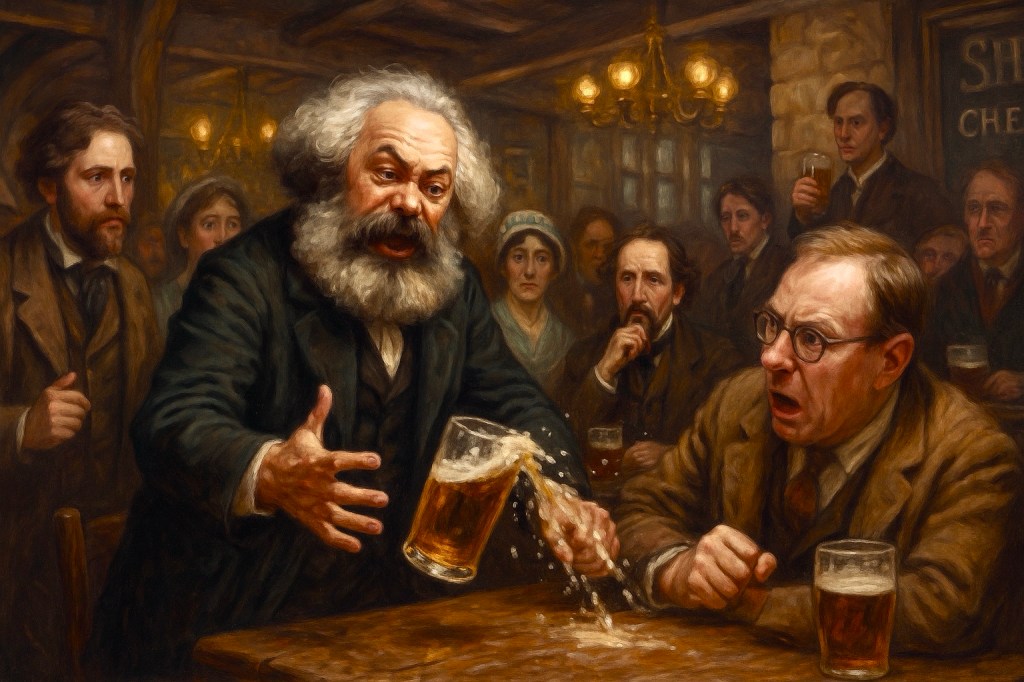
There are few things more dangerous to a peaceful evening than a Marxist in full flow. One minute you’re happily contemplating the head on your shandy, the next you’re being lectured about ‘historical inevitability’ by someone who’s never held a job long enough to be sacked.
The conversation usually begins with the inevitable:
“Dialectics is the engine of history.”
Which, to the untrained ear, sounds like an interesting philosophical claim. To my ear, it’s a signal to start scanning for the exit or the nearest blunt instrument.
Hegel – The Harmless Cloud-Dancer
To be fair, Hegel at least had the decency to keep his dialectics largely confined to the realm of ideas. In his vision, history unfolds as a grand, lofty conversation between concepts – Being and Nothing having a tiff, then making up to form Becoming. It’s basically Pride and Prejudice with metaphysics: long sentences, lots of pride, and at least one Bennet sister fainting.
Boring? Yes. Dangerous? Not really. You can fall asleep halfway through The Phenomenology of Spirit without any risk of being collectivised.
Marx – The Bearded Menace
Karl Marx took Hegel’s dialectic, flipped it “on its head” (his words), and replaced the genteel ballroom with an angry mob. In Marx’s world, it’s not ideas that move history but material struggle – which sounds reasonable until you realise that, in practice, this ‘struggle’ usually means some bloke with a clipboard telling you your farm now belongs to the people, and by ‘the people’ he means the five party officials currently living in it rent-free.
Marx’s dialectic goes like this:
- Thesis: Someone owns something.
- Antithesis: Someone else decides they should own it instead.
- Synthesis: Nobody owns it, but everyone’s hungry.
I’ve always thought Marx would have made an appalling pub landlord. He’d confiscate the dartboard, declare the crisps “the means of production,” and give the best seats to a committee. Within a week, there’d be queues down the street for watered-down lager, and you’d need a ration card to get a pork pie.
The Acolytes
The only thing worse than Marx himself is the modern Marxist, usually found lurking in universities like moss in damp stonework. They quote The Communist Manifesto as if it were scripture, completely oblivious to the fact that Marx’s great ‘worker’s paradise’ has never, in all of human history, ended in anything except bread queues, secret police, and the slow, grinding realisation that everyone is equally miserable.
They’re the kind of people who, when confronted with the spectacular failures of every Marxist state, will say, “Ah, but that wasn’t real socialism,” the same way a drunk insists he drives better after six pints.
Classic Literature Knows Better
Frankly, the great authors worked this out long before Marx’s beard darkened a pamphlet. Dickens, in Hard Times, skewered the joyless utilitarian obsession with reducing human life to economic formulas. Orwell gave us Animal Farm, in which the pigs (quite accurately) become the thing they overthrew. Even Shakespeare knew: when you let schemers run the show, you get Julius Caesar – but with more blood and fewer well-dressed senators.
My Pub Version of the Dialectic
- Hegelian: You order a pint, they don’t have it, you try something else and maybe even like it.
- Marxist: You order a pint, they take the whole bar into state ownership, and now no one can have a drink until the collective decides what’s fair – which is never.
Final Reflection
Hegel might bore you senseless, but Marx will bore you, rob you, redistribute your coat, and then have the gall to tell you it’s for your own good. His dialectic isn’t the march of history – it’s the drunken stagger of a man who keeps falling into the same ditch and insists the ditch is progress.
If that’s the ‘engine of history,’ then I’ll walk, thanks.

 Wording
Marx was a thug and his followers today are even worse. But they have become experts at knowing exactly when to stop pushing and let the other side “incite” so they can protest their innocence. Sadly, even a bloodbath only helps them. It’s only when society as a whole rejects the very idea that they fail. And that doesn’t usually happen until something like the reign of the USSR shows everyone the sad truth.
As it happens, I have a rather scathing piece on Marx I wrote some years ago. I’ll tidy it up this evening and pop that one on. Makes for interesting reading – to think, those snivelling little Marxists adored this fool.