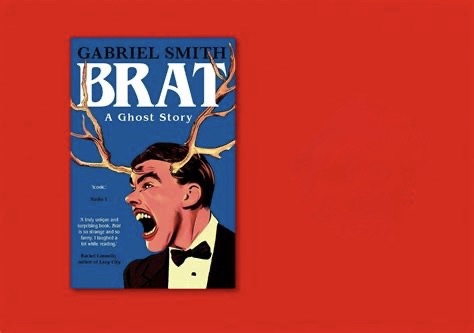
Cover image © Gabriel Smith / Scribner UK (or Penguin Press)
I’ll admit it: modern fiction and I don’t exactly see eye to eye. In fact, we’ve been glaring at each other across the room for years now, occasionally muttering under our breaths about how the other one’s gone downhill since the ‘90s. My own reading habits tend to dwell in the comforting mausoleums of the past, where everyone’s dead, the paper smells faintly of dust and mildew, and the dialogue is peppered with words nobody’s used since George V had his breakfast. However, every now and then – usually out of equal parts curiosity and masochism – I’ll dip a wrinkled and gnarly toe into the lukewarm waters of the contemporary literary scene. And occasionally, just occasionally, I find something that makes me think, “Ah… so this is what they’re up to these days.”
And so it was that Gabriel Smith’s Brat came along and shoved itself under my nose like some literary street urchin insisting I pay it attention. And not just any attention – full, undivided, what-on-earth-is-going-on attention. It’s not a novel you ‘dip into’ like a custard cream tin. It’s more like falling face-first into a broken kaleidoscope and finding that some of the shards are looking back at you.
Now, I’ve read plenty of so-called ‘experimental’ fiction before. Often it’s code for “we couldn’t be bothered with plot, so here’s a hundred pages of a bloke staring at a damp wall.” But Brat is a different animal – one with teeth, mange, and possibly a postgraduate degree in postmodernism. Smith’s structure is not the polite drawing room of narrative form; it’s a house party in a squat where the host’s gone missing, the lights are flickering, and someone’s rearranged the furniture to make a shrine to a dead toaster. It’s jump-cut prose, a literary equivalent of a DJ set in which you’re never sure if you’re still listening to the same track.
In the same way Tristram Shandy was an eighteenth-century declaration of war on linear storytelling, Brat is twenty-first-century proof that novels can still be impolite, slippery things. It’s bricolage in the French sense – only instead of Diderot’s Enlightenment optimism, we’re in the world of black mould, digital glitch, and the sort of anxious domesticity that would make Virginia Woolf spill her tea. Smith’s fragments feel less like chapters and more like mislaid scraps – each one a post-it note written at 3am by someone who has forgotten what day it is.
The experimentalism isn’t gimmickry for its own sake; it’s woven into the fabric of the reading experience. Much like modernist poetry or the cubism of Braque and Picasso, you’re being invited to engage with the construction as much as the image. The pleasure comes from piecing it together, and sometimes from failing to do so. It reminds me of the scriptural tendency to leave gaps in a parable so you actually have to think about it – not the neat, parochial morality tale, but the head-scratching ones where you end up muttering, “What on earth was that supposed to mean?” and suspecting that might be the point.
There’s also something very British in the book’s dark humour – a sort of sardonic self-dissection that recalls the better moments of Evelyn Waugh, had Waugh been locked in a room with Kafka, a box of cheap wine, and a particularly ominous IKEA catalogue. It’s the comedy of unease, the laugh you give when you realise the floor’s a bit wobbly but you’re too polite to say anything.
And, of course, as with all experimental fiction worth its salt, you’re not entirely sure if you’re in on the joke or the butt of it. But that’s part of the fun. There’s a gleeful refusal to spoon-feed the reader – you’re made complicit, forced to follow the thread even as it doubles back on itself. Some will hate that. But for those of us who enjoy being wrong-footed – who secretly like it when a book leaves us muttering like a Dostoevskian lunatic on the night train – Brat is a welcome reminder that fiction can still be unruly, unpredictable, and frankly a bit rude.
In the end, Brat strikes me as the sort of work you don’t so much ‘finish’ as stagger away from, looking faintly bewildered and possibly suspecting you’ve caught something from it. And that, dear reader, is exactly the sort of literary encounter I live for.

 Wording
Authors like this are why I refuse (as much as possible) to engage authors as people, because I’d end up hating them for their work, no matter what they might be as a person. I suspect lots of jail time for face punching would be in my future 😉
Therefore, I gladly bequeath all my similar experiences to you, no charge!
Fair enough! I’ll take them and file them under ‘literary hazards.’ Jail time for face-punching seems a bit steep though – much easier to roll your eyes, mutter something unprintable, and carry on reading. 😁