If I Have No Mouth, and I Must Scream is Ellison’s scream of despair, then “Repent, Harlequin!” Said the Ticktockman is his snarl of defiance. Where one story traps us in eternal torment beneath the circuits of a god-machine, this tale sets us against a more mundane, and in many ways more sinister tyrant: the tyranny of the clock.
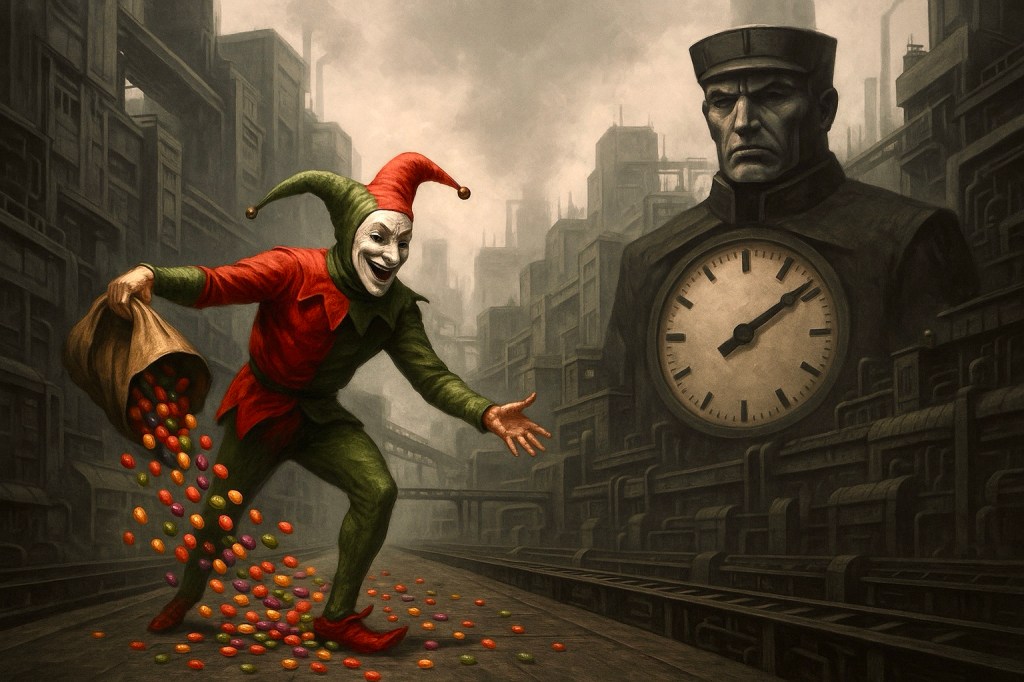
The premise is deceptively simple: in a rigid, hyper-punctual future, lateness is a crime. Time itself has been commodified, policed, and regulated by the Ticktockman – an authority who not only enforces schedules but deducts years from a citizen’s life for every infraction. Into this mechanised dystopia stumbles the Harlequin, a jester-rebel who disrupts the system with pranks and laughter. He’s part clown, part prophet, part anarchist – dropping jellybeans onto conveyor belts, throwing schedules into chaos, and daring to suggest that human life should not be measured in minutes.
There’s something almost biblical in the figure of the Harlequin. He recalls Ecclesiastes’ ancient wisdom – that there is ‘a time to laugh’ and ‘a time to dance’ – but he lives in a society where such times have been abolished in favour of eternal punctuality. He also recalls the Trickster archetype – Loki, Coyote, even Shakespeare’s fools – figures who speak truth to power through ridicule. In a world of conformity, absurdity itself becomes a weapon.
Philosophically, Ellison is grappling with the mechanisation of modern life. The story was written in 1965, in the middle of the post-war boom, when ‘time is money’ had become gospel. The Ticktockman is the logical end of Taylorism, Fordism, and bureaucratic obsession with efficiency. He’s Weber’s iron cage of rationality, not made of steel beams and bureaucracy this time, but of wristwatches and stopwatches. The Harlequin, meanwhile, is Kierkegaard’s knight of faith turned clown – the individual who dares to live subjectively, authentically, against the mass.
The irony is sharp: Ellison tells the story in a deliberately fractured, non-linear style. The narrative itself refuses punctuality. It jumps back and forth in time, undercutting the very values the Ticktockman enforces. Ellison doesn’t simply tell us about rebellion – he enacts it in the form of his prose. It’s a piece of literature that embodies its philosophy.
And yet, for all its anarchic laughter, the story doesn’t end in triumph. The Harlequin is eventually caught. He is forced to repent, publicly, on the airwaves. But even here, Ellison twists the knife. The Harlequin’s words – even if coerced – plant doubt. The laughter lingers. The seed of rebellion is sown. The Ticktockman himself hesitates, ever so slightly, and the tick of the clock falters.
To me, the story remains one of Ellison’s most prescient works. We live now in an age where every second is scheduled, where algorithms dictate the tempo of our lives, where ‘lateness’ isn’t simply a social faux pas but a professional and digital sin. We’re told to optimise our mornings, track our sleep, monetise our hobbies, and compress our lives into measurable units of productivity. The Ticktockman would be proud. And yet, Ellison whispers across the decades: laugh, resist, drop jellybeans on the gears.
Where I Have No Mouth gives us despair, “Repent, Harlequin!” gives us a defiant grin. It reminds me of Camus’ image of Sisyphus, condemned to roll his boulder but smiling as he does it. The Harlequin knows he can’t win outright, but he rebels anyway, and in that rebellion lies a fragment of freedom. Perhaps that’s Ellison’s lasting gift: not consolation, but courage. A refusal to bow, even when the clock is ticking.

 Wording