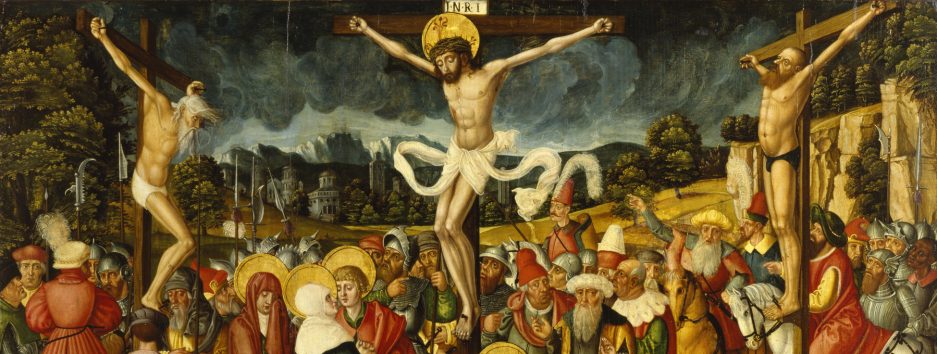

It’s almost too neat that Salomé should have been written in French. The language of Baudelaire, Mallarmé, and decadence itself lent Wilde the perfect tongue for blasphemy dressed in silks. The Victorians expected their theatre to teach morality, to improve the soul, to extol duty. Wilde offered them instead a necrophilic waltz in candlelight, where the sacred is profaned and desire drips like sacramental wine into the gutter.
At its core, Salomé is a simple story, borrowed from the Gospels: the Baptist denounces Herod’s adulterous union, Salome dances, Herod promises her anything, and she demands John’s head. The New Testament treats it briefly, like a judicial record: crime, request, execution. But Wilde, in true decadent fashion, takes that bare scaffolding and ornaments it with perfumes, visions, and a fatal languor. What Scripture framed as a moment of grim politics becomes, in Wilde’s hands, a theatrical meditation on lust, power, and the inexorable pull of death.
Desire and Denial
The play begins in a strange register. Salome, bored at Herod’s banquet, drifts onto the terrace where Iokanaan (John the Baptist) is imprisoned. She desires him not because he welcomes her, but because he resists her. The prophet’s voice rises from the cistern like an echo from Hades, denouncing the corruption of Herod’s court. He calls her “daughter of Babylon,” “daughter of Sodom.” Each insult excites her further. Here we glimpse Wilde’s profound sense of the psychology of desire: love’s never so compelling as when it’s forbidden.
I think of St Augustine’s pear tree, stolen not for hunger but because theft itself was sweet. Salome desires Iokanaan not to embrace life, but to embrace rejection, to taste the bitter fruit. Wilde himself knew this rhythm intimately. The Victorian world denied him, and he turned denial into art.
The Dance of the Seven Veils
The infamous ‘Dance of the Seven Veils’ was Wilde’s invention, and though the text provides no stage directions, it’s become the defining image of the play. It’s more than a striptease. It’s civilisation itself, shedding its polite hypocrisies, revealing flesh beneath linen, hunger beneath ritual.
Herod, half-drunk and wholly depraved, demands the dance. Salome agrees – but only if she may ask for whatever she wishes. The contract is ancient, Faustian, and inevitably fatal. She dances. Herod, sweating, trembles. And when the music ends, her wish is spoken: not jewels, not kingdoms, but the head of the prophet.
It’s an act of symbolic cannibalism: she doesn’t want Iokanaan alive, for alive he resists her. She wants him dead, to silence his purity, to own it utterly. She kisses the cold mouth of the severed head and utters Wilde’s most notorious line: “The mystery of love is greater than the mystery of death.” But in her act, she fuses the two. Love becomes necrophilia, desire becomes devourment, and death itself becomes the consummation of lust.
The Femme Fatale and the Decadent Imagination
Salome is no mere villainess. She’s the archetype of the fin-de-siècle femme fatale, sister to Flaubert’s Herodias, cousin to Gustave Moreau’s painted visions of the biblical temptress, and granddaughter of Lilith. Wilde inherits her from myth and remakes her as the very emblem of the Decadent imagination: the woman whose beauty is inseparable from corruption.
This is not merely misogyny. It’s symbolism. The femme fatale in Wilde is the mask of art itself – alluring, dangerous, destructive, yet irresistible. She embodies Nietzsche’s Dionysian force: the intoxication of beauty and terror, the wild frenzy that undermines Apollonian order. When Salome dances, we are watching not only a woman but civilisation itself sway into chaos.
Wilde, Censorship, and His Own Tragedy
It’s impossible to read Salomé without hearing echoes of Wilde’s fate. The Lord Chamberlain banned the play from the English stage on grounds of blasphemy – biblical characters couldn’t be portrayed in theatres. But what the censors feared wasn’t theology but honesty: Wilde had held a mirror to the secret appetites of Victorian society. The banquet of Herod is a parody of their own moral feasts, all propriety above the table and rotting sin beneath.
In Salome’s hunger for the forbidden, I hear Wilde’s own hungers: desires criminalised by the laws of the time, condemned by pulpit and Parliament alike. When Wilde himself was put on trial for ‘gross indecency,’ he was cast in the role of Salome – punished for desiring what society would not permit. The line “the mystery of love is greater than the mystery of death” became prophecy: his love brought him not joy but ruin.
Beardsley’s Black Lines
No discussion of Salomé is complete without Aubrey Beardsley. Commissioned to illustrate the English edition in 1894, he gave the play its visual twin: elongated figures, androgynous and sinister, leering on the page in sharp black lines. His The Peacock Skirt, The Toilette of Salomé, and The Climax turned Wilde’s text into a decadent bible. The book itself became an artefact – part scripture, part scandal, wholly irresistible.
Love, Death, and the Dance Unending
What remains after the curtain falls isn’t a moral but a mood. Wilde doesn’t teach; he intoxicates. Salomé insists that love and death are inseparable – that to desire beauty is already to court its destruction. The play is, in truth, a Passion narrative inverted. Where the Gospels offer redemption through sacrifice, Wilde offers corruption through desire. Where Christ drinks the cup of suffering to save, Salome drinks the cup of lust to destroy.
And yet, in that inversion, there’s truth. Wilde, quoting from the lips of his doomed heroine, places before us an epigram worthy of any Gospel: “The mystery of love is greater than the mystery of death.” It’s both confession and curse, for in Salome’s kiss we see not salvation, but the dark glamour of a civilisation peeling away its veils, one by one, until nothing remains but the bare, unashamed stare of the abyss.
Salome and Saint John: Wilde, Caravaggio, and the Theatre of Beheading
It’s a curious coincidence – or perhaps not a coincidence at all – that Oscar Wilde and Michelangelo Merisi da Caravaggio, two artists centuries apart, should both find their most haunting expression in the fate of John the Baptist. Wilde’s Salomé (1891) and Caravaggio’s The Beheading of Saint John the Baptist (1608) present the same biblical moment: the execution of the prophet at Herod’s command, delivered at the whim of a girl’s dance. Yet they couldn’t be more different in form. Wilde offers us theatre – a Symbolist poem of decadence and desire. Caravaggio offers us canvas – a monumental slab of oil paint, the largest he ever laid brush upon. And yet, both are mirrors of their makers’ souls: scandal, exile, lust, and the inexorable pull of destruction.
Step into St John’s Co-Cathedral in Valletta, Malta, and the first thing that strikes you is the scale. At over five metres across, the canvas dwarfs its viewers. This isn’t a panel to be admired; it’s an execution you’re compelled to witness.
At the centre, John lies on the ground, pinned by his executioner. The prophet’s no longer the fiery preacher of the desert but a man subdued, hands bound behind him, his body slumped. His red robe, symbol of martyrdom, bleeds across the stone floor, echoed – horribly, literally – by the blood spurting from his neck. It’s in that crimson pool that Caravaggio signs his name: Fra Michelangelo, knight of the Order of Malta, sealing his masterpiece not with flourish but with gore.
The executioner crouches over John, sword already spent, now reaching for a dagger or cleaver to finish the job. His gesture is crude, almost hesitant – no clean act of Roman justice here, but a butcher’s messy improvisation.
Around them, the cast of witnesses is arranged with brutal simplicity. To the left, a young girl holds a basin ready to receive the head, her face eerily composed. Behind her, an old woman recoils in horror, hands raised to shield her eyes. A gaoler stands impassive, the bureaucrat of death. And in the far right, two prisoners press their faces to the iron bars, watching from their own captivity as John’s freedom is extinguished.
The background is bare: a wall, an arch, the iron ring in the stone. No heavenly visions, no choirs of angels – just architecture, shadow, and flesh. The divine light, Caravaggio’s eternal motif, falls only on the violence itself. The holy is revealed, not in the absence of blood, but in its very spill.
If Caravaggio gives us the moment of execution, Wilde gives us the desire that demanded it. In Salomé, John (Iokanaan) resists the princess, condemns her corruption, and is dragged from the cistern only to be condemned by her lust. She dances, she bargains, and she kisses the prophet’s severed head with necrophilic fervour. Where Caravaggio presents martyrdom as brutal fact, Wilde makes of it a theatre of obsession, desire twined with death like ivy on a tomb.
Both works hinge on the same paradox: that John’s holiness lies precisely in his resistance. He’s untouchable, incorruptible – and thus, for Salome, irresistible. Wilde’s heroine demands his destruction not despite his purity but because of it. Caravaggio’s executioner bends low, blade in hand; Wilde’s princess bends lower still, lips pressed to the prophet’s dead mouth.
Why this subject? Why John?
For Caravaggio, exile and violence were never abstractions. He painted this work in Malta as a fugitive, a knight who’d killed a man in Rome and fled across the Mediterranean. In John’s prone figure, one sees Caravaggio himself – hunted, condemned, pinned to the ground by his enemies. The painting’s his confession, his absolution, and his signature in blood.
For Wilde, Salomé was prophecy. Within four years of its publication, he would be in the dock, condemned for his desires, stripped, humiliated, imprisoned. He too would find that ‘the mystery of love is greater than the mystery of death,’ and like John, he’d be sacrificed to the appetites and hypocrisies of others.
What unites Wilde’s and Caravaggio’s visions is the refusal to separate the sacred from the profane. Caravaggio’s divine beam of light doesn’t sanctify John in triumph but exposes his brutalisation. Wilde’s poetry doesn’t ennoble love but corrupts it, showing that love itself can demand death as its consummation.
Both works remind us that the line between sanctity and sin, between beauty and brutality, is perilously thin. John dies because he’s holy; Salome desires him because he’s holy. And the artist – whether with brush or with epigram – insists we watch.
Caravaggio forces us to look at the moment we’d avert our eyes from – the mess of martyrdom, the indecent reality of execution. Wilde compels us to hear the words we’d forbid – the dangerous confession that desire can’t be tamed. Both scandalised their societies because both refused to flatter them.
In the end, The Beheading of Saint John the Baptist, and Salomé are twin mirrors of art’s cruel honesty. Caravaggio’s figures crouch in silence, Wilde’s characters shriek in poetry, but the truth is the same: the mystery of love and the mystery of death can’t be disentangled. To look at either work is to feel civilisation peel away its veils – until, at the heart of the stage and the canvas alike, there remains only the executioner’s blade and the abyss it opens.
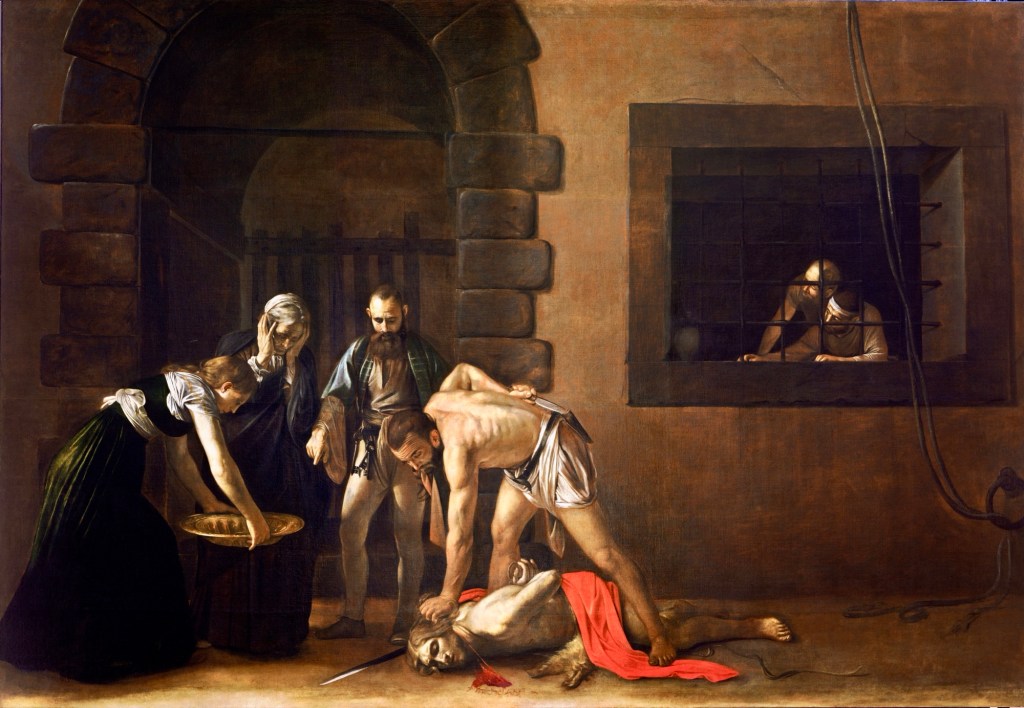
The Beheading of Saint John the Baptist, Michelangelo Merisi da Caravaggio, 1608, oil on canvas, 370 × 520 cm, St. John’s Co-Cathedral, Valletta, Malta.

 Wording