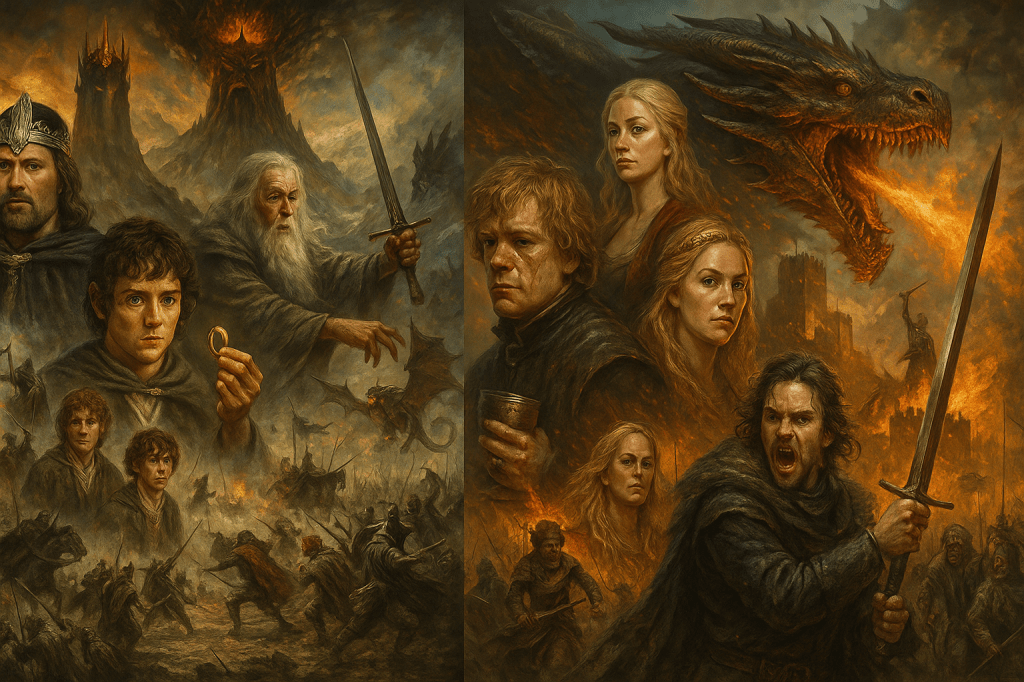
I recently stumbled across a post taking shots at Tolkien, quoting George R. R. Martin’s usual grumblings about The Lord of the Rings – no tax policies for Aragorn, evil vanquished too ‘neatly’ when the Ring was destroyed, destiny over realism, and so on. The more I read, the more it irritated me. Tolkien wasn’t writing an accountant’s ledger or a grimy political thriller; he was creating a myth. So, in defence of Tolkien – and with a little sharpened wit against Martin – here’s my response.
It’s a curious sight to watch George R. R. Martin – shambolic scribe of Westeros, high priest of brothels and betrayals – take potshots at Tolkien, the father of modern fantasy. I have the impression of a local pub dramatist sneering at Homer because The Odyssey failed to give us Odysseus’ pension scheme.
Martin’s great grievance, of course, is that Tolkien dared to write myth instead of tax code. Aragorn becomes king and marries Arwen, and this is apparently insufficient, because we’re not given his tariff policies on imported pipeweed. The complaint’s laughable. The Lord of the Rings is not a civil service manual; it’s an epic. Myths transcend the petty machinery of governance. Imagine demanding that Arthur’s legend halt midway to outline Camelot’s sewage system. It’s the complaint of a man who confuses grandeur with grit.
His second quibble is with the destruction of the Ring: too clean, too decisive. Evil, Martin insists, should be messier, more politically entangled, more like his own pages stuffed with incest, treachery, and whores. But Tolkien was no cynic; he knew evil not merely as political corruption but as metaphysical rot. The Ring is the embodiment of sin, and its unmaking is salvation. The neatness isn’t a flaw, it’s the point.
Martin sneers too at Tolkien’s reliance on destiny. Frodo is ‘meant’ to bear the Ring; Aragorn is ‘destined’ to be king. How dreary, he sighs, how inevitable. Yet Martin misses the twist entirely: Frodo fails at the last. He can’t surrender the Ring. Providence alone – working through the wretched creature Gollum – brings about victory. This isn’t shallow determinism, but theology disguised as fantasy: the mystery of grace. It’s subtle, elegant, profoundly human.
Tolkien understood that myths must soar above the dust and decay of bureaucratic realism. They’re not meant to wallow in cynicism, but to elevate, to reveal that beyond despair there’s hope, beyond ruin, renewal. Martin, for all his vaunted ‘realism,’ offers nothing of the sort. His world is a pitiless charnel house where power alone is worshipped. Little wonder he can’t comprehend Tolkien, for he’s chained to the mud.
The truth is plain: Martin’s criticisms say less about Tolkien’s supposed ‘flaws’ than about Martin’s own limitations. He can’t see beyond the brothel, the battlefield, the throne room. He mistakes myth for naivety because his imagination is starved of transcendence.
Tolkien wrote a masterpiece for the ages. Martin wrote an unfinished saga, bloated with digressions, now rotting in its author’s study. The irony’s delicious: the man who mocked Tolkien for failing to account for tax policies can’t even bring himself to account for his own plotlines.
So let him carp and sneer. In the long twilight of literature, when readers look for courage, hope, and beauty, they’ll still turn to Tolkien. And Martin will remain what he is: a petty jester at the feast of a king.

 Wording
All too true!
Personally, I don’t care of Martin never finishes Game of Thrones. I never got invested in it, so I have no skin in that game. But I despise Martin for his very public words on Tolkien. It’s almost like Martin revels in evil itself and sneers at anyone not as corrupted as himself.
Martin’s endless sneering at Tolkien says far more about him than it does about Middle-earth. Game of Thrones always felt shallow to me: a spectacle of base appetites dressed up as ‘realism.’ That kind of moral mud might titillate, but it doesn’t nourish. Tolkien gave us myth, hope, and meaning – Martin gives us incestuous scheming and an unfinished manuscript. One is timeless, the other already fading. I only bought the books and DVDS for my late dad as he was interested – and even he admitted they were bad.