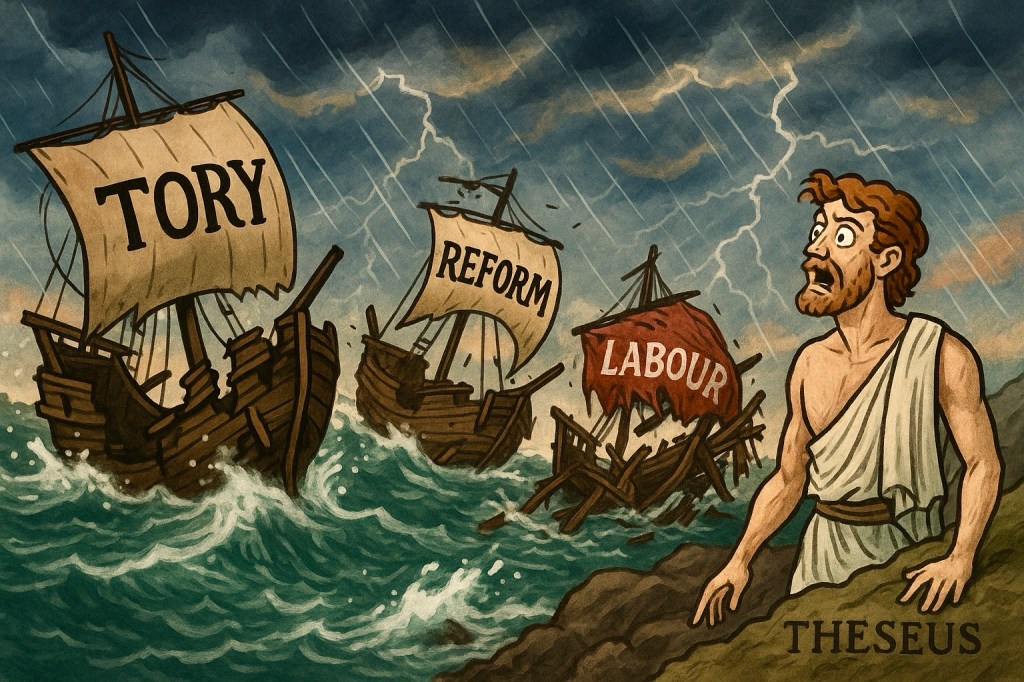
Plutarch’s riddle is older than our language but no less urgent for its age. If every plank of Theseus’ ship were replaced, was it still the same vessel? The Athenians insisted that it was – because their pride needed it to be so. Hobbes, less sentimental, pressed the matter: what if the discarded planks were reassembled into another ship – which then bore Theseus’ true identity? Such puzzles were once confined to philosophers. Now they drift in our harbour, played out upon the weary stage of Westminster.
The Conservatives once commanded a vessel of stature. Its keel was laid by Disraeli, its sails filled by Churchill, its timbers reinforced by Thatcher. It carried the nation across seas of war and storm. But the galleon is now a hollow hulk, stripped plank by plank until only the paint remains. Oak has been replaced with balsa, ballast with jargon. It’s no longer a ship but a pantomime set, a floating museum of what conservatism once meant.
Nadine Dorries – architect of the Online Safety Act, that censor’s charter dressed in the garb of protection – now parades across the gangplank of Reform, proclaiming her devotion to free speech. Nigel Farage, indefatigable as Odysseus, returns from Washington warning that Britain is gagged by its own laws. Michael Gove, the changeling of our age, blesses Reform’s gathering like a bishop tired of his diocese. Jake Berry purchases trinkets, as though relics of Tory wreckage could be treasured as charms. Zia Yusuf, Reform’s voice of policy, declares Boris Johnson unwelcome: better a half-built hull than worm-ridden timber. Thus, the Tory ship is revealed for what it is – not a vessel but a ghost, its voyage long forgotten.
Reform itself is loud with hammering, its planks salvaged from the ruins of Conservatism. But a raft, however noisy, isn’t yet a ship. Hobbes’ challenge resounds: can the discarded timbers carry the same identity, or is Reform merely a mimic? Farage, like Aeneas fleeing Troy, carries a vision of a new foundation, but the smoke of the old city still clings to him. Reform stands at the shoreline, promising oceans, but remains untested on the open sea.
And here, cutting across the water with bureaucratic solemnity, sails Labour’s ark under Sir Keir Starmer. If the Conservative hull is hollow and Reform’s incomplete, Labour’s vessel is a darker parody: Theseus’ ship rebuilt with rotten planks. Starmer governs not as a captain but as a clerk, cautious, colourless, managerial. His reshuffle has filled the deck not with able mariners but with placeholders, the uninspired promoted for loyalty rather than brilliance. The Cabinet’s floating committee: a meeting that never ends, a spreadsheet given flesh.
It’s here that scripture offers its harshest warnings. Labour’s ship is Nebuchadnezzar’s statue in Daniel’s dream: the head of gold long vanished, the feet of clay brittle, waiting to collapse. It’s Jonah’s ship without Jonah: a voyage launched in hubris, heedless of the storm that gathers. It’s the Pharisees’ whitewashed tombs: gleaming rhetoric concealing lifelessness within. Even Paul’s shipwreck in Acts carries more promise, for though the vessel shattered, the Gospel reached the shore. Starmer’s government preserves the husk of bureaucracy while letting the soul of Britain slip quietly beneath the waves.
The poets tell the same story in their own tongues. Hardy, ever the fatalist, would see in our politics the inevitability of decline. ‘If way to the Better there be, it exacts a full look at the Worst,’ he once wrote – and Starmer’s Britain seems determined to test that maxim, inching toward the Better only by trudging through the sludge of mediocrity. Dickens would have lampooned the scene mercilessly: a Cabinet of Micawbers and Gradgrinds, counting figures while the ship lists, declaring improvement while the mast cracks. Eliot, gloomier still, would find in this government the wasteland made flesh: a grey fog of procedure, the dry voices of officials whispering like rats’ feet over broken glass. ‘This is the way the world ends,’ he wrote, ‘not with a bang but a whimper.’ Starmer governs as though that whimper were policy.
Philosophy too offers its verdict. Plato warned that democracy collapses into chaos when the ship is steered by a mutinous crew shouting over one another. Nietzsche foresaw the reign of the ‘last men,’ blinking, joyless, content in their safety but incapable of greatness. Roger Scruton spoke of the culture of repudiation, where the guardians of tradition despise their own inheritance. All three converge in our present reality. Our politics isn’t Odysseus steering between Scylla and Charybdis but a ferry of caretakers, muttering about regulations while the tide engulfs the harbour.
The paradox of Theseus, then, is no longer philosophical but existential. The Conservatives cling to a name scrawled on hollow planks. Reform hammers away, promising vigour but lacking sail. Labour sails a bureaucratic ark, oppressive in its socialism, joyless in its grey control, commanded by a captain who governs like a solicitor drafting contracts no one reads. The Britain that once carried liberty, faith, enterprise, and grit has been dismantled plank by plank, until its voyage is lost.
And perhaps therein lies the solution to the riddle. Theseus’ ship was not its planks but its voyage. Identity isn’t material but purpose, not paint but direction. A nation, like a vessel, endures only if its compass points outward to the horizon. Without that, it’s wreckage, however carefully patched. Britain today has no voyage. Her ships quarrel in harbour, disputing timbers, boasting of paintwork, but none knows the sea, none knows the storm, none remembers the destination.
The Psalmist asked, ‘If the foundations be destroyed, what can the righteous do?’ We might now ask: if the timbers are rotten, what can the nation sail upon? Until Britain finds a true vessel, a ship of oak with anchor, compass, and captain, she’ll drift as she is – decaying in harbour, awaiting a storm that will one day sweep the paradox away. For the sea doesn’t care for planks or names or paint. It cares only for the voyage. And if we forget how to sail, the waves will remember for us.

 Wording