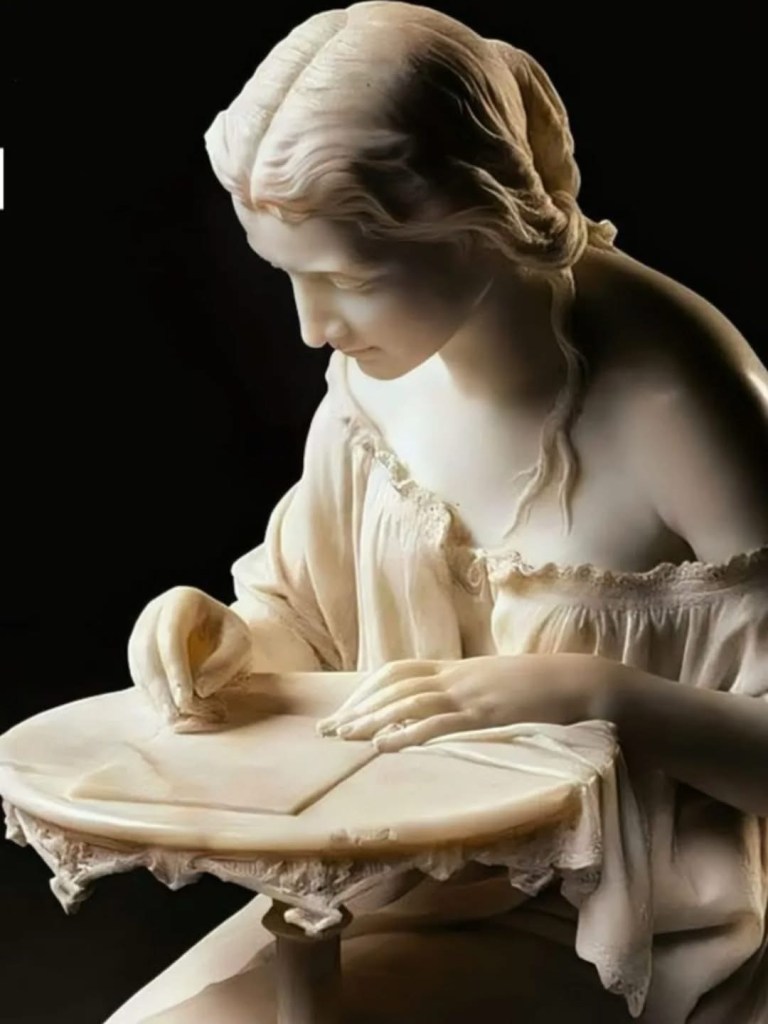
Giovanni Spertini, The Writing Girl, c. 19th century. Marble sculpture. Public domain image via Wikimedia Commons.
Marble has no business being this soft. Giovanni Spertini, born in Milan in 1821, clearly never got the memo. With a chisel and an unholy amount of patience, he coaxed flesh, lace, and even stationery out of Carrara stone as though it were warm butter. His Writing Girl isn’t some Greco-Roman goddess brandishing a thunderbolt, nor a martyr gnawed on by lions, but a very ordinary young woman – hair loosely tied, chemise slipping in a way that is both accidental and perfectly staged – hunched over a letter.
And it’s this modesty that makes the thing radical. Canova had chiselled heroic Venuses, Thorvaldsen brought us mythological allegories. Spertini? He gives us the domestic scene: a girl at her desk, writing – perhaps to a lover, perhaps to a cousin reminding them to return her books. A subject so simple it becomes almost outrageous. Why would you immortalise that in marble? And yet, it works.
The illusion’s almost indecent. The lace trim looks like it might snag on your sleeve, the paper might fold if you breathed on it. You find yourself wanting to lean in, to peek over her shoulder – and there the trouble begins. For in truth, the sculpture is as much about us as about her. We become the voyeur, caught snooping on her secret correspondence. St. Augustine fretted about the lust of the eyes; Spertini makes us complicit in it, in marble form.
There’s a comic irony here too. Imagine chiselling a letter out of marble: an object whose entire point is transience, fragile as pulp, turned instead into eternal stone. Kafka once said that ‘a book must be the axe for the frozen sea within us’ – Spertini seems to reply, ‘or, failing that, at least the frozen letter.’
And I can’t help but wonder about the girl herself. Is she some allegory of education, of literacy, of the spread of Romantic sentiment into the parlours of Milan? Or simply a charming piece of bourgeois decoration, designed to sit in a salon and elicit sighs from visitors? Perhaps she’s both. Sculpture, like scripture, loves its double meanings. Ecclesiastes would have told Spertini that ‘of making many books there is no end’ – to which he seems to have replied: ‘Yes, but I’ll make just one letter. In marble. Forever.’
The Victorians, for all their hypocrisy, adored such things. They liked their art tender but respectable, intimate but marble-chaste. Spertini obliged them: a little domestic virtue, a little illusionistic bravado, and enough folds of cloth to keep the thing modest. It’s hardly Michelangelo’s Last Judgement, but nor is it meant to be. It’s a small miracle of empathy, showing that the act of writing – humble, private, fragile – could be elevated to the grandeur of eternity.
And so we’re left with the paradox: the most fleeting of gestures, captured forever in the least forgiving of stones. A young woman dipping her pen, ready to scratch out her thoughts – perhaps to confess love, perhaps to send her regrets – and there she stays, paused mid-sentence for eternity. Which is really rather funny, when you think about it. The one thing she can’t do is finish the letter.

 Wording