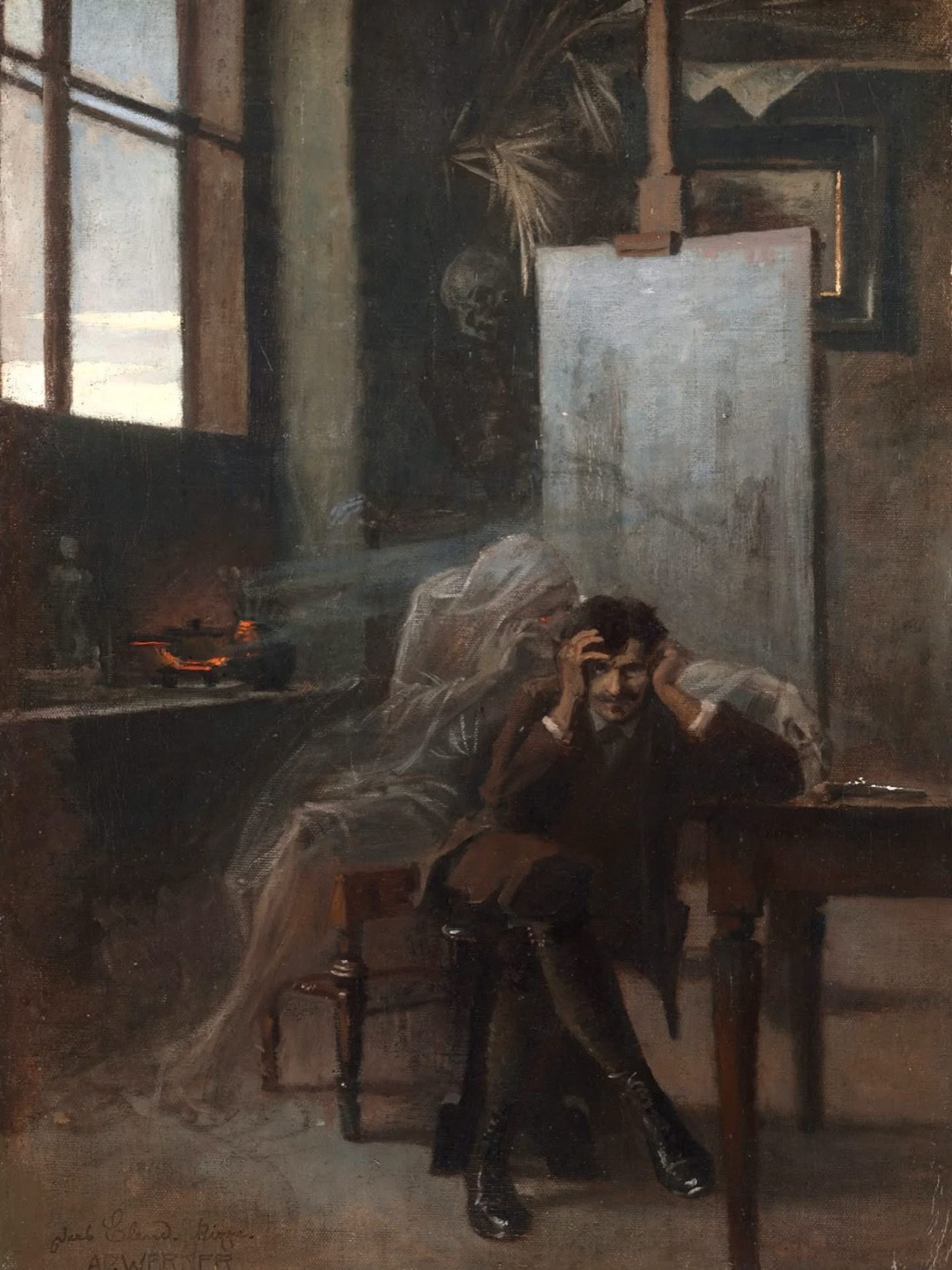
Adolf Werner (1862–1916), The Misery, c. 1900. Public domain.
Some paintings merely decorate a wall, and some paintings accuse you from the other side of the room. Adolf Werner’s The Misery (c. 1900) is firmly in the second category. It doesn’t flatter the parlour, nor charm the eye with pastoral pleasantries. It leans forward, ghost on shoulder, and whispers: So – have you thought about despair lately?
At first glance, it’s a simple studio interior. A young man sits hunched in a chair, his hands clamped to his head as though to keep it from shattering. Behind him an easel stands with a pale, unfinished canvas – creation halted, inspiration gone. This ought to be the laboratory of art, but it’s become a morgue.
And then we see what he feels. Out of the shadows a phantom swells into being, a translucent figure with shrouded face and skeletal hints. It leans forward and murmurs into his ear, one finger pointing at the pistol resting so casually on the table. This isn’t the muse; this is the saboteur. One can almost hear the muttered words: Why not end it? Why not leave?The very temptation of silence.
The background contributes to the unease. If you look long enough into the half-light, a skull appears, gazing out with grim serenity. Death hasn’t been invited to the studio; it’s simply taken up residence. The whole space feels heavy, the air thick with smoke and shadow, as though time itself had slowed to a stagnant crawl.
Werner isn’t flamboyant. His palette is muted: browns, greys, the dim silver of ghostly fabric. But that restraint is precisely what gives the painting its grip. The phantom isn’t a cartoon apparition; it emerges softly, almost reluctantly, as if misery itself were embarrassed at being caught on canvas. The folds of the ghost’s veil shimmer with delicacy, half-present and half-absent, in a way that photography could never manage.
The composition is equally cunning. The diagonal pull between the whispering ghost and the pistol drags our eye into the drama, while the strong verticals of the window and easel pin the scene in place, trapping the man in his claustrophobic box.
What I admire most is the restraint. Werner could have gone gothic – blood, chains, thunderclouds. Instead, he leaves us with a room, a man, and a whisper. The result’s more terrifying, for it feels plausible. I imagine any artist, any thinker, sitting in such a posture, visited not by angels but by a thin suggestion of the abyss.
Philosophers have written at length about despair, but rarely with such a handy prop. Kierkegaard, in his Sickness Unto Death, defined despair as ‘not being willing to be oneself.’ Here, that refusal finds a weapon ready to hand. Freud would’ve nodded grimly, diagnosing the whisper as the voice of Thanatos, the death-drive, speaking from behind the curtain. Camus, meanwhile, would’ve shaken his head and declared that the absurd must be met with revolt, not resignation – ‘The struggle itself… is enough to fill a man’s heart.’ Yet poor Werner’s protagonist looks in no mood for revolt.
There’s even a theological overtone. The ghost, pointing to the pistol, is a parody of the angel pointing to salvation. Instead of ‘Behold the Lamb of God,’ we hear, ‘Behold the exit wound.’ This is what happens when the sacred is inverted: temptation replaces annunciation, and despair becomes the only liturgy in town.
And yet – let’s not be too solemn. Misery, like most serious things, is faintly ridiculous when drawn out of hiding. The ghost’s earnest pointing finger has about it the air of a stage-manager reminding an actor of his next line: ‘Pistol, darling, don’t forget the pistol!” One half expects the skeleton in the corner to yawn, bored of waiting its turn. Even despair, when caught by paint, has to strike a pose.
Perhaps that’s Werner’s slyest insight: misery likes the limelight. It whispers, yes, but it also points. It wants to be noticed, paraded, granted the dignity of drama. And the artist, in spite of himself, has given it exactly that.
The Misery isn’t a comfortable painting, nor is it an obscure one. It’s the sort of work that makes you mutter, ‘Yes, I’ve been there,’ even if you haven’t stared at a pistol on a table. It catches the mood of paralysis, the voice that suggests the worst, the skeleton that sits patiently in the corner of every studio.
And yet, by painting it, Werner redeems it. The ghost is fixed in pigment, not in psyche. The skeleton can only grin from the background. The pistol will never fire. Misery is real – but so’s art. And between the two, one can usually find enough irony to go on living.

 Wording
This is brilliant. So beautifully written, yet the words also hold a disturbing description of painting and of the feeling it holds. Perfection.
Thank you, Chae. The Misery struck me as one of those rare paintings that almost seems to whisper to the observer, and I wanted the writing to carry that same uneasy hush. I’m really glad it resonated with you – it’s heartening when someone catches the mood exactly as it was meant.