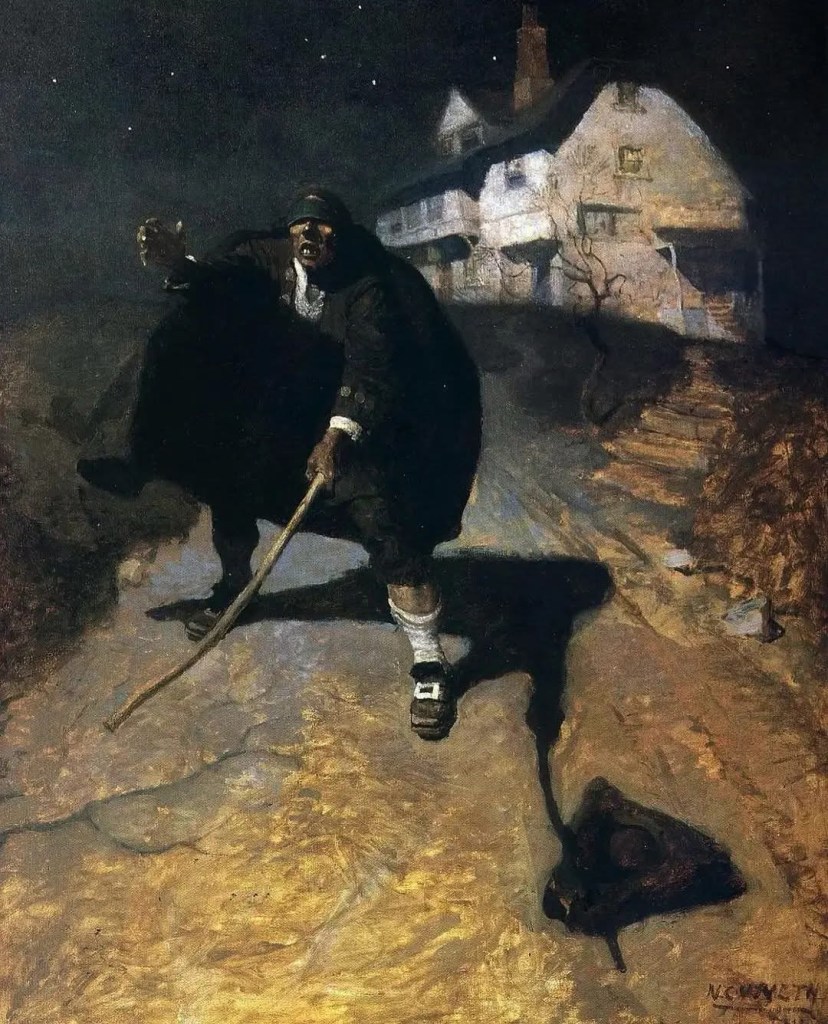
Newell Convers Wyeth, Blind Pew (1911).
A haunting illustration for Stevenson’s Treasure Island: the blind beggar strides down the moonlit lane, stick thrust forward, half-frail and half-fearsome – fate itself tapping towards us.
In another life, back at home, whenever something went awry – a cup chipped, a tool gone missing, a mystery mischief no one would own up to – I’d often lay the blame on ‘Blind Pew.’ It was a phrase I’d heard from the older generation when I was small, a half-joke, half-superstition that summoned the shadow of Stevenson’s blind beggar to cover our household mishaps. And so, in light of those childhood echoes, here he is at last: the real Blind Pew, tapping out of the dark lane and into memory.
To speak of Newell Convers Wyeth is to speak of colour and courage. He painted not so much illustrations as visions: bold, theatrical scenes where figures loom larger than the pages they decorate. In Blind Pew (1911), he gives us one of Stevenson’s shortest-lived villains, yet Wyeth makes him monumental, mythic, unforgettable.
What do we see? A crooked figure advancing down a starlit road. His hat lies discarded, as if the wind of fate itself has blown it from his head. His stick juts forward like a weapon, and his face – though blind – is set in a grimace of terrible determination. Behind him, the Admiral Benbow Inn glows with ghostly whiteness, a beacon of safety that looks more like a mirage. Above, the stars prick the night, silent witnesses to human dread.
This isn’t merely a scene of a beggar on a road. It’s an allegory of menace. Wyeth has placed us – the viewer – in the position of Jim Hawkins, paralysed as Pew comes straight towards us. We feel the scrape of the stick, the shuffle of his uneven gait, the dreadful inevitability of his approach. In art-historical terms, Wyeth uses perspective and diagonals to drag us into the drama. In human terms, he uses fear.
Blindness itself becomes a kind of symbol here. Pew can’t see the inn, the stars, or the terror in Jim’s eyes. And yet, in Stevenson’s tale, his blindness makes him all the more terrifying. He ‘sees’ through reputation, through the weight of the dreaded black spot he carries, through the inevitability of fate. Wyeth paints him not as a frail cripple but as death itself on the march – unseeing, unstoppable, indifferent.
Notice the tension: he’s both threatening and precarious. His bent knees and hunched shoulders reveal fragility; one wrong step could send him sprawling. Yet that fragility is what sharpens the dread. Here’s no invincible demon, but a ragged man who has somehow become an instrument of doom. Shakespeare loved such figures – the Fool who speaks truth, the Blind Seer who reveals destiny. Stevenson, in his Scottish irony, allows Pew to terrify before letting him perish under hooves. Wyeth freezes him before that downfall: the eternal moment of terror, undiluted by comedy.
Psychologically, Pew’s the nightmare of vulnerability turned inside out. He’s the blind beggar who commands, the weak man who terrifies, the dependent who dominates. He embodies that disquieting truth that terror doesn’t always come from the strong – sometimes it’s the broken, the dispossessed, the marginal who wield the greatest fear.
And so, Blind Pew isn’t just an illustration, nor just a moment from Treasure Island. It’s a meditation on menace itself: fate tapping its way along the cobbles, half-broken yet unstoppable, blind but all-seeing, vulnerable yet armed with inevitability. The inn behind glows like the last refuge of innocence, but it can’t save us. The stars above glitter coldly, but they’ll not intervene. Pew keeps walking, and he’s always walking towards us.

 Wording