There are few mirrors in literature as merciless as Stevenson’s, and none quite so fogged by our own breath. The Strange Case of Dr Jekyll and Mr Hyde is less a Gothic tale than a confession disguised as one – a dimly lit sermon on the human condition, preached from the pulpit of a London laboratory. To read it properly is to hear one’s own heartbeat echoed through the stethoscope of sin.
Dr Henry Jekyll, the respectable physician, believes he can divide the light from the dark within him – extract the beast without losing the man. It’s the oldest human heresy: to believe evil can be caged without first confessing it. The potion he brews is less chemistry than theology; it’s alchemy’s final blasphemy – man attempting to separate his own fallen nature from his desire to appear pure. In that moment, he becomes his own serpent, promising himself a moral Eden where no shame need bloom.
Mr Hyde emerges not as an intruder, but as an inheritance. He’s not created by the potion; he’s revealed by it. Hyde is Jekyll with the mask removed – the creature who already lurked behind the waistcoat and moral smile. The horror, then, isn’t transformation but transparency. What terrifies the reader is the recognition that the division between saint and sinner isn’t chemical, but circumstantial. Hyde is the man unobserved.
Stevenson’s London is a moral laboratory – cobblestones and gaslight concealing a city of split souls. Every respectable door has its disreputable alley. In this sense, Jekyll and Hyde is the perfect parable for both the Victorian age and our own: an age of clean facades and dirty appetites, of philanthropy performed for applause. The Victorians built their morality as they built their architecture – with ornamental fronts and hidden chambers behind. We moderns have merely digitised it. Our potions are filters; our Hydes live in comment sections.
There’s a curious humour in Jekyll’s tragedy. Like so many reformers, he believes he’s conquering evil when he’s merely reorganising it. He talks of science and morality as if they were compatible, as if a microscope could reveal the soul’s condition. Yet every experiment in human nature ends the same way: with the patient on the slab and God not answering. The modern reader may laugh at Jekyll’s potion, but he takes his own daily – a brew of self-curation and half-belief.
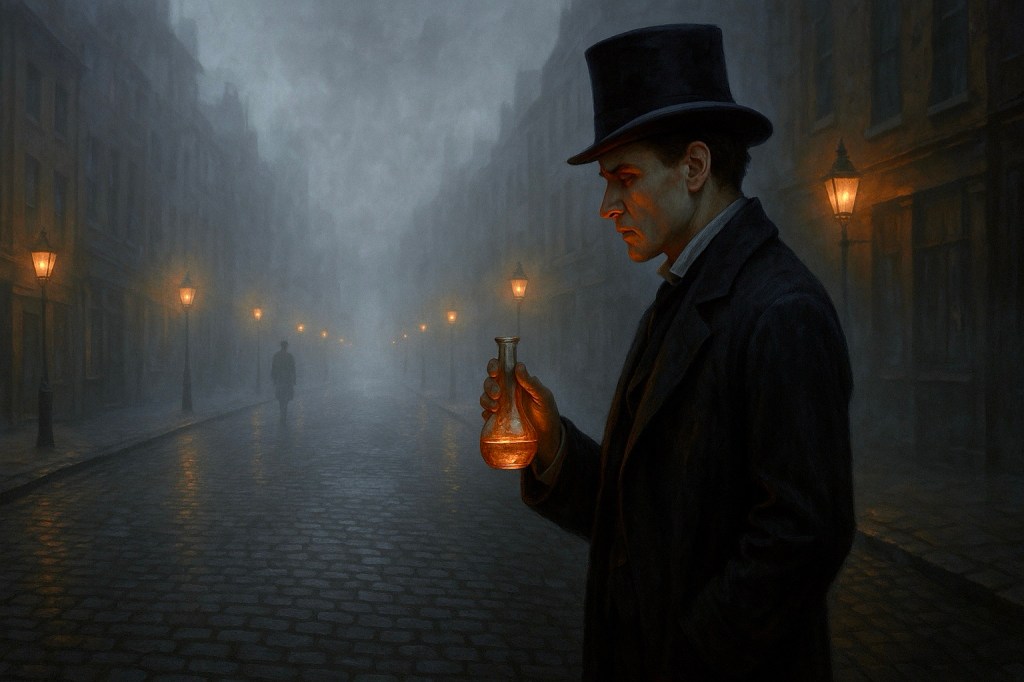
Freud, had he lived earlier, would’ve found his entire career foreshadowed here. The repression of desire, the splitting of self, the conflict between the Apollonian doctor and the Dionysian brute – it’s all bottled within that fog-bound flask. Jung would later call Hyde ‘the shadow,’ but Stevenson’s shadow is no metaphor. It kills. And yet it kills because Jekyll believed he could amputate what only confession could heal. The wages of repression, like those of sin, are death.
There’s also a profound Christian irony in the tale. Jekyll, the man of reason, plays both God and Devil – the Creator and the Destroyer – and finds himself damned by both roles. He wishes for redemption without repentance, virtue without vigilance, grace without God. But Hyde, that sneering parody of man, is the true theologian; for he at least acknowledges what he is. The Devil, after all, never pretends to be an angel. It’s the saint who falls hardest when pretending holiness.
One might say Jekyll was not destroyed by Hyde but by the lie that they were ever separate. ‘Man is not truly one, but truly two,’ he writes. But perhaps the truer tragedy is that he was never two enough. His sin wasn’t duality but denial – he wanted the pleasure of Hyde with the reputation of Jekyll, and in the end, he achieved neither. He became the divided corpse of his own delusion.
If the novella still haunts us today, it’s because we’re all Jekylls with smartphones, concocting ever more refined elixirs to disguise the Hydes within. We dose ourselves daily with distraction and self-definition, believing we can outwit conscience with content. But the mirror remains, and every reflection eventually asks the same question: which face is yours?
In the end, Stevenson’s moral is almost biblical in its simplicity. ‘Be sure your sin will find you out,’ says Numbers 32:23 – and it always does, usually in the shape of yourself. Jekyll tried to cheat God, and discovered that the Almighty is also the best chemist. The soul, it turns out, can’t be distilled.

 Wording