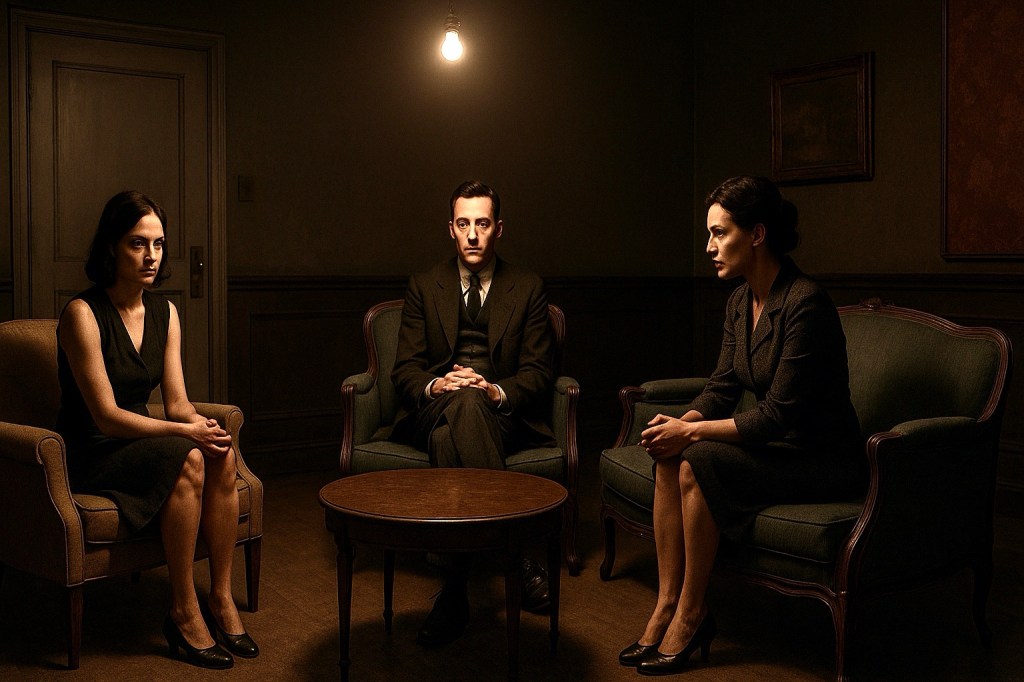
No Exit is Sartre’s vision of the afterlife and contains no fire, no pitchforks, and no sulphuric pits; it is, instead, a perfectly reasonable room – which is precisely what makes it horrifying. He replaces Dante’s inferno with a waiting room furnished by IKEA and irony.
This isn’t the Hell of theology but of psychology – not punishment from without, but exposure from within. Here, souls don’t burn; they chatter. Sartre understood that the modern world, having lost its God, would invent its own eternal torment: the inability to escape the self, or the people who remind us of it.
At first glance, his Hell appears absurdly mundane. There are no demons, only décor – and yet the terror arises precisely from that civility. It’s the agony of polite conversation stretched to infinity. Imagine being trapped forever in a drawing-room drama with no exit cue, the audience having left centuries ago. That’s the exquisite cruelty of Sartre’s imagination: damnation as etiquette without end.
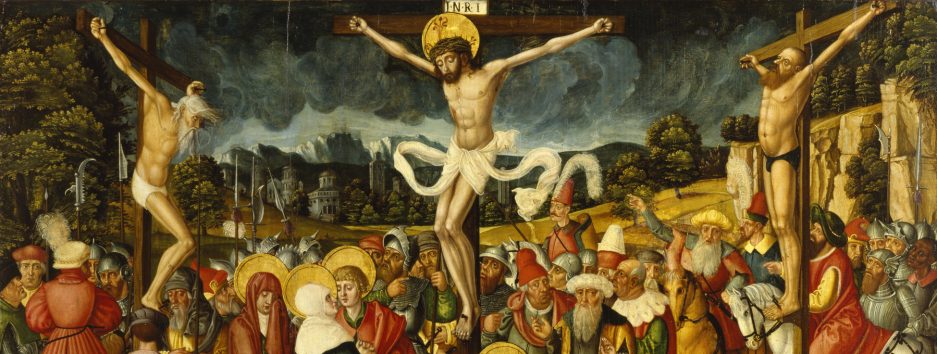
The play distills Sartre’s entire existential project into a single claustrophobic tableau. ‘Existence precedes essence,’ he once declared – meaning, roughly, that we’re born first and define ourselves later, usually poorly. No Exit shows what happens when that freedom becomes a sentence. Its characters, stripped of pretence and excuse, discover that there’s no divine judge – only the judgement of each other. It’s the Last Supper without the Host: three egos and a locked door.
And yet, beneath its bleakness lies savage humour. Sartre may be God’s undertaker, but he performs the funeral with style. His dialogue crackles with wit, pettiness, and existential slapstick. Hell, it turns out, has excellent comic timing. The damned still flirt, boast, and preen; they still try to win arguments long after meaning has expired. It’s as if humanity’s last defence against despair is small talk.
No Exit is blasphemous in the most illuminating way. It suggests that mankind no longer needs Satan – we’re perfectly capable of tormenting ourselves. The Devil, if he exists, has outsourced his work to our egos. It’s the ultimate privatisation of Hell. In Sartre’s universe, punishment and freedom are indistinguishable: we’re free to act, free to choose, and thus forever condemned to ourselves.
One could almost read the play as a grim parody of the Last Judgment. There are no angels weighing souls, only mirrors that refuse to flatter. Salvation isn’t denied – merely irrelevant. There’s nowhere to go, no one to appeal to, no silence to hide in. It is, in every sense, the afterlife of the Enlightenment: the kingdom of reason finally realised, and therefore unbearable.
Yet, for all its cruelty, the work possesses a peculiar purity. Sartre’s Hell is honest. It tells us nothing we didn’t already suspect: that conscience survives belief, and that other people, being our mirrors, are often more terrifying than our sins. His famous dictum – that ‘hell is other people’ – isn’t misanthropy but metaphysics. He simply observes that once God’s gone, our neighbours take His place, and they’re rarely as merciful.
Stylistically, No Exit is both austere and electric. It has the rhythm of a trial, the intimacy of confession, and the absurdity of cabaret. The language, though philosophical, is also ferociously theatrical – sharp as a scalpel, glittering as irony itself. Sartre knew that ideas alone can’t haunt; they must wear faces, use perfume, and argue about trivialities. That’s why his play feels both cosmic and claustrophobic – eternity dressed for cocktails.
And here lies the final irony: the play’s supposed nihilism conceals an inverted faith. In denying transcendence, Sartre proves how deeply he still longs for it. His Hell exists because he can’t quite believe in Heaven; his characters speak because silence would be unbearable. The absence of God, it seems, doesn’t free them – it simply removes the witness to their despair.
In the end, No Exit leaves us with a moral riddle worthy of Wiesel’s courtroom: what if damnation isn’t something inflicted upon us, but something we construct together – one glance, one judgement, one misunderstanding at a time? What if the door has always been open, but we never thought to walk through?
Sartre never answers. He only smiles that philosophical smile, half saint and half cynic, as if to say: ‘You wanted freedom? Here it is. The door’s open. But do you really want to leave?’

 Wording