There are two kinds of devilry in this world: the kind that froths and foams in the convent, and the kind that wears a signet ring and drafts policy. Huxley’s The Devils of Loudun is about both — a tale where hysteria kneels before power and calls it holy. I’ve long thought that if Lucifer fell from heaven, it wasn’t because he was wicked, but because he was interesting — and Urbain Grandier, the priest at the heart of this affair, was nothing if not interesting.
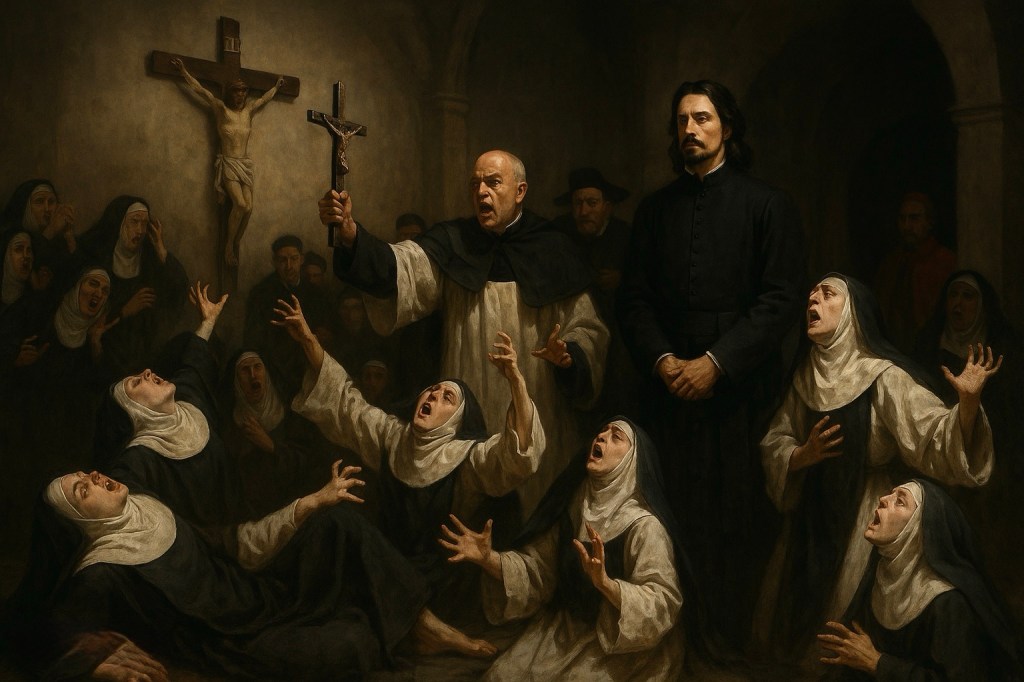
It begins, as all good scandals do, with repressed desire in a small town. Loudun, 1634: a priest too handsome for his own salvation, a gaggle of cloistered nuns too lonely for their own good, and a political climate too tense for truth to breathe. The ingredients are all there — chastity, envy, superstition, and the great French love of spectacle. The result? A possession that makes Netflix look like a catechism.
Grandier was accused of having made a pact with the Devil — which, in the Church of Richelieu, was not so much a sin as a career move. The nuns shrieked, convulsed, and claimed he came to them in dreams — the poor fellow became the scapegoat for an entire society’s neuroses. What they called ‘the Devil’ was really the repressed body of France, bursting out of its cassock. And Huxley, ever the surgeon of civilisation, saw this for what it was: theology weaponised by politics, lust transfigured into liturgy, and hysteria given a halo.
He tells it, of course, with that peculiar blend of detachment and despair. Huxley never quite laughs — he smirks, like a man who has read too much Augustine and not enough hope. Beneath his polished prose, one can hear him whisper: man is a creature forever inventing demons to excuse his appetites. He saw the Loudun affair not as an anomaly but as a rehearsal — the first act in a long tragicomedy of collective delusion that would run through the centuries, gathering steam with every new ideology that promised purity.
And here we are. Four hundred years later, the bonfires still burn, only now they’re pixelated. The nuns’ cries have been replaced by trending hashtags; Richelieu’s cunning by algorithms; Grandier’s pyre by the court of public opinion. The same fever of righteousness, the same ecstasy of denunciation. We call it cancel culture; they called it an exorcism. Both are rituals of purification, performed by the possessed upon the condemned.
The genius of Huxley is that he never lets us off the hook. His devils are never purely supernatural — they are psychological, political, and above all, human. He traces them from the cloister to the court, from libido to ideology. In his view, modernity itself is one long exorcism — a desperate attempt to drive out mystery with the holy water of science, and guilt with the incense of therapy. But the devils, like taxes, always return.
Grandier himself fascinates me. Proud, intelligent, eloquent — the sort of man who quotes Seneca while flirting with parishioners. His tragedy wasn’t that he sinned, but that he sinned publicly in an age when hypocrisy was the only virtue. He was less a priest than a tragic actor caught in the wrong play — damned not by God, but by politics disguised as piety. In the end, he was burned alive, though one suspects that if Richelieu had owned a newspaper, he’d have simply destroyed him in print instead.
Huxley’s narrative pulses with this irony: that institutions built to fight evil so often manufacture it. Loudun becomes a laboratory of human folly — a place where the divine and the depraved coexist, separated only by costume. The nuns’ ‘possessions’ are really the cries of women crushed under centuries of enforced chastity; the inquisitors’ zeal is lust in vestments. Everyone in the story is possessed — not by Satan, but by their own unacknowledged desires.
And what of faith? Huxley, ever the sceptic-mystic, leaves us dangling between heaven and hysteria. He doesn’t mock religion outright — he mourns what it could have been. He sees that when transcendence dies, it leaves behind a vacuum into which madness rushes. The devils of Loudun are not so different from the devils of Westminster or Silicon Valley — spirits of pride, envy, and control, wearing the masks of moral certainty.
If the book teaches anything, it’s this: that the line between exorcist and possessed is perilously thin. Every age thinks it’s purging demons, when in truth it’s feeding them — baptising its vices under new names. Once it was witchcraft; now it’s misinformation, bias, extremism, hate speech. Always the same melody: purify the world by destroying someone else.
Huxley wrote as a man watching civilisation’s nerves unravel. I read him as one watching the encore. His prose, rich with scholarship and acid wit, feels like an autopsy of belief — performed by a man who still, somewhere deep down, wants to believe. He dissects faith, but with the tenderness of one who still hears the choir.
And that, perhaps, is why The Devils of Loudun endures. It isn’t just a story about nuns and nightmares. It’s a meditation on power, repression, and the eternal human need to find an enemy within. We may not burn priests anymore, but we still light our pyres — virtual, political, and moral — and gather around them for warmth.
The devils of Loudun have not been cast out; they have been domesticated. They tweet, they legislate, they moralise. And we, the ever-pious congregation of modern man, clap along — certain that the smoke we see rising is the stench of evil vanquished, not the scent of our own souls burning politely.

 Wording