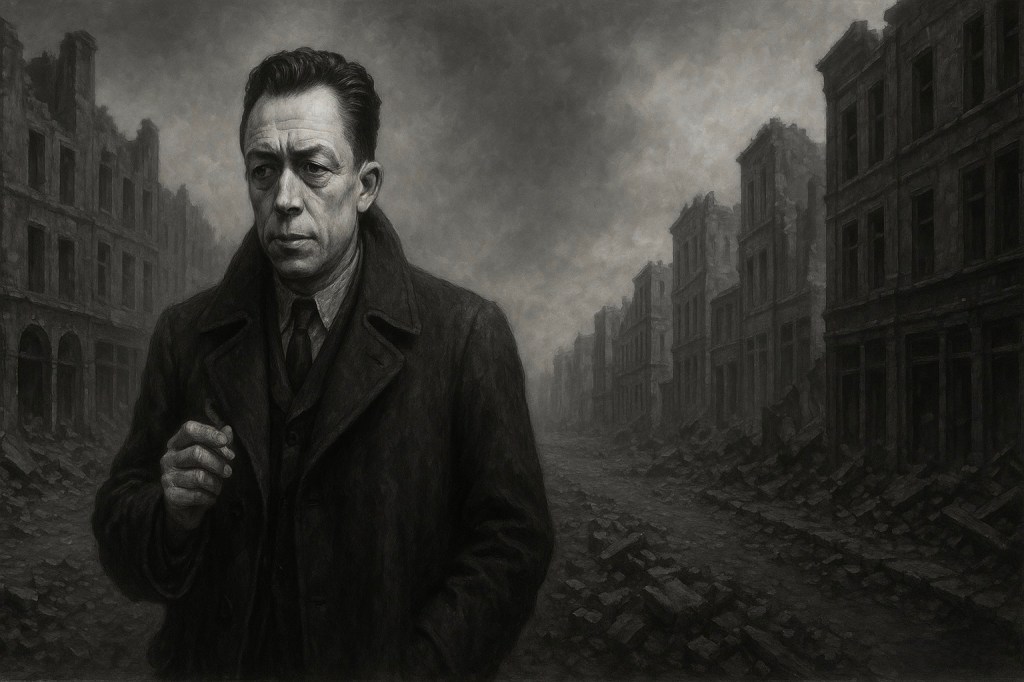
Sometimes the world goes so mad that only a sane man looks insane. Albert Camus was one of those men. While Europe tore itself to pieces, he stood, cigarette in hand, between hell and reason — and, miraculously, refused to join either.
When I first read his wartime essays, I could almost smell the ink and gunpowder. These weren’t polished lectures from a Paris salon, but dispatches from the moral trenches. Camus wasn’t a philosopher in an armchair; he was a philosopher in hiding — editing an underground newspaper, Combat, while Gestapo boots echoed above him. He wrote, not as an academic, but as a man trying to remain human in an inhuman hour.
The title Between Hell and Reason feels less like a book and more like a diagnosis. Hell, for Camus, was the Nazi dream — that ghastly rationality which justified murder in the name of order. Reason, on the other hand, had been so abused by ideologues that it limped through the streets like a wounded saint. Camus was trying to nurse it back to health — to reclaim clarity from cleverness, and decency from despair.
His Letters to a German Friend read like missives from one conscience to another, written across barbed wire. He addresses an imaginary German intellectual, seduced by destiny and discipline, and replies with that quiet, obstinate French insistence: I believe in justice, not victory. He refuses to mirror cruelty. Even in rage, he remains tender — like a man who believes that truth must be whispered, not shouted.
Camus, of course, would later become the great apostle of the absurd. But here, during the war, his absurdity is still raw, unfinished — the kind found in foxholes and famine queues. He had seen too much to be naive, and felt too deeply to be cynical. He once wrote that ‘the only way to fight the plague is with decency.’ It sounds almost quaint until you realise that every tyranny begins with people who decided decency was optional.
In our own time, I see echoes of Camus’ torment. We too live between our own hells and our own counterfeit reasons — between ideological fanaticism and intellectual fatigue, between mobs that burn and elites that sneer. The slogans have changed, but the moral arithmetic hasn’t. Everyone wants to be right; no one wants to be good.
Camus’ refusal to hate feels almost scandalous now. He reminds us that rebellion mustn’t become revenge, that the rebel who kills his tyrant becomes one if he isn’t careful. He never preached utopia — he preached limits. And that’s why the modern mind finds him so irritating. In an age addicted to outrage, moderation sounds like treason.
What I love most about Camus is that he never let despair monopolise intelligence. Even when the world seemed senseless, he looked for meaning in the act of defiance itself. To think clearly, to speak honestly, to love foolishly — these, he thought, were small victories against the void.
Today, his ghost lingers in the pages like a man at the edge of a crater, cigarette glowing in the dark. ‘We must imagine Sisyphus happy,’ he once wrote — but here, amid war, he imagines him simply human. It’s enough. Between hell and reason, Camus built a narrow bridge of hope, and dared to walk across it barefoot.
After the Smoke
We still inhabit that bridge. Every generation thinks itself on the brink of apocalypse; ours has merely added Wi-Fi. Camus’ warning endures: that civilisation survives not by its slogans but by its silences — the quiet refusal to join the chorus of hatred. Between hell and reason, there is only us, trying not to become the monsters we fear.

 Wording