The wind remembers what the Church forgot.
Two for the price of one. Today I managed 2.5k words of my book; today’s project was a sombre one so it’s fitting that I pull out these two old essays and share them with you here.
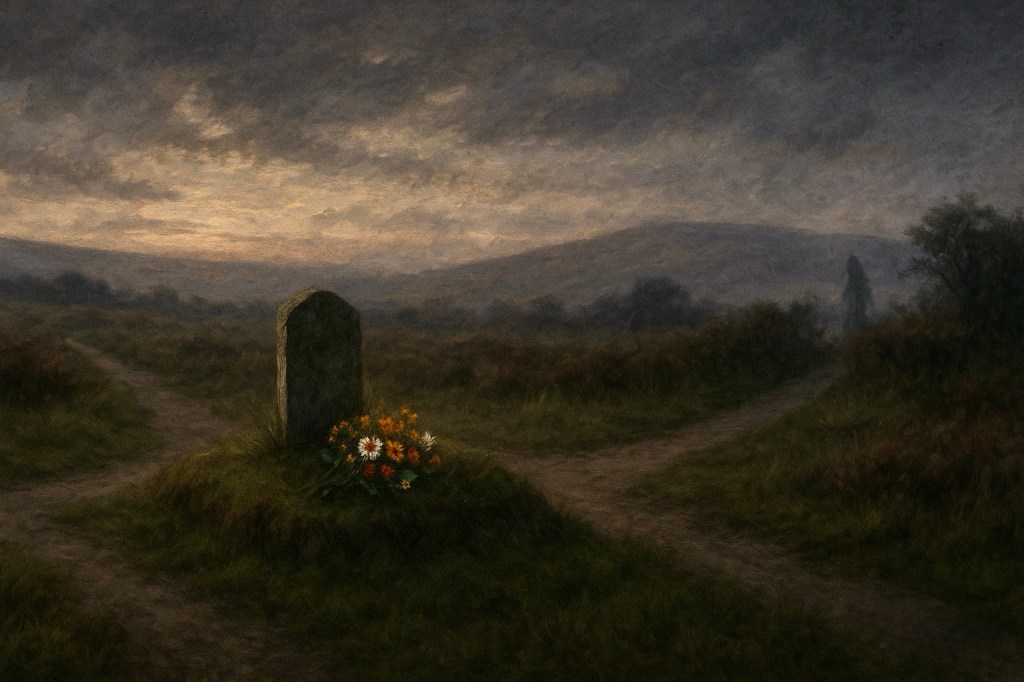
I came upon her grave quite by accident, though I suspect the moor had planned it all along. Dartmoor is good at that sort of thing — it leads you in circles, pretends indifference, and then suddenly opens its hand to reveal something ancient, small, and inexplicably alive.
It was late afternoon, the sky bruised violet, the heather trembling in the wind. At the junction of two narrow lanes, half-hidden by ferns, there she was: a low mound of turf with a rough granite headstone and, laid upon it, a small bouquet of fresh flowers. No inscription. No date. Just the unmistakable presence of someone once loved and still remembered.
They call her Kitty Jay — sometimes Mary, sometimes Ann, sometimes simply ‘the girl at the crossroads.’ The names change, but the story remains stubbornly the same, as if the moor itself were unwilling to rewrite it.
She was, so they say, a servant girl, an orphan perhaps, working on a nearby farm. When she became pregnant, the world turned on her — as it has turned on so many women since Eve first took the blame for curiosity. Shamed, abandoned, and convinced that even God had bolted His gates against her, Kitty took her own life in a barn.
And for that one desperate act of sorrow, she was denied burial in consecrated ground. The priest locked his gate; the parish turned away. So they carried her to this lonely place — where four roads meet — and buried her like an inconvenience, hoping the passing wheels of eternity would grind her memory down to dust.
But the moor had other plans.
For two hundred years, flowers have appeared on this grave. No one admits to leaving them. In winter, when frost blackens the hedgerows, still they bloom. In summer, when the heather is ablaze and the air smells faintly of honey and rot, the bouquet changes — as though some unseen gardener keeps vigil.
The locals say it’s done by a kindly farmer. Others insist it’s the work of a ghost. I rather think it’s the moor itself, repaying a debt of decency the Church neglected to settle.
Standing there, I felt the old superstition rise — that a crossroads confuses spirits, that the dead can’t find their way home if the paths split in four directions. Yet perhaps it’s not confusion at all, but liberation: a kind of celestial roundabout where the soul may choose again. The medieval mind buried suicides at the crossroads to contain them; but the irony, of course, is that it gave them options.
A car passed by and broke the spell — a splash of diesel and indifference — and I thought of all the centuries between her and us. Once she was damned for despair; now she’s pitied for it. In another hundred years, who knows? She may yet be canonised by the sentimental, or forgotten entirely by the efficient. Either way, the flowers will keep coming.
I touched the headstone. It was cold, rough, and indifferent, like most theology. But beneath it — somewhere deep — was the proof that memory has its own resurrection. The moor hummed faintly, as though it approved.
And I realised, walking away, that every soul buried outside the gate is a sermon against the gate itself.
The Flowers That Never Fade
They say no one knows who tends her grave. I believe everyone does. Each of us who has stood there — traveller, sinner, mourner, fool — leaves behind some invisible trace: a sigh, a prayer, the tiniest petal of remorse.
Those flowers, renewed each day by unseen hands, are the conscience of a civilisation that once buried its pain at the crossroads. And perhaps that’s why Kitty Jay still haunts Dartmoor — not to frighten us, but to remind us that mercy, like the wind, ignores fences.
The Outcast of Foulshiels Hill: Tibbie Tamson
I climbed from Selkirk in the amber hour when the day loosens its collar and the hills breathe out. The path to Tibbie Tamson’s grave isn’t long, but it feels like a pilgrimage — past hedges turning copper, over the rough stitch-work of pasture, up towards a brow of ground where the world seems to pause between one parish and the next. Boundaries upon boundaries: the very geometry of exclusion.
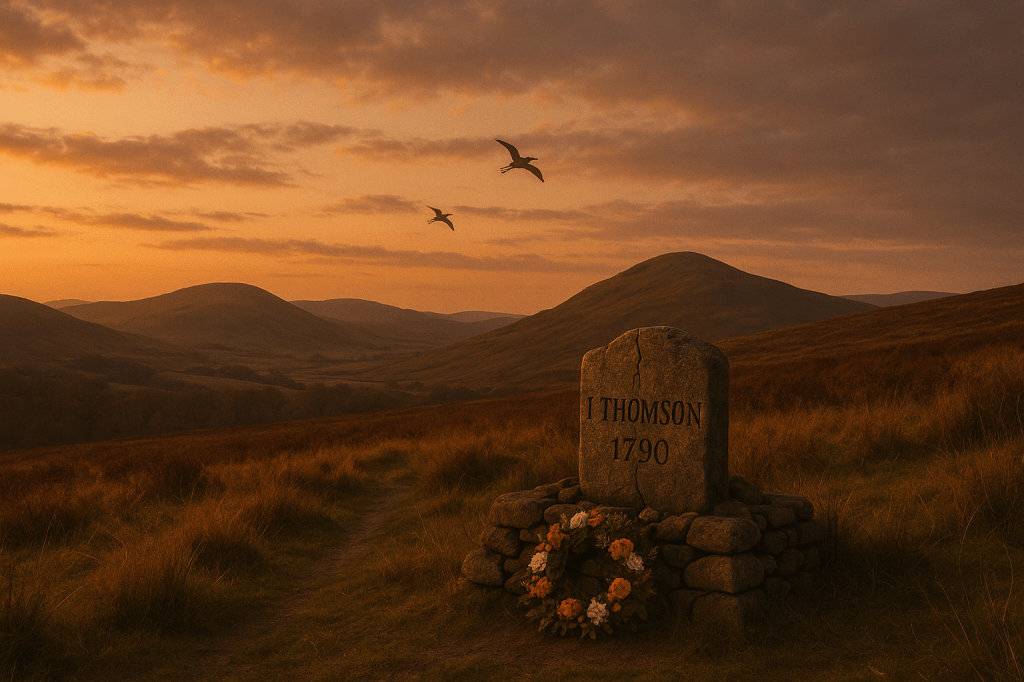
There it was: a small cairn and a weathered stone — cracked, stubborn, and still speaking. ‘I THOMSON… 1790,’ the old mark says in its own halting way, as if the hillside itself had learned to write. Tibbie (Isabella) Tamson: poor, simple, accused — over a ball of yarn, they say — and broken on the wheel of public virtue. Despair did the rest. For that self-wound she was judged unfit for consecrated ground and carried to this edge-place, the moral backroom of the Borders, where the curlews keep the minutes and the wind delivers the sermon no priest would preach.
I stood and listened. The hill had a hush to it, not silence but a listening — like a congregation waiting for the first chord of a hymn. Down in the town, the righteous once tidied their consciences with a verdict; up here, the sky refused to file the paperwork. The stone, the cairn, the bristling grasses: all of it felt like an appeal that outlived the court.
It’s a strange quirk of Christian history that mercy, which ought to be lavish, learned to ration itself with keys and fences. The old law called suicide felo de se, felony against the self, and barred the gate. Yet look: the barred gate has weathered; the hill endures. Each Common Riding, riders still come from Selkirk and lay a wreath. It’s as if the town, grown older and a touch wiser, climbs back each year to apologise in flowers for what it once did in fear.
I touched the stone. It felt like a palm turned outward: no threat, only witness. A rook crossed overhead, black punctuation on an ochre sky, and I thought of how small a thing it took to end this girl — shame, gossip, a court date, and the long, straight road to a lonely choice. We like to imagine evil as operatic; most of it is admin.
I said a prayer of the agnostic sort: half complaint, half hope. If God is just, He remembers the whole of a person, not merely the last ten minutes. If God is kind, He keeps a special acre for those who could no longer carry the weight we pretend is light. And if there is no God, then all the more reason to stand here and behave like there might be one: hat off, heart open, words few.
Dusk gathered. The cairn glowed the colour of old honey; the hills beyond Philiphaugh went the blue of a healing bruise. I thought of Tibbie walking up here under other colours — dragged, perhaps — and I felt the indecent nearness of history: how a single life can be folded into the landscape until it becomes part of the weather. We inherit the wind as we inherit our sins.
On my way down I looked back and saw it — the smallest shimmer in the grass, something like a shawl of light around the stone. Trick of the sun, no doubt, but I took it as benediction. Churches don’t have a monopoly on altars. Some are built of heather, some of apology.
And I realised, as I often do at graves, that the dead haven’t stopped teaching us; we’ve merely been slow to enrol.
The Cry of the Curlews
They sound like laughter and lament sewn together — the curlews over Foulshiels. Each year the riders come with their wreath, and each year the birds rehearse the same strange hymn, as if reminding the town that remembrance without repentance is only nostalgia in nicer clothes. Let the wreaths come. Let the wind keep the liturgy. And let the stone stand — cracked, yes, but not mute. It says what we can’t: forgive us our tidy cruelties.

 Wording