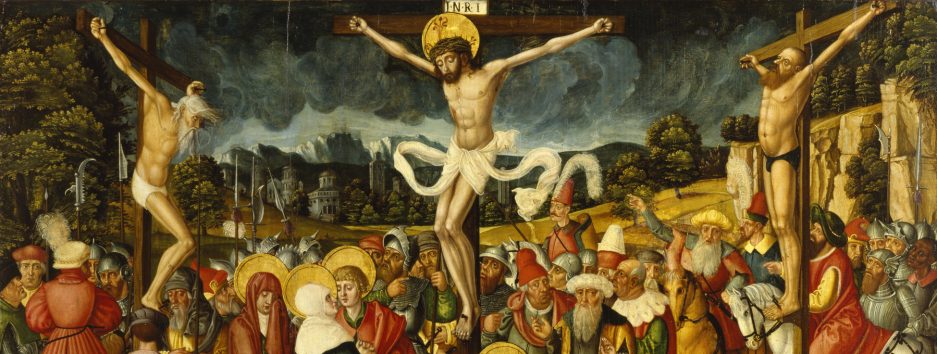
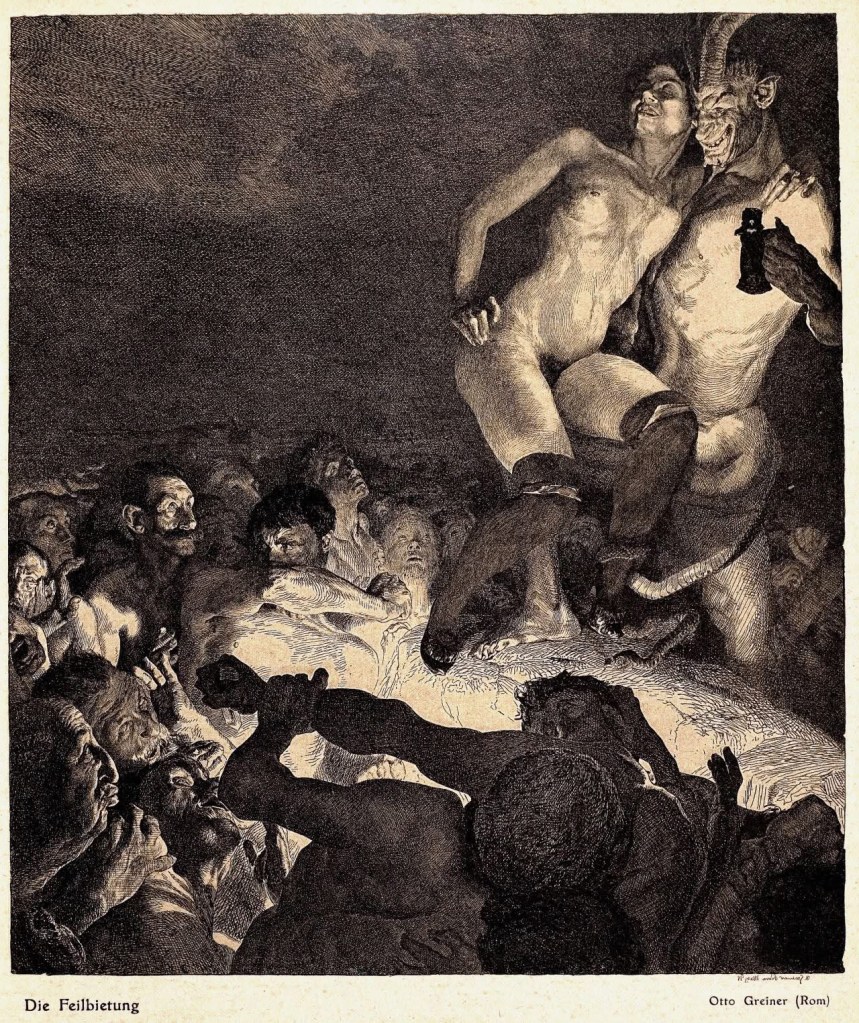
Otto Greiner (1869–1916), Die Feilbietung (The Sale), 1898. Lithograph, 25 × 20 cm. Public domain.
The devil as auctioneer, mankind as eager bidder – Greiner’s vision of damnation is less warning than mirror, a Halloween reminder that we often sell ourselves far too cheaply.
Night and day belong together. One can’t savour dawn without knowing what shadows preceded it, nor understand death without glimpsing the promise of life. So too with these two feasts of the turning year: Halloween and All Saints’ Day. They stand as opposites, yet also as partners – one a parody of damnation, the other a hymn of redemption. First comes the devil’s auction at midnight, as etched by Otto Greiner and echoed in our hollow festivities; then follows the radiant company of the saints at morning, when heaven answers with splendour. Shadow and light, masquerade and unveiling.
The devil’s always been a good salesman. From Eden’s orchard to Goethe’s study, from the witch-market of Faust’s Walpurgisnacht to the auction houses of our modern appetites, Old Nick has been peddling his wares with all the charm of a snake-oil merchant and the reliability of a banker. Otto Greiner’s Die Feilbietung – The Sale – shows us the spectacle in its purest form: the devil enthroned as auctioneer, a naked soul displayed like a prize heifer, and the mob below, eyes bulging, hands raised, eager to buy.
What makes the print so unsettling isn’t its fantasy, but its familiarity. The bidders aren’t grotesques – they’re us. Greiner doesn’t paint monsters; he paints men who want to be monsters, and who mistake their own damnation for a bargain. The lithograph isn’t so much a warning as a mirror, and in that glass we see ourselves, grinning in the torchlight, ready to pay.
And this, perhaps, is Halloween’s truest likeness. For what’s Halloween but the annual rehearsal of the devil’s auction? We don our masks, we play at death, we laugh in the graveyard, and all the while we forget what it is we are imitating. Once upon a time, All Hallows’ Eve was a vigil of the Church, the night of prayer before the feast of All Saints. The dead were remembered, the saints invoked, and the living reminded that they too would pass through the veil. It wasn’t candy, but contemplation. It wasn’t ghoulish delight, but holy dread.
But strip away the prayers, silence the bells, and what remains? Pumpkins in plastic, children dressed as demons, adults staggering about in polyester costumes, and an empty parody of the sacred. This is where the damage lies – not in the masks themselves, but in the absence of context. We dance in the dark with no thought of dawn. We play at horror without hope, at damnation without redemption. We’re Greiner’s mob, bidding gleefully for shadows.
And yet the longing is genuine. We crave this night because, beneath the glitter and the vodka, there’s an instinct that death is near and eternity closer. The heart knows that the veil is thin, that the grave isn’t far, and that some reckoning waits. The problem isn’t that people love Halloween, but that they love it stripped of its purpose. The vigil becomes a carnival, the auctioneer takes his seat, and the devil smiles.
Greiner understood what we’d rather not see – that evil is at its most dangerous when it’s entertaining. The devil’s auction isn’t conducted in terror but in laughter; the crowd doesn’t shrink back but surges forward, eager to buy. And so it is with Halloween, when death becomes a joke and damnation a costume. Without the prayers of All Hallows, the night becomes little more than the devil’s market, where men sell themselves cheaply and call it fun.
But the story doesn’t end in the graveyard’s flicker. For as the masks are discarded and the dawn rises, the Church lifts her eyes from the auction block to the throne. If Halloween is the devil’s night, then All Saints’ Day is God’s coronation. One night we see the mob bidding for shadows; the next, we name aloud the multitude no man can number.
The feast is ancient. It didn’t spring from pumpkins or parades, but from the simple truth that martyrs were too many to count. In the early centuries, Christians gathered at the tombs of their dead to remember their sacrifice; when persecution swelled and the blood of witnesses poured like a river, the Church declared that one day in the year should honour them all. The festival spread, expanded, and by the Middle Ages it embraced not only martyrs but every saint, known or unknown, whose light had pierced the dark.
It’s a glorious irony: the world dresses as ghouls the night before, then the Church answers with the splendour of the transfigured. One night we imitate the damned; the next, we commemorate the redeemed. The pairing is deliberate, for the vigil and the feast aren’t enemies but opposites, two sides of one truth. Death has its terrors, yes, but the saints bear witness that those terrors aren’t final. The devil may hold his sale, but the risen Christ holds the deed.
And what, then, is a saint? Not a plaster statue or an impossible hero, but an ordinary man or woman who has been caught by grace and changed by love. Wilde once quipped that every saint has a past and every sinner a future. That’s the whole scandal of sanctity: that fishermen, tax-collectors, housewives, scholars, and beggars might one day shine brighter than the stars. The saints aren’t distant figures to be admired from afar; they’re fellow-travellers who beckon us onward, proof that the human soul wasn’t made for auction but for eternity.
In this, All Saints’ Day is profoundly consoling. It reminds us that the grave isn’t our terminus, but a door through which countless others have already passed. When we speak of the ‘communion of saints,’ we don’t mean something misty or abstract, but the most intimate of fellowships – the family of God, living and dead, united in Christ. Our prayers reach them; their prayers reach us. The veil is thin, but unlike Halloween’s parody, it’s not thin for terror but for love.
If Halloween is the dance of masks, All Saints’ is the unveiling. If Halloween is the devil’s gavel, All Saints’ is the hymn of the redeemed. In the end, it’s not Greiner’s devil who has the last word, but the radiant company who surround the throne and sing, ‘Salvation belongs to our God.’
Thus night gives way to morning. The devil may grin in the marketplace of souls, but the saints sing louder in the courts of heaven. Halloween without All Saints’ is a parody; All Saints’ without Halloween is an answer without a question. Taken together, they remind us of the peril and the promise, the masquerade and the unveiling.
For the gavel will fall, yes – but so too will the crown descend. And while the auctioneer deals in shadows, the radiant company holds fast to light eternal.

 Wording