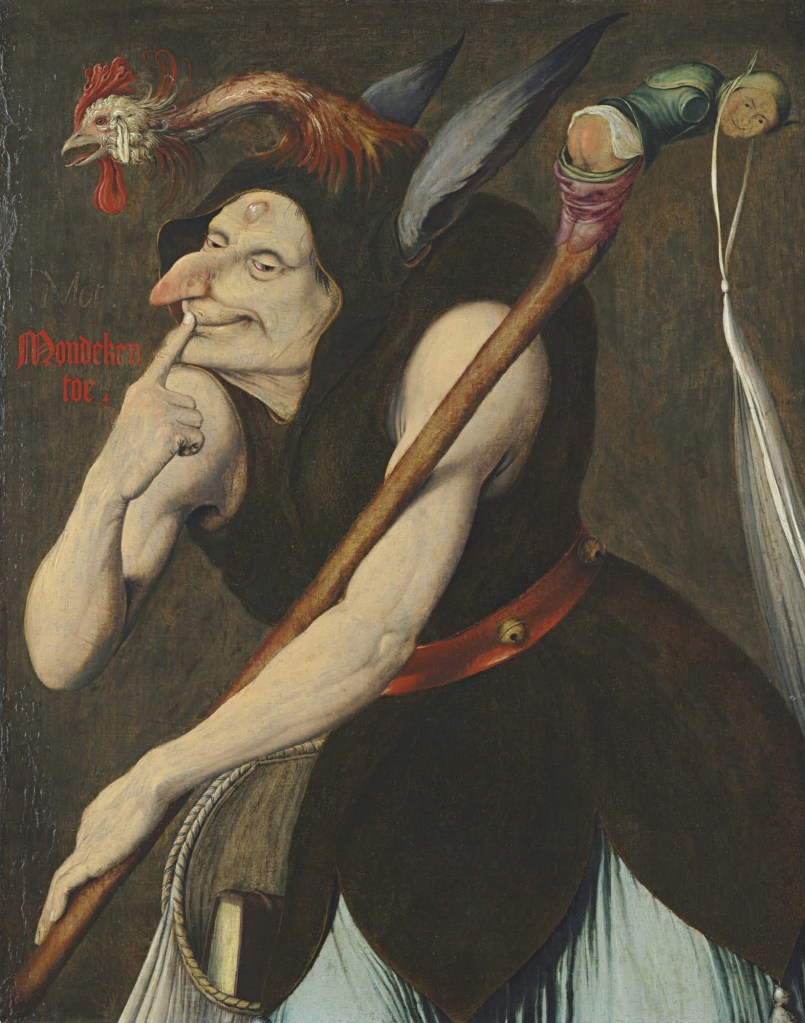
Quentin Matsys, An Allegory of Folly (c.1510–1520, Musée du Louvre, Paris). Public domain.
Folly, that eternal fool in mankind’s court, is rarely so vividly dressed as in Quentin Matsys’ An Allegory of Folly. Painted in the early sixteenth century, when Europe was still shaking off the medieval habit of believing its own sermons, this grotesque half-figure leans toward us like a conspirator – one finger pressed to his lips as though whispering the greatest secret of all: that wisdom is mostly theatre, and men are its jesters.
He wears a cowl shaped like a cockerel’s head — the proud bird of vanity – yet it seems to have molted into absurdity, as if pride itself had aged into parody. A red comb juts from the hood, like a moralist’s exclamation mark, while a set of wings sprout uselessly behind him, mocking his pretensions to flight. The fool’s eyes, heavy-lidded and sly, are those of every self-satisfied sage who confuses cunning with intellect. His nose, long as deceit and curved like a moral lesson, points accusingly at nothing in particular – which, one suspects, is where most accusations end.
In his hand he holds the staff of office — not a sceptre of authority, but a grotesque puppet’s head, a kind of secondary fool, wrapped in rags and crowned with a walnut. It’s a portrait of man carrying his own mockery upon his back. The entire staff is an emblem of conscience as ventriloquist — a reminder that our inner voice often speaks in the same cracked tone as our folly.
Behind this carnival grotesquerie lies the calm hand of Matsys, a moral anatomist in oils. The Antwerp master, famed for his Moneylender and His Wife and The Ugly Duchess, painted not simply faces but fables. His brush dissects human vice like a surgeon’s scalpel dipped in irony. Each wrinkle, each wart, is theological commentary disguised as portraiture. One might even say Matsys invented the Renaissance selfie: an unflattering image revealing what man looks like when he poses for eternity.
The inscription beside the fool – Mondeken toe (‘Fool, keep your mouth shut’) – reads like a pre-emptive strike against both gossip and philosophy. Silence, after all, is the only wisdom the fool can claim; yet silence is also complicity. There’s a deep paradox here, one the modern age has resolved by embracing perpetual noise. Our own era has multiplied Matsys’ fool across a billion glowing screens: each one of us leering, posturing, and finger-to-lips, sharing nothing and everything at once. The staff has become the smartphone; the puppet, our curated persona.
Still, there’s something strangely holy about the fool’s knowing grin. He reminds us of Erasmus’s Praise of Folly — that laughter, not reason, is often the last refuge of truth. Matsys’ jester seems to wink across five centuries and say: ‘Yes, I am ridiculous, but so are you — and at least I know it.’ In that self-awareness lies the faintest halo of redemption, the divine comedy beneath all human tragedy.
The composition is stark: a dark, empty background against which the fool gleams like an illuminated sin. There are no saints, no symbols of salvation — only the flesh, the leer, the cock, the puppet, and the gesture of secrecy. And yet, in its mockery, the painting becomes moral. It tells us that the fool isn’t a character but a mirror. Every age paints its own reflection in his grin.
In the end, Matsys’ Allegory of Folly is less a painting than a parable. It whispers that civilisation itself is a grand masquerade — a perpetual carnival of clever idiots and eloquent buffoons. To know that, and still smile, is the nearest thing to wisdom that art has ever achieved.
Art-Historical Commentary
Quentin Matsys (also Massys or Metsys, c.1466–1530) stands at the hinge between the late Gothic world of moral allegory and the emergent realism of the Northern Renaissance. Working in Antwerp — then a flourishing mercantile hub — Matsys fused Netherlandish precision with Italianate depth, producing works that balanced theology, satire, and startling psychological insight.
An Allegory of Folly, painted circa 1510–1520, belongs to a broader humanist tradition in which vice and madness were personified to instruct and amuse. It reflects both the theological preoccupations of the late Middle Ages and the humanist irony of the early sixteenth century — a time when Erasmus of Rotterdam’s In Praise of Folly (1511) was circulating through the Low Countries, and painters, sculptors, and printmakers were giving vice a face.
The grotesque figure’s features — exaggerated nose, sagging mouth, and feathered cap — derive from the medieval ‘fool’ archetype, but Matsys turns the caricature inward. His fool is not a court entertainer but an emblem of human corruption and pride, possibly modelled on real physiognomic studies of the mentally infirm or criminal. The rooster’s comb on the hood symbolises vanity and lust, while the wings may represent hubris — the futile attempt to transcend one’s station. The staff topped with a puppet effigy, meanwhile, echoes the fool’s sceptre (marotte) in medieval theatre, a prop that mirrored its bearer’s absurdity.
The inscription Mondeken toe (‘Fool, keep your mouth shut’) deepens the irony: it’s both a rebuke and a revelation. To speak is to expose folly; to stay silent is to embody it. The moral balance here is exquisite — Matsys paints not merely an idiot, but man in his fallen state, halfway between beast and philosopher.
The work’s technical qualities reinforce its allegory. The figure’s muscular arms and smooth modelling betray Matsys’ engagement with Italian Renaissance naturalism, possibly influenced by Leonardo da Vinci’s physiognomic sketches, which circulated in Antwerp through prints. Yet the painter retains the Flemish delight in texture — the gleam of skin, the matte softness of cloth, the rooster’s feathers rendered with almost scientific precision.
Today the painting is housed in the Musée du Louvre, Paris, where it stands among the northern European collections as one of the most psychologically charged portraits of the early sixteenth century. It invites comparison with Matsys’ The Ugly Duchess (National Gallery, London), a painting so vividly grotesque that John Tenniel later echoed its features for the Duchess in Alice’s Adventures in Wonderland.
In both works, Matsys achieves what might be called the theology of the grotesque: he renders sin, folly, and vanity not as abstract vices but as physical realities — moral deformity turned visible. His fools, misers, and grotesques are sermons in flesh and pigment.
If the Italian Renaissance sought beauty to find divinity, Matsys and his Flemish peers sought truth through distortion. In An Allegory of Folly, we see humanity unmasked — the whispering fool reminding us that, though centuries change, the face of folly never really does.

 Wording