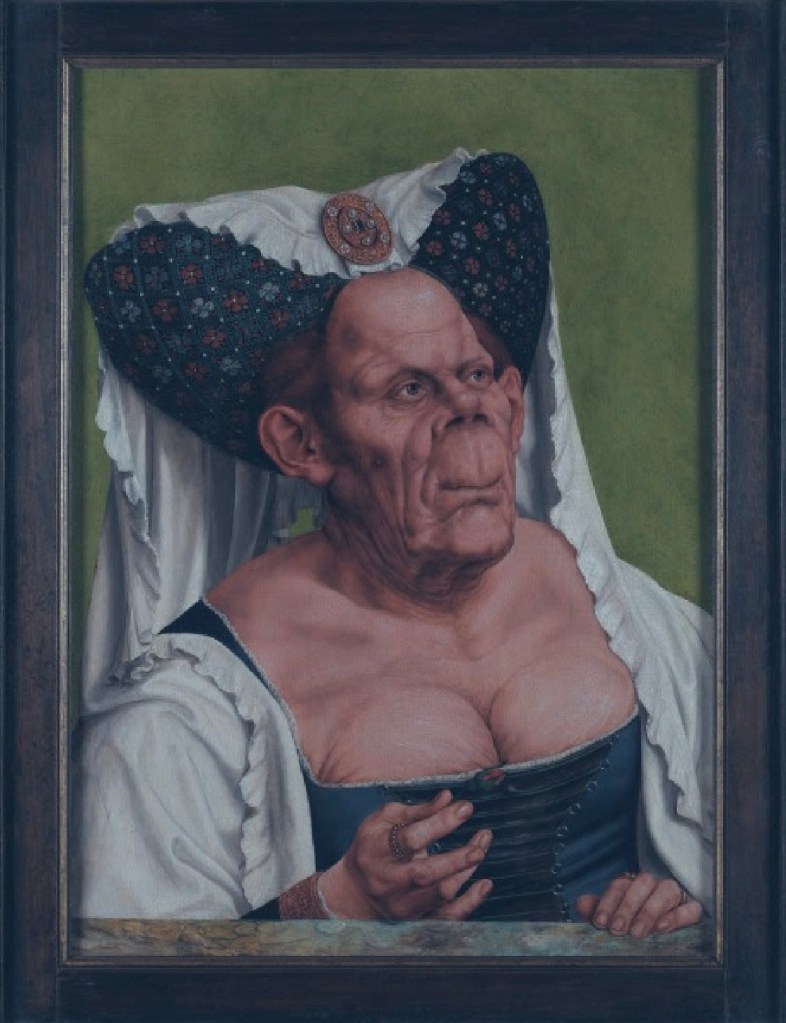
The Ugly Duchess (c. 1513) by Quinten Matsys. The National Gallery, London. Public domain image.
When I first looked at Matsys’ An Allegory of Folly (see previous post), I remember thinking that the jester’s cap was the most honest crown mankind ever designed. A fool’s bauble, yes — but at least it declared what kings and courtiers tried so hard to conceal: that we are all ridiculous beneath the robes of reason. Yet if that painting was Matsys’ philosophical jest — a meditation on the universal comedy of pride — then The Ugly Duchess is his cruel punchline.
Painted around 1513, this grotesque portrait of a woman who refuses to grow old gracefully could almost be the jester’s mother, his mirror, or his muse. Where An Allegory of Folly laughs at the clown who knows he’s a fool, The Ugly Duchess mourns the one who doesn’t. Her eyes, watery and wide with delusion, are the eyes of humanity itself — forever flirting with the illusion of permanence. She thrusts her sagging bosom toward a world that no longer desires her, offering a single red rose like a relic of her own extinction.
But this is no simple caricature. Matsys wasn’t merely sneering at an old woman’s vanity — he was, I think, painting a sermon on the body as theatre, the flesh as folly. In that gnarled hand clutching the rose, in that cracked face beneath the horned headdress, he gave visual form to the same moral absurdity Erasmus had just written of in In Praise of Folly: the desperate comedy of self-love masquerading as dignity.
The Duchess’ headdress itself deserves a meditation. Two great horns rise like blasphemous wings, suggesting both devilry and delusion — a parody of beauty’s halo. The effect is both comic and tragic: an infernal parody of the Virgin’s veil, recast as a costume for the damned. She’s the Madonna of Misapprehension, patron saint of those who believe time can be seduced by rouge and lace.
There’s something deeply theological here, as there always is in Matsys. His laughter, like Erasmus’, hides a sermon sharper than the painter’s brush. The Duchess isn’t a woman but a mirror — a human soul refusing to accept mortality, draped in costume and cosmetics like fig leaves of denial. It’s Genesis in grotesque form: the moment after the fall, when knowledge has arrived but wisdom has not.
And yet, how strangely sympathetic she is. Her tragedy is ours — for who among us hasn’t tried, in one form or another, to outwit decay? We dye our hair, filter our faces, edit our lives, and offer up our digital roses to invisible admirers. We, too, are duchesses in the digital age — gnarled souls with airbrushed avatars.
When Lewis Carroll’s illustrator, John Tenniel, later borrowed her features for the Duchess in Alice’s Adventures in Wonderland, he wasn’t merely reviving a grotesque: he was resurrecting the archetype of absurdity itself. In Wonderland, she barks moral platitudes between slaps and sneers — a perfect reincarnation of Matsys’ sermon in flesh.
But beneath the mockery there lies compassion, that quiet note that redeems true satire from cruelty. Matsys doesn’t condemn his Duchess; he mourns her. The joke isn’t on her, but on all of us who fear the mirror. She’s Eve in evening wear, awaiting an invitation from a Heaven she long ago stopped believing in.
In An Allegory of Folly, Matsys held up the mask of laughter. In The Ugly Duchess, he tears it away — and what remains is both hideous and holy. The two belong together like sin and confession, the jest and its echo. One laughs at our folly; the other shows us its face.
Perhaps that’s why the painting still unsettles. Because behind every Duchy of Flesh there lingers the faint memory of Paradise — and every rose, no matter how absurdly offered, was once the colour of Eden.
Art Historical Commentary
Quinten Matsys (1466–1530) was a leading figure of the early Netherlandish Renaissance, working primarily in Antwerp. His art bridges the late Gothic style of the fifteenth century and the new humanist naturalism of the sixteenth. The Ugly Duchess belongs to a small group of satirical portraits produced in the Low Countries at this time — works that reflect a growing fascination with moral allegory, physical deformity, and social parody.
The painting was likely created around 1513, a period when Northern artists were combining humanist interest in the individual with medieval moralising traditions. Antwerp, then a bustling mercantile city, provided fertile ground for this kind of social satire.
The sitter is an elderly woman wearing a low-cut dress more appropriate to a youthful bride than to her advanced years. She sports a fantastical horned headdress and presents a red rose — the traditional emblem of love and courtship. The portrait is half-length, turned slightly to the viewer’s right, against a plain background that isolates the figure and intensifies her grotesque presence.
Her exaggerated features — the jutting jaw, sagging cheeks, and leathery skin — have led some scholars to suggest that Matsys observed a real medical condition such as Paget’s disease (osteitis deformans), which can cause bone enlargement and facial distortion. However, most art historians regard the figure as a deliberate caricature rather than a literal likeness.
The Ugly Duchess is best understood as a moral allegory on vanity and the folly of sensual desire in old age. By dressing the aged woman in youthful finery and placing a rose in her hand, Matsys ridicules the delusion that beauty and erotic appeal can survive time. The work thus fits within the broader Northern European tradition of vanitas imagery — reminders of mortality and the transient nature of pleasure.
It’s long been connected to Erasmus’s In Praise of Folly (1511), a satire written in nearby Rotterdam only a few years before. Erasmus personified Folly as a female speaker who mocks human pride and pretension; Matsys translates that theme into visual form. His An Allegory of Folly (also known as The Fool) complements The Ugly Duchess, and the two may originally have been conceived as pendants — one representing male folly, the other female vanity.
Matsys demonstrates the meticulous oil technique inherited from earlier Netherlandish masters such as Jan van Eyck and Rogier van der Weyden. The crisp rendering of skin texture, fabrics, and jewels reflects the continuing Northern commitment to detail, while the bold modeling and satirical exaggeration anticipate later developments in caricature. The artist’s handling of light — cool, even, and frontal — enhances the sculpture-like solidity of the figure and leaves no shadow for illusion or flattery.
Although humorous in intent, the image unsettles viewers with its mixture of realism and distortion. The grotesque exaggeration aligns it with the emerging genre of ‘monstrous’ or ‘fantastic’ portraiture that flourished in the sixteenth century — a forerunner to the later caricatures of Leonardo da Vinci and the moral satires of Pieter Bruegel the Elder.
During the Victorian period, The Ugly Duchess gained renewed fame when Sir John Tenniel used it as a model for the Duchess in Alice’s Adventures in Wonderland (1865). The resemblance is unmistakable, confirming the painting’s long afterlife as a symbol of comic grotesquerie.
The panel entered the National Gallery collection in 1947. It had previously been in private hands and associated with its supposed pendant, An Old Man (or An Allegory of Folly), also by Matsys. The surface shows minor craquelure typical of early-sixteenth-century oak panels, but the colours — especially the reds and greens — remain strikingly vivid after conservation.
Art historians regard The Ugly Duchess as a landmark in the study of Northern Renaissance satire and psychological portraiture. It demonstrates how moralising allegory could be expressed through extreme naturalism and humour rather than through idealisation. The painting encapsulates a uniquely Netherlandish balance between devotion and derision — between the moral gravity of religious art and the worldly wit of humanist observation.
Quinten Matsys’ The Ugly Duchess and An Allegory of Folly (both c. 1513–1515) are among the most incisive examples of early Northern Renaissance satire. Though they can be appreciated individually, their shared format, scale, and thematic unity suggest they were conceived as a pendant pair — moral opposites representing the two faces of human absurdity.
Both panels are oil on oak, roughly the same dimensions, and painted with a comparable frontal lighting and neutral background. In each, a single figure dominates the pictorial space: in The Ugly Duchess, an aged woman clinging to the symbols of courtly love; in An Allegory of Folly, a grotesque male fool crowned with the cap and bells of licensed madness. This compositional symmetry reinforces their moral dialogue — vanity answering folly, delusion replying to mockery.
While The Ugly Duchess embodies erotic folly, the female delusion of beauty and desirability, An Allegory of Folly personifies intellectual folly, the human appetite for empty wit and self-importance. The two together constitute a visual treatise on the complementarity of sin and stupidity — a pairing not uncommon in late medieval moral imagery, where pride and folly were often twinned as the first and most fatal of vices.
Both works draw heavily from the moral climate shaped by Erasmus’s In Praise of Folly (1511). Erasmus’ satirical oration, delivered by the goddess Folly herself, ridiculed the pomp of scholars, clerics, and courtiers alike. Matsys translates this literary tradition into painted form, embodying human irrationality through portraiture rather than personification.
His approach diverges from the idealised virtus et vitium allegories of the Italian Renaissance. Instead of moral types, Matsys presents recognisably human faces, exaggerating them just enough to expose their psychological absurdity. The result is closer to the Northern tradition of grotesque realism — a visual cousin of the carnival spirit later explored by Rabelais and Bruegel.
The woman’s rose and décolletage in The Ugly Duchess mock the pursuit of sensual love beyond nature’s limit; the man’s bauble and smirk in An Allegory of Folly parody reason itself reduced to entertainment. One clings to beauty, the other to brilliance — both illusions undone by Matsys’ merciless naturalism.
Technically, the two panels exhibit identical craftsmanship: thin glazes over a smooth ground, minute attention to surface texture, and a balanced palette dominated by greens, reds, and flesh tones. The artist’s realism is neither documentary nor entirely satirical; it serves instead as a vehicle for moral precision. The calm, even lighting denies theatricality, forcing the viewer to confront the sitter without distraction — as if illuminated by divine exposure rather than artistic sympathy.
Viewed together, the pair articulate a distinctly Northern Renaissance moral humanism — critical of human weakness yet grounded in compassion. They reveal Matsys as both moralist and psychologist: the first painter in the Low Countries to treat folly not merely as a sin but as a condition of existence.
Their influence can be traced forward to Pieter Bruegel the Elder’s Netherlandish Proverbs and The Battle Between Carnival and Lent, where laughter and judgement coexist in uneasy harmony. Centuries later, The Ugly Duchess would find new life through Tenniel’s reinterpretation in Alice’s Adventures in Wonderland, while An Allegory of Folly prefigured the modern fascination with the absurd, from Bosch’s demons to Daumier’s caricatures.
Together they mark a turning point in Western art — the moment when the sacred mask of virtue slipped, and the human face, ridiculous and real, looked back from the canvas.

 Wording