There are lines in Dante that feel less like poetry and more like a divine diagnosis — a sudden flash of God’s own X-ray slicing through human pretence. This is one of them. It’s as though he leans over the parapet of Hell, raises an eyebrow, and says, ‘Really? You expect Heaven to applaud that?’
We moderns have become experts at laundering vice through benevolence. We baptise our sins in the holy water of public gestures, hoping nobody notices the dirt beneath the surface. Dante, however, isn’t fooled. He understood what most of our ‘virtuous’ age refuses to admit: that the moral value of a deed is inseparable from its source. A good act born from a corrupt heart is no more charity than a poisoned chalice is a cup of wine. You can drink it, but you’ll not toast with it.
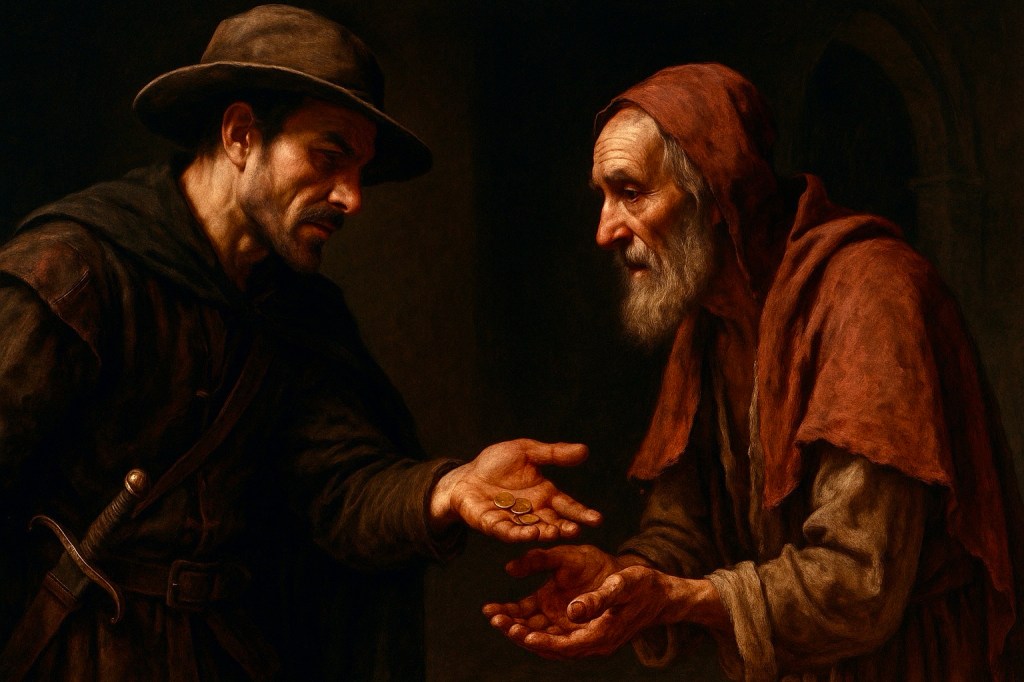
The thief who gives alms isn’t a saint; he’s simply outsourcing his conscience. He steals from one man and tosses coins at another, believing the moral arithmetic will cancel out. But God isn’t an accountant, and Heaven keeps no books for creative balancing. The thief hasn’t become generous — he’s become spiritually schizophrenic, robbing with the right hand while the left hand performs a pantomime of mercy.
Dante’s point is razor-sharp: you can’t build virtue upon vice. Charity that depends on injustice isn’t charity; it’s restitution disguised as compassion. It’s guilt wrapped in a halo. It’s moral theatre.
And the world, as we well know, is full of performers.
From billionaires who fund charities with money squeezed from the poor, to institutions that parade their ‘good works’ while rotting behind the scenes, to individuals who castigate others to disguise the stench of their own faults — the thief’s alms are everywhere. Modern society practically teaches us how to sin with one hand and sanctify ourselves with the other. It’s the oldest trick in the infernal book: appear good, rather than be good.
But Dante’s gaze – medieval, merciless, and miraculously honest – slices through all this. He reminds us that the road to paradise isn’t paved with ‘good deeds’ performed for the wrong reasons, but with the slow, grinding work of becoming the sort of person for whom goodness is natural, not performative.
True charity begins not with the act, but with the heart that makes the act possible.
Everything else is spiritual counterfeiting.
In the end, Dante’s line is a moral thunderclap across the centuries:
You can’t buy your way out of Hell with stolen coins.
And God help the age that thinks it can.

 Wording