Some stories don’t so much frighten as warn. They creep into the mind like a chill beneath the door, whispering that intellect is no armour against the irrational. M. R. James’s Casting the Runes is one of these — a genteel little ghost story that begins with a letter of complaint and ends with damnation delivered by recorded post.
The villain, if villain he may be called, is Mr Karswell — scholar, occultist, and wounded narcissist. He’s the sort of man who, having been refused entry to the Royal Society, summons a demon as one might write a stern letter to the editor. The hero, or rather the victim, is Mr Edward Dunning — a mild academic who reviews papers on alchemy and witchcraft for a learned journal, believing all such nonsense beneath him. In a lapse of courtesy that will prove fatal, he rejects Karswell’s paper with a touch of professional contempt. That small gesture — a scrawl of dismissal — is enough to stir an ancient grammar of vengeance.
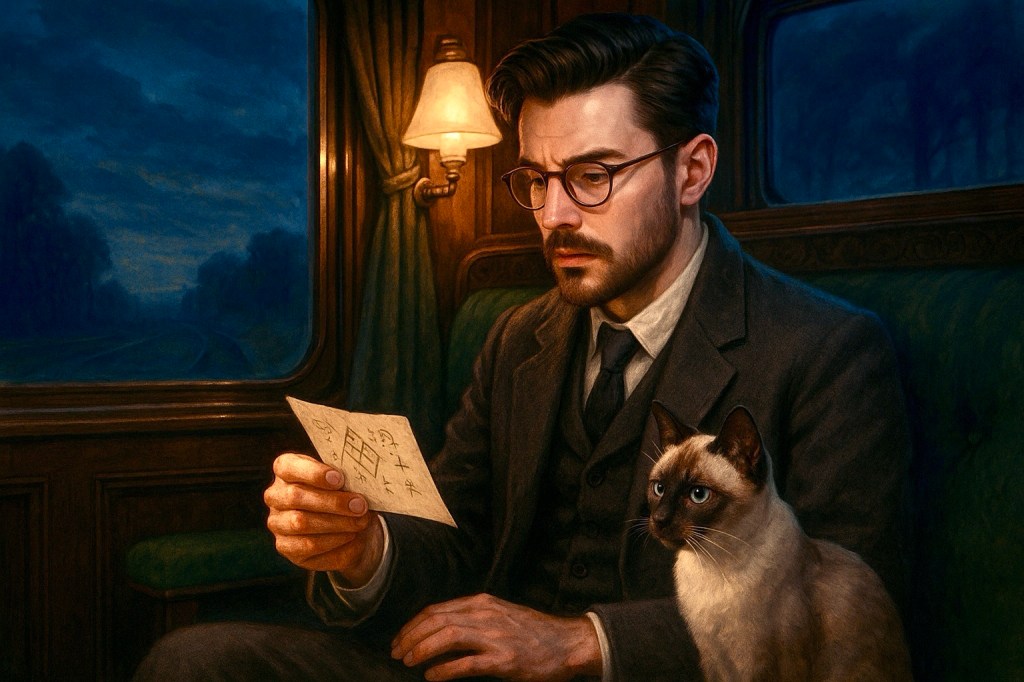
Soon after, Dunning begins to sense that something invisible and uninvited has taken up residence in his days. A stranger mutters his name in the street. The flick of a shadow crosses the lamplight. The air grows close. He later learns that another reviewer met the same fate: John Harrington — dead within months of critiquing Karswell’s work. Both men, it transpires, had been given a scrap of paper inscribed with peculiar runes. Once you receive the slip, you’re doomed — unless you can pass it back to its sender. The curse must be returned to sender, in the most literal sense.
There’s something almost comically English about the whole affair. The apocalypse comes not with trumpets but with stationery. Evil is delivered on cream-laid paper. The devil, in James’ world, is a civil servant — efficient, punctual, and dreadfully well-mannered.
Dunning’s final act — slipping the cursed paper back into Karswell’s pocket aboard a railway carriage — reads like a genteel espionage scene from Le Carré: an exchange of folded death notices on a train bound for nowhere. And when Karswell meets his grisly end abroad, torn apart by invisible forces, one cannot quite cheer. The vengeance is just, perhaps, but unholy; justice administered by a power indifferent to both law and mercy.
I’ve often thought that James’ tale is less about ghosts than about intellectual hubris. It’s a fable for the learned — a warning that the mind, when swollen with certainty, invites its own haunting. The runes represent forbidden knowledge: the kind that bypasses reason and lodges itself in the soul. Once read, it can’t be unread.
There is, too, a theological irony: Dunning, the man of letters, finds himself damned by letters. His salvation lies not in knowledge, but in a desperate act of faith — the belief that unseen forces exist and can be turned against one another. He must, for the first time, believe in the irrational to survive it. Thus does the academic become the penitent.
Karswell, meanwhile, is the archetype of the modern sorcerer — the man who mistakes the study of power for possession of it. He wields the supernatural with the entitlement of an ego wronged. In another age he would have been a petty magician; in ours, perhaps, a bureaucrat in charge of artificial intelligence.
There’s something sacramental about James’ cursed paper. It’s an inverted relic — a relic of damnation. The word becomes flesh in reverse: language that kills instead of redeems. I can’t help but think of Genesis, where creation begins with a Word. In Casting the Runes, uncreation begins with one too.
The paper also mirrors the anxiety of the written word itself. Every writer, deep down, fears that what he sends out into the world may return to him transformed — misread, mocked, or cursed. Karswell’s vengeance, then, is almost poetic: a literalisation of the writer’s nightmare that one’s words will come back to destroy.
I confess, as someone who spends his nights scribbling essays and epitaphs, I feel a tremor of sympathy. We, too, cast runes. We post our thoughts into the void, never knowing what spirits might answer.
Beneath its antiquarian decorum, the story anticipates existential dread. Dunning’s terror lies not merely in dying, but in discovering that the universe isn’t indifferent — that it pays attention. He learns, to his horror, that there’s a moral order, but it’s not kind. In this way, Casting the Runes inverts the atheistic despair of modernity: the problem isn’t that God is absent, but that something else has taken His place — something precise, legalistic, and without compassion.
Nietzsche might have admired Karswell’s defiance, had he not seen in him also the absurdity of the will to power carried beyond sanity. Kierkegaard would have noted that Dunning’s salvation begins the moment he abandons rational proof and acts out of desperate faith. Camus, perhaps, would simply shrug: ‘The universe is unreasonable, and so is man.’
In the end, M. R. James leaves us with the quietest apocalypse imaginable: not a scream, but a sheet of paper fluttering from a man’s hand. The story is a parable of boundaries — of what happens when the civilised world of scholars and libraries dares to look too closely into the abyss it categorises. The abyss, being a poor sport, sends back a reply — in duplicate.
And so I close the book gently, with a glance at the papers on my desk, half-expecting one of them to move. For in every story, every line, and every essay written after midnight, there lies the faint chance that one has cast a rune without knowing it.

 Wording