This book didn’t slip quietly into the world like a well-behaved parishioner. The Naked Civil Servant — Quentin Crisp’s scandalous act of cultural streaking, his autobiographical confession written with the dignity of a saint and the insolence of a man determined to rattle the tea trays of middle England. It’s a work so defiantly honest, so scandalously self-exposing, that even Augustine might have raised an eyebrow and asked for a second reading.
Crisp’s life, as painted by his own hand, is a pilgrimage through the hostile geography of 20th-century Britain — a landscape littered with moral hedgerows, respectable hypocrisies, and enough pearl-clutching to supply a Tudor court. He was a man determined not merely to live outside convention, but to erect his chaise longue there, drape himself upon it, and dare the world to take offence. And take offence it did — with gusto, like a nation that finds itself morally threatened by a feather boa.
What strikes me most is how Crisp transforms suffering into aesthetics. He writes about humiliation with the precision of a jeweller setting stones. Abuse, poverty, ostracism — he polishes each experience until it gleams. No one else could speak of being beaten in the street with the tone of a man describing an inconvenient change in the weather. Other memoirists strive for catharsis; Crisp strives for style.
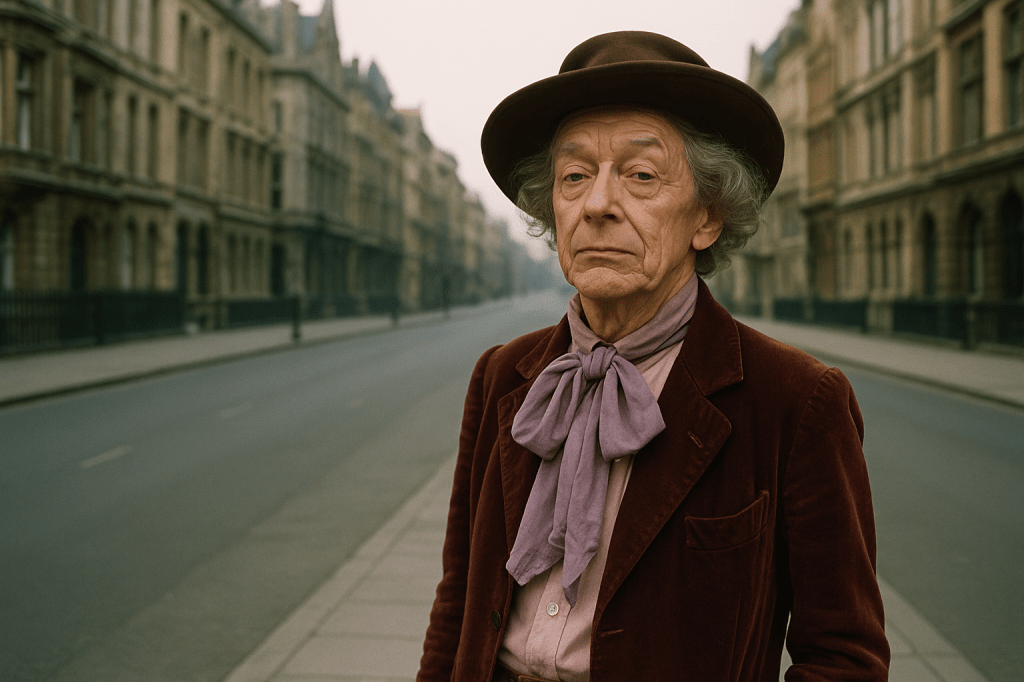
And then comes the film — the miraculous transfiguration of autobiography into performance — and at the centre stands John Hurt, inhabiting Crisp so completely that even Crisp himself later admitted it was like seeing his own soul rented out to a better actor.
Hurt doesn’t play Crisp. He becomes him. He doesn’t imitate; he incarnates. His performance is one of those rare celestial alignments when acting stops being mimicry and becomes revelation. Like a Caravaggio painting brought to life, Hurt gives us the chiaroscuro of a human being — the harsh glare of public disdain burning against the soft lamplight of Crisp’s internal dignity.
There’s a moment in the film — brief, almost whispered — when Hurt’s Crisp pauses mid-sentence, eyes glistening with a kind of exhausted triumph. It’s the look of a man who has survived both society and himself, and is quietly astonished to have done so. That single expression contains a library of philosophy. Kierkegaard, Camus, Sartre — all their existential angst compressed into one raised eyebrow and a battered wig.
Hurt understood what the book teaches: Quentin Crisp wasn’t merely eccentric; he was prophetic. In a century allergic to honesty, Crisp insisted on telling the truth about himself with all the flamboyance of a peacock lecturing a committee of pigeons. He made his identity an act of civil disobedience long before the term became fashionable. And Hurt, with that uncanny precision of his, captured the martyrdom and mischief in equal measure.
For beneath the camp, beneath the drawl, beneath the carefully poised persona, there’s something utterly Christian about Crisp — not doctrinally, but spiritually. He turns the other cheek so often he practically performs a pirouette. The cruelty he endured would have crushed a lesser man; Crisp turned it into an epigram. Hurt, in the film, reveals the cost beneath the wit — the bruised theology of a man who refused to hate the world that hated him first.
And this is where the work achieves something transcendent. The Naked Civil Servant isn’t merely a memoir; it’s a testament. A declaration that beauty can be found even in dereliction, that courage sometimes comes powdered and perfumed, and that dignity is possible even when the world’s determined to deprive you of it.
For my part, when I read Crisp or watch Hurt’s performance, I’m reminded of Wilde’s lament that ‘to love oneself is the beginning of a lifelong romance.’ Crisp extends that — to live as oneself, however impossible, is the beginning of a lifelong war. And Hurt shows us the soldier: frail, lonely, flamboyant, defiant, and wondrously unbroken.
That’s the gift of both book and film. They strip away the polite veneers of civilisation and show us a single human being — naked in every sense that matters — insisting on the right to exist beautifully.
And if there’s a moral (there must always be a moral; I am incorrigible), it’s simply this:
To be oneself in a world determined to sand you down is the bravest absurdity of all. Crisp lived that absurdity. Hurt sanctified it.
And we, dangling as we are on our own rotten ropes above our own abysses, can only applaud.

 Wording