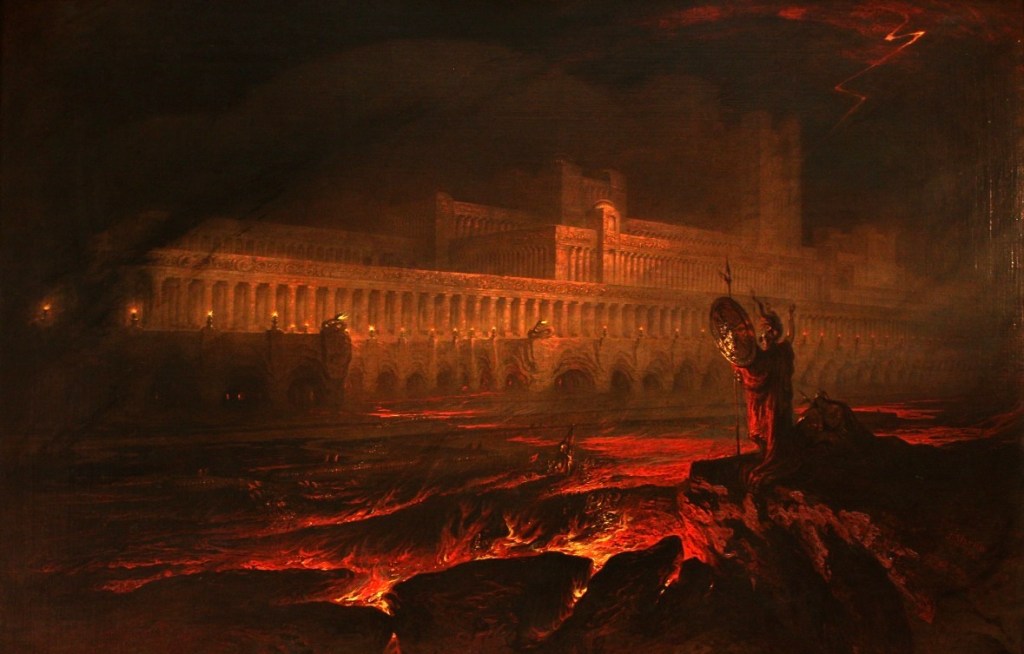
John Martin (1789–1854), Pandemonium, 1841.
Oil on canvas. Tate Britain, London. Public domain.
There are certain paintings before which I feel less a viewer and more a trespasser — a mortal who has wandered into a divine quarrel. John Martin’s Pandemonium (1841) is one such work. One scarcely enters it so much as one plummets into it, as though stepping unwittingly onto a black stage where Heaven and Hell are locked in their eternal, pointless custody battle for the human soul. Martin, that Northumbrian prophet of spectacle, paints not as a gentle observer of nature but as a man who gazed too long into the furnace and came back with a sketchbook full of brimstone.
The first thing that strikes me is the architecture. Martin’s Hell is suspiciously well organised. I imagine that even the damned must queue. Pandemonium, Milton’s infernal capital, rises from the molten earth like a fever-dream of Babylon crossbred with an industrial-age railway terminus. It’s vast, solemn, and brilliantly useless — a monument to the one thing the fallen angels have in abundance: pride. The great classical façade, all colonnades and impossible arches, gleams beneath a sky that is less atmosphere than accusation. Martin gives Hell a palace so grand that I suspect he understood that evil rarely arrives in rags; it usually comes with a blueprint and a treasury.
And there, a tiny black spear against the colossal city behind him, stands Satan. Martin knew precisely what he was doing when he reduced the Prince of Darkness to a silhouette on a precipice: he made him heroic by accident. The Romantic era had a weakness for the tragic rebel, and Martin indulges this with a wink. Look at him — shoulder set, hand raised, as commanding as Wellington on horseback — but dwarfed by the very empire he claims to rule. It’s the irony of the painting: Lucifer may have defied God, but here he is reduced to a decorative punctuation mark in the vast grammar of divine wrath.
What makes Martin so singular, and so infuriating to his Victorian critics, is this taste for the sublime — for scenes so enormous and so theatrically convulsive that the spectator feels like a speck on their own gallery floor. Ruskin sniffed at him, calling his cataclysms mere ‘effects,’ as though Martin had only to flick a brush to conjure biblical weather. But the public adored him. He was, after all, the first painter who truly understood the Victorian mind: anxious, devout, self-important, and never happier than when imagining the world ending in an orderly blaze of glory.
Art historically, Martin belongs to that great Romantic genealogy stretching from Piranesi’s prisons to Turner’s storms — yet he isn’t precisely like either. Piranesi imprisoned men in stone; Turner drowned them in light. Martin consumes them in scale. He’s the cartographer of the apocalypse, the draftsman of damnation. His canvases are architectural treatises written by a man convinced that the next great British public works project might very well be the reconstruction of Hell. He gives us precise lines, almost archaeological detail, set against skies that have utterly lost their temper. It’s this tension — the mathematical city versus the feral heavens — that makes his paintings feel like revelations on the cusp of exploding.
In Pandemonium, the lighting isn’t merely dramatic; it’s theological. Lightning cracks across the sulphurous sky like a divine rebuke, threatening to smite the very city the devils have raised. The ravine in the foreground glows with molten despair. Nothing in the composition sits still. The rocks tremble. The sky roars. Even the city seems to shimmer with the anxiety of beings who know that building anything in Hell is rather like erecting a conservatory on a volcano: impressive, but ultimately doomed. Only Satan stands calm, serene, surveying the handiwork of his legions as though hosting the world’s bleakest housewarming party.
But beneath the theatrics lies something far more poignant. Martin, like Milton before him, understood rebellion not as glamour but as tragedy. His Satan isn’t a triumphant conqueror but a lonely figure, a commander whose army is vast yet whose kingdom is hollow. His magnificence is a mask; his city is a mausoleum. The whole scene whispers that the greatest punishment of Hell isn’t fire but futility — that eternal defiance is simply eternal failure with better lighting.
Yet, there’s something undeniably seductive here, too. The British have always found a perverse comfort in doom. Give us a storm, a gothic ruin, or a Victorian death rate, and we feel quite at home. Martin’s Pandemonium invites us into this cultural instinct: the pleasure of standing safely before chaos, of reading Revelation without having to endure it, of admiring the fall of angels from the warmth of the Royal Academy.
Still, if you look long enough, you sense that Martin isn’t merely entertaining us; he’s warning us. Those monumental walls of Hell bear a faint resemblance to the new industrial architecture rising across Britain in the 1840s. Those glowing pits recall furnaces in which men laboured for pennies and perished for profit. His Hell is strangely familiar — too familiar — as though it were not metaphysical at all, but simply a catastrophic version of our own ambition. Martin’s landscapes are eschatological mirrors, held up to the face of a civilisation very pleased with itself.
And perhaps that’s why this painting still unsettles. You realise, after a while, that Pandemonium isn’t merely an illustration of a poem but an accusation: this is what happens when pride builds cities and rebellion becomes a worldview. It’s the triumph of architecture over humility, spectacle over soul. Satan raises a glorious palace and stands before it as though it proves something — but Martin’s composition shows us the truth: it proves nothing. It’s grandeur without meaning, splendour without salvation.
In the end, as the lightning fractures the heavens and Satan spreads his arms as though in some infernal parody of benediction, I feel an odd sympathy for him. Not affection — never that — but pity for a creature who mistook the size of a building for the size of his worth. Pandemonium is therefore not a painting about Hell so much as a painting about humanity: our appetite for magnificence, our foolishness in the face of eternity, our belief that the world will applaud us even as it crumbles beneath our feet.
John Martin gives us a Hell that looks suspiciously like our own world, with its glittering towers, its storms of ambition, and its lonely figure strutting upon a precipice, convinced of his own importance whilst the universe laughs quietly behind him. And that, perhaps, is Martin’s final joke — that damned or saved, angel or man, we’re all standing on the edge of our own Pandemonium.

 Wording