I’ve always thought that the most frightening people don’t slam doors, rattle chains, or float about moaning like an amateur operatic chorus. They make the tea properly. They keep the house tidy. They speak softly. And they watch you.
That’s why Seaton’s Aunt by Walter de la Mare unsettles me far more than any amount of shrieking Gothic theatre. This isn’t a story that lunges at you. It sits down beside you. It asks after your health. It may even tuck you in. And then, quietly, it begins to own you.
I first read the story expecting a traditional ghost tale — something with a payoff, perhaps a nicely behaved spectre, a little chill up the spine, a tidy moral bow at the end. Instead, what I got was a sort of existential house arrest. No spoilers, but if you’re looking for fireworks, De la Mare politely suggests you try next door. Here, the horror is internal, domestic, and so English it practically apologises for existing.
What strikes me immediately is the texture of the story. De la Mare writes like a man who understands childhood not as a golden meadow but as a state of quiet imprisonment. Children, in his world, aren’t innocent because they’re naïve; they’re innocent because they see too much and lack the vocabulary to defend themselves. They feel wrongness long before they can define it. Adults, meanwhile, are marvellously skilled at calling rot by the name of tradition.
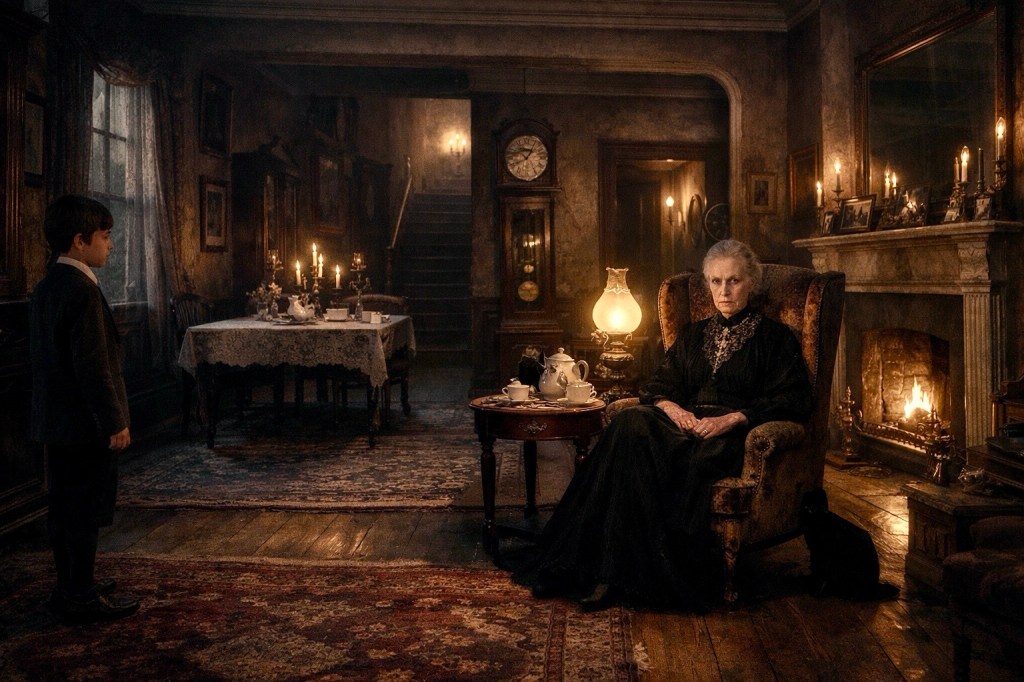
And then there’s the aunt herself — a figure so restrained, so proper, that she almost feels unreal. Not monstrous, not theatrical. Just… present. Permanently. The sort of presence that drains a room without ever raising its voice. I won’t say what she is — De la Mare wouldn’t thank me for that — but I will say this: she belongs to that chilling category of figures who don’t chase, because they don’t need to. You come to them. You stay. You diminish.
What makes this deeply uncomfortable — and darkly amusing, if you’ve a taste for gallows wit — is how recognisable it all feels. We’ve all met people like this. They don’t haunt castles; they haunt institutions. Families. Committees. Sometimes parishes. They don’t need fangs. They feed on obligation, grief, propriety, and the dreadful English terror of making a scene. If there were a supernatural handbook for such creatures, it would almost certainly be bound in brown cloth and shelved alphabetically.
De la Mare’s great trick is refusing to explain himself. Modern readers are used to systems: rules, lore, diagrams, cinematic universes with flowcharts. Seaton’s Aunt offers none of that. It understands — wisely — that fear collapses the moment it’s explained too well. The story hovers instead in suggestion, implication, and moral unease. You’re never quite sure what’s happening, only that it shouldn’t be.
There’s also something quietly theological going on, though De la Mare would never preach it. The aunt represents a world without grace. A world of possession without love, authority without warmth, care without mercy. She keeps, but she doesn’t give. And that, I’d argue, is one of the oldest definitions of evil we have. Hell isn’t fire; it’s stagnation. Heaven moves. Hell preserves.
And yet — because De la Mare is too sly to be solemn for long — there’s a faint, almost wicked humour running beneath it all. The sheer politeness of the horror. The way dread is served on a doily. The fact that the most terrifying thing in the room might also remind you to wipe your feet. It’s the kind of comedy that doesn’t laugh out loud, but raises an eyebrow and lets you do the rest.
When I finished the story, I didn’t feel shocked. I felt… watched. As though something had noted my presence and filed it away for later reference. That, to me, is the mark of lasting horror. Not that it scares you in the moment, but that it quietly rearranges the furniture in your head and leaves the door unlocked.
Seaton’s Aunt doesn’t end when you turn the page. It simply withdraws — very politely — and waits for you to grow older, wiser, and a little more aware of how easily warmth can be replaced by control.
And if that sounds amusingly bleak, well — De la Mare would probably smile, pour the tea, and say nothing at all.

 Wording