This afternoon I found myself once again wandering the countryside in the company of a dangerously attractive lady – the sort of woman who improves both the scenery and one’s vocabulary.
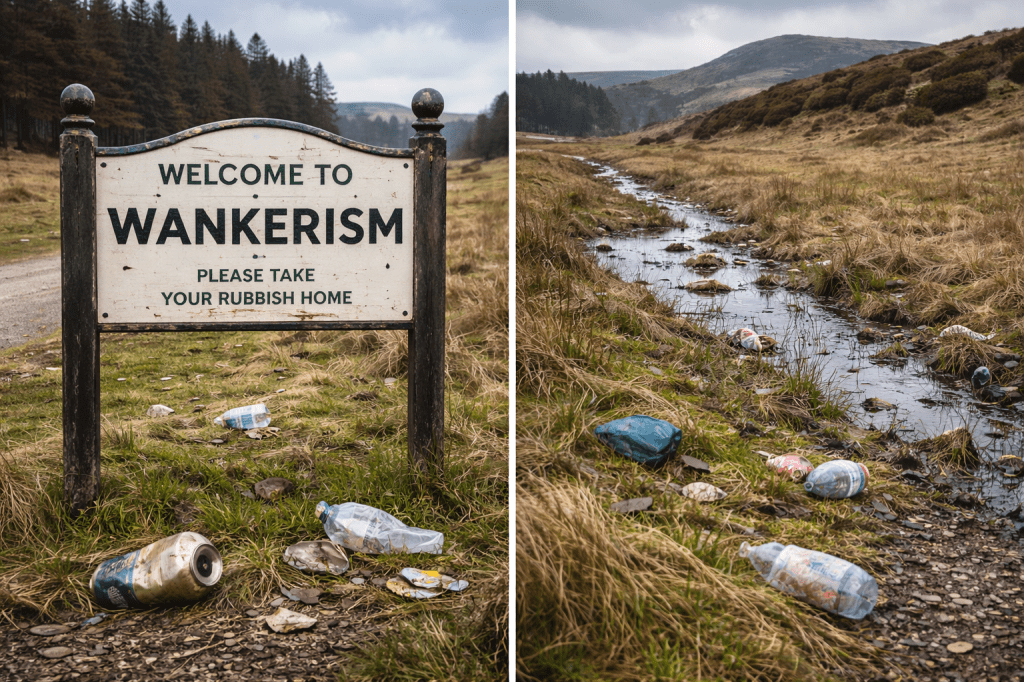
There’s something about walking that encourages philosophical invention. The Greeks had the Peripatetics; we have the footpath and a thermos. And so it was that, somewhere between a hedgerow and a lay-by decorated with the cultural artefacts of modern Britain (a discarded Costa cup, two crisp packets, and what looked suspiciously like the carcass of a vape), we, or rather she, coined a new word: Wankerism.
Now, like all good words, it arrived fully formed – as though summoned by the muses themselves after several centuries of disappointment in the human race. Wankerism, as we defined it, isn’t merely the behaviour of a fool. Fools have always existed. The medieval village had its idiot; the Georgian drawing room its bore; the Victorian club its pompous windbag. But the modern world has refined the fool into a system – a philosophy – a way of life. Wankerism is the organised practice of petty idiocy conducted with absolute confidence. And the countryside, my friends, is its museum.
Consider the modern litterer – the aristocrat of Wankerism. Here’s a man who will drive forty thousand pounds’ worth of German engineering into a beauty spot, gaze upon a view that took several million years to produce, and then – with the serene dignity of a Roman emperor – fling a plastic bottle out of the window. I sometimes imagine these people returning home and emptying their kitchen bin directly onto the living-room carpet. ‘Ah yes,’ they would say. ‘A nice domestic ambience.’ There’s something almost theological about it. The litterer treats the earth as though it were a cosmic ashtray. Even the devil, I suspect, would tidy up occasionally.
Then we encounter another branch of Wankerism: the Selfie Pilgrim. You’ll recognise him instantly. He arrives at a waterfall, cliff edge, cathedral, or ancient ruin – not to see it, not to contemplate it, not even to enjoy it – but to photograph himself pretending to enjoy it. The landscape exists merely as a decorative backdrop for his own face.
I’m reminded of the line from Oscar Wilde: ‘I am the only person in the world I should like to know thoroughly.’ The Selfie Pilgrim has taken this observation not as satire but as scripture. Where once pilgrims journeyed to Santiago or Canterbury seeking salvation, the modern traveller seeks Wi-Fi and validation. The cathedral is irrelevant. The lighting is everything.
No taxonomy of Wankerism would be complete without the Portable Speaker Barbarian. This creature believes that silence – that most delicate and ancient of human experiences – is a personal insult. He climbs a hill, surveys the valley, breathes in the clean air, and then proceeds to play what I can only describe as a kind of musical crime. Usually rap. Although last year atop Surprise View in the Lake District, it was K-pop – whatever that means. Now, I don’t object to music. I object to acoustic vandalism. There are few things more surreal than standing beside a medieval dry-stone wall while someone’s portable speaker bellows lyrics about luxury cars and dubious anatomy. It’s rather like hearing a foghorn in a monastery. Even Friedrich Nietzsche – who famously warned that ‘without music life would be a mistake’ – probably didn’t have Bluetooth speakers in mind.
But the highest expression of Wankerism – its Sistine Chapel ceiling – must surely be the Dog Bag Paradox. You’ll know this phenomenon well. A dog owner dutifully picks up the animal’s offering in a plastic bag… and then ties the bag to a tree branch. I often stand before such sights with the quiet wonder of a medieval pilgrim beholding a relic. Why bag it at all? It’s the philosophical equivalent of writing a letter and then throwing it into the sea. It solves nothing. It explains nothing. It merely elevates the problem. Somewhere, perhaps, there exists a forest entirely decorated with these dangling ornaments – the Christmas tree of Wankerism.
All of this would be amusing were it not so depressingly revealing. Because Wankerism isn’t simply bad manners. It’s the triumph of the self over the world. The ancient Stoic Epictetus taught that civilisation begins when a man learns to govern himself. The modern wanker, by contrast, believes civilisation exists to accommodate his impulses. The countryside isn’t a place to respect. It’s a place to consume. A picnic with no responsibility. A playground with no caretaker. In this sense Wankerism is the natural religion of the age – the sacrament of selfishness. And like most religions, it has its apostles.
Yet walking there today, beside that dangerously attractive lady, I was struck by a curious thought. England itself seems to resist Wankerism. The old hedgerows endure. The stone walls stand. The curlews and those black and white long-beaked-birds cry above the moor with complete indifference to human stupidity. Civilisation may wobble, but the landscape remains stubbornly dignified. It has seen worse. After all, these hills survived the Romans, the Normans, the Victorians, and several centuries of government planning departments. They’ll probably survive the vape cartridge too.
Still, as we returned along the footpath, stepping over the occasional relic of modern civilisation, I realised something rather comforting. Wankerism, for all its confidence, is also a kind of confession. It reveals a poverty of imagination. A man who throws rubbish in a field has never truly seen the field. He is blind to beauty. And blindness, as literature has long taught us, is the most tragic of conditions. Even the villain of Treasure Island – the sinister Blind Pew – at least had the courtesy to tap his way carefully through the world. The modern wanker doesn’t even do that. He simply blunders through it.
And so I leave you with this simple rule, which ought perhaps to be engraved upon every litter bin in the kingdom: Civilisation is what remains when the wankers go home. Until then, I shall continue walking – preferably in the company of a dangerously attractive woman – inventing new words for the peculiar absurdities of our age.

 Wording