This song seized me by the lapels and demanded my tears like a debt collector at the door. It’s rare, subtle, infinitely dangerous – it simply stands at a distance, tips its hat, and in doing so undoes you entirely. Ans Herz geh’n is lethal.
I didn’t understand a word of it when I first heard it. Not one. My German extends roughly to ordering a cup of coffee and apologising for my existence. And yet, within seconds, I felt something tighten – not dramatically, not theatrically – but with the quiet insistence of a memory that has no right to exist.
It is, I think, a song about love. But not the vulgar, modern variety that bellows its sincerity like a drunk at closing time. No – this is love in gloves. Love with posture. Love that knows better than to embarrass itself. The song says ‘Ans Herz geh’n’ – to go to the heart, or more precisely, to touch the heart. Already we’re in dangerous territory. The phrase suggests intimacy, but not possession. It isn’t ‘to take the heart,’ nor ‘to conquer it,’ nor even ‘to break it’ (as modern pop seems contractually obliged to do). It’s gentler. Almost hesitant. As though the heart were a drawing room one enters only after knocking. The song speaks, in essence, of someone who has moved beyond superficial flirtation and into that rarer condition: emotional sincerity. But – and here’s the rub – it does so with the restraint of a man who’d rather die than be caught making a scene.
There’s a sense of confession, but it’s veiled. One might say:
‘I feel something real… but I shall express it as though discussing the weather.’
Which, to my mind, is infinitely more affecting.
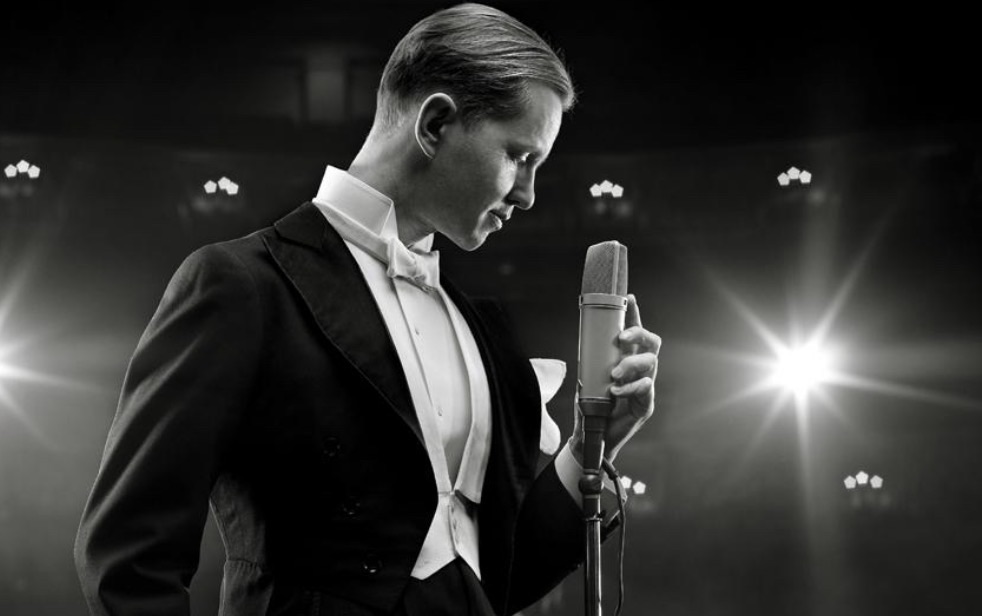
Now, Max Raabe does something here that borders on the miraculous. He refuses to feel the song – at least outwardly. No trembling voice. No swelling crescendo. No anguished grimace of the modern troubadour. Instead, he delivers it as though reading minutes from a particularly polite funeral. And therein lies the genius. Because what we witness isn’t the absence of emotion – but its containment. Like steam trapped in a sealed vessel. One senses that if he were to allow even a crack – just the smallest fissure – the whole performance would collapse into something unbearably human. It’s the emotional equivalent of a man saying: ‘I’m perfectly fine,’ while gripping the edge of the table hard enough to whiten the knuckles.
The song doesn’t belong to our time, and thank God for that. It carries with it the perfume of the Weimar Republic – that peculiar moment when Europe dressed itself beautifully while quietly losing its mind.
There’s always something slightly haunted about this style. One hears it and thinks not only of love, but of: candlelight in a room that will soon be empty, and laughter that’s already begun to fade, a civilisation fiddling with its cufflinks while history sharpens the knife.
And so even a simple love song acquires an undertone of impermanence. It’s not merely ‘I love you,’ but: ‘I love you… and somehow I suspect this cannot last.’
The modern world has a peculiar allergy to restraint. We’re forever declaring, announcing, confessing – flinging our feelings about like confetti at a wedding no one particularly wanted to attend. And yet here comes this song, impeccably dressed, quietly spoken, and devastatingly sincere. It doesn’t shout. It doesn’t explain itself. It doesn’t beg to be understood. It simply is. And because of that, it slips past the defences. It bypasses the intellect entirely and goes straight – quite literally – to the heart.
I’ve come to suspect that the reason this song affects me so isn’t because I understand it – but because I don’t. It leaves space. Space for projection. Space for memory. Space for all the things one has felt but never quite articulated. It is, in that sense, less a song and more a mirror. And like all mirrors worth their salt, it shows you not merely what’s there – but what’s missing.
So yes, I think my emotional response isn’t only understandable, it’s almost inevitable. For Ans Herz geh’n doesn’t attempt to move you. It merely stands, composed and dignified, and allows you to realise – quietly, almost apologetically – that you’ve already been moved.
The Republic of Hearts
And then, as if the song wasn’t already impertinent enough, the video commits a quiet act of rebellion. It shows not one love – but many. Young faces, bright with the arrogance of beginnings. Older faces, lined with the quiet dignity of having endured one another. Hands clasped not out of urgency, but out of habit – those most sacred of habits, forged not in passion, but in persistence. There’s something almost democratic about it. A kind of unspoken declaration that the heart – contrary to all modern marketing – doesn’t belong exclusively to the young, the beautiful, or the temporarily desirable. No, the heart is a far more indiscriminate organ. It wanders. It lingers. It returns, rather inconveniently, to the same person year after year like a dog that refuses to be rehomed.
And here, in this gentle procession of couples, one sees love not as a single blazing moment – but as a continuum. A thread pulled through time, occasionally frayed, occasionally knotted, but never quite broken.
At the centre of it all remains Max Raabe, observing – or perhaps presiding – like a particularly well-dressed witness at a wedding that’s been happening for decades. He doesn’t intervene. He doesn’t narrate their stories. He simply allows them to exist. And what stories they imply. The young couple, standing just a fraction too close, as though proximity alone might guarantee permanence. The older pair, touching with the casual certainty of those who’ve already survived disappointment – and found, to their mild surprise, that something gentler remained.
There are glances in this video that contain entire biographies. There are embraces that feel less like passion and more like recognition. And that, I think, is the quiet thesis of the whole affair:
Love isn’t merely the spark – it’s the staying.
What strikes me most, however, is the absence of spectacle. No grand gestures. No cinematic declarations. No desperate insistence that this – this – is the moment that defines everything. Instead, we’re given something far rarer: people looking at one another as though they already know. Not perfectly. Not completely. But sufficiently. Sufficiently to remain.
In our age, we’ve made a dreadful habit of confusing intensity with importance. We chase the extraordinary moment, the overwhelming feeling, the grand confession – as though love were a fireworks display rather than a fire. But here – quietly, almost mischievously – the video suggests otherwise. It suggests that love is: the hand that stays the glance, that softens the body, that leans, not out of need, but out of familiarity. It suggests, in short, that love isn’t something one falls into… but something one inhabits.
And suddenly, the song’s title – Ans Herz geh’n – takes on a richer, almost mischievous meaning. For it’s not merely about touching the heart. It’s about being allowed near it. Not storming it like a fortress, not conquering it like a territory – but approaching it, gently, repeatedly, until one is no longer a visitor but a resident.
So when I watch these couples – young, old, hopeful, tired, tender – I’m left with a curious and slightly uncomfortable thought: that love, in its truest form, isn’t dramatic at all. It is, rather, a long conversation held in glances, conducted in silence, and concluded – if one is very lucky indeed – not with a grand finale, but with a quiet, mutual decision…to stay

 Wording