I was reading an old story the other day – Guy de Maupassant’s Regret – and it sat with me longer than I expected. There’s this man, Monsieur Savel, sixty-two years old, known around town as Old Savel, who gets up on a wet autumn morning and can’t quite settle. Rain coming down, leaves falling slower and heavier than the rain itself, like the sky has decided to drop its furniture one piece at a time. He walks from the fireplace to the window and back again, the way you do when your thoughts have nowhere useful to go and your feet have decided to keep them company.
Life, he realises, has its dreary days, and from here on out most of them are going to be dreary, because he’s alone and the years have already been spent. No wife, no one devoted to him, nothing much that ever happened except the same meals at the same hours and the slow stacking of quiet rooms. He thinks about dying and how strange it is that other people will still be laughing somewhere while he simply ceases to exist – like the party continuing in the next room after you’ve already gone home and locked the door. If death were only probable you could still bargain with it. But it isn’t. It’s as regular as night after day, and he has nothing to set against it except the thin record of a life that never quite started.
He knows the reason, or thinks he does. Apathy. Not the dramatic kind where you lie in bed refusing the world, but the quieter sort that makes getting out of bed with any real purpose feel like moving a piano up three flights of stairs in your socks. He had money. He could have married. Opportunities existed or could have been made. He just never quite stirred himself. Some temperaments, he reflects, find it genuinely difficult to bustle about, to speak, to study a problem long enough to do anything about it. And so the years went by like a man standing at a bus stop who keeps deciding the next one will be better, until the last bus has already gone and he’s still holding his ticket.
There was a woman, of course. There usually is. His old friend’s wife, Madame Sandres. He had loved her quietly and without much hope from the first day he saw her, the way some people love a view they never walk toward. One spring afternoon years earlier the three of them had picnicked by the river. The husband fell asleep – the best nap of his life, he later claimed, which tells you something about the general standard of excitement. She took Savel’s arm. She was light, laughing, a little drunk on the weather. She made a wreath of flowers and asked if she looked pretty. He couldn’t find a single word. She called him a great goose and told him he might at least say something. She leaned so close her hair brushed his cheek and he moved his head away as if she’d offered him a lit firework. Later she grew quiet. When he suggested they go back she gave him a look he only understood decades afterward. The moment had been handed to him on a plate and he’d examined the plate, admired the pattern, and handed it back untouched.
Of course, one does have to pause here and note, with all due dryness, that had he actually taken the plate, the afternoon would have involved a certain amount of unfaithfulness. Embracing, kissing, or whatever else two people get up to on a warm balmy riverbank while the husband snores twenty yards away under a willow – none of that would have qualified as an especially honest relationship. It would have been the classic borrowed afternoon, the sort of thing that looks romantic in retrospect and rather shabby in the moment, complete with the later problem of looking the friend in the eye over Sunday lunch. Savel’s apathy spared everyone that particular mess. Whether that counts as moral virtue or merely another form of not quite managing to live is a question the story leaves politely unanswered, like a guest who has already put his coat on.
Years later the memory won’t leave him alone. He crosses the street, finds her older and rounder and up to her elbows in fruit preserves, and finally says the thing. He’s loved her since the first day. She laughs – the easy laugh of someone who has nothing left to lose on the subject – and tells him she knew all along. He asks what would have happened that afternoon by the river if he’d been bold. She says she would have yielded. Then she turns back to the pears, because winter is coming and the jam won’t make itself, and the past has never once paid the gas bill.
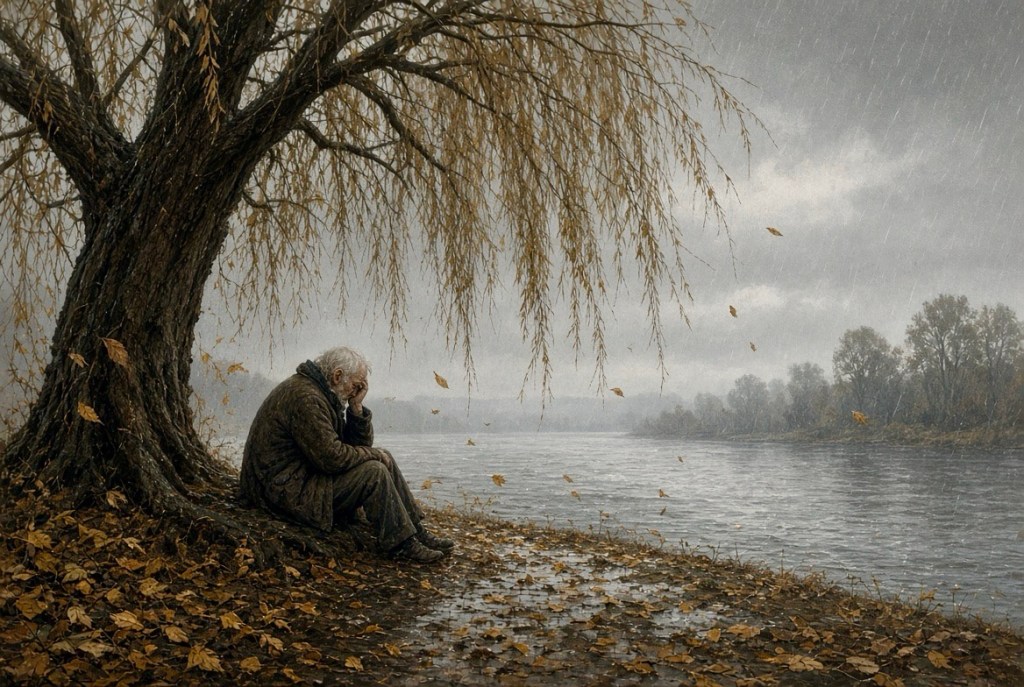
He walks out into the rain until he finds the same stretch of bank, sits under the bare trees, and weeps. Not because she refused him. Because she didn’t. Because the other life had been real and available, and he had spent decades protecting himself from it so successfully that now there’s nothing left to protect. Even the version of it that would have required a certain flexible attitude toward marriage vows.
I keep turning that over. How many of us are standing in some version of that same rain, holding a ticket for a bus we never quite boarded? Not always a person. Sometimes a city, a piece of work, a conversation, a belief we never tested because doubt felt cleaner than the mess of trying. We tell ourselves we’re waiting for the right moment, or that we’re simply not the sort of person who forces things, and the sentence sounds so reasonable it could be printed on a greeting card. Meanwhile the days keep their shape, the fireplace stays where it is, and the window keeps offering the same view of leaves coming down like slow, wet punctuation.
There’s a kind of grace we talk about less than we should – the ordinary grace of being known and wanted by someone, of having at least one other life braided with your own so that when you disappear you don’t disappear entirely. Without it the days don’t become tragic. They become weightless, and weightless things are hard to hold when you know they’re finite. The psychology of it is almost embarrassingly simple: avoidance that once kept the nervous system safe becomes the habit that keeps the life empty. After enough repetitions the habit starts to feel like character. “I’m just not the type,” we say, and the type nods back, perfectly satisfied, while the river keeps moving and the afternoon keeps ending.
What the story leaves me with isn’t a moral so much as a small, practical suspicion. Most of the doors we later mourn were never locked. They were simply heavy, and we’d grown used to the weight of not pushing. Some of those doors, admittedly, open onto other people’s marriages and would have required a rather elastic conscience to walk through. The lesson, if there is one, isn’t that we must seize every moment like heroes in a film – that way lies exhaustion, bad decisions made at speed, and the occasional awkward explanation to a husband waking up from his nap. It’s quieter than that. It’s the suspicion that the cost of speaking, of moving, of creating the chance instead of waiting for it to arrive already perfect, is almost always smaller than the cost of discovering, years later, that the chance was real and we examined it politely and handed it back. Even when the chance comes with complications. The pears still need preserving. The rain still falls. But every so often the afternoon is still there, waiting to see whether this time we’ll find something to say before the trees are bare and the only thing left to do is sit under them and count what we refused – honestly or otherwise.


