If there’s one thing Geoffrey Chaucer wanted us to know from The Canterbury Tales, it’s that the 14th century was rife with characters who were just as colourful, complex, and questionable as the ones we know today. Among the motley crew of pilgrims, none stand out quite like the Wife of Bath, a woman who has earned her right to be the poster child for marital experience, proto-feminism, and the aggressive deployment of sexual economics. Let’s dive into her Preamble and Tale, which are essentially a TED Talk on relationships, sprinkled with a dash of Arthurian legend.
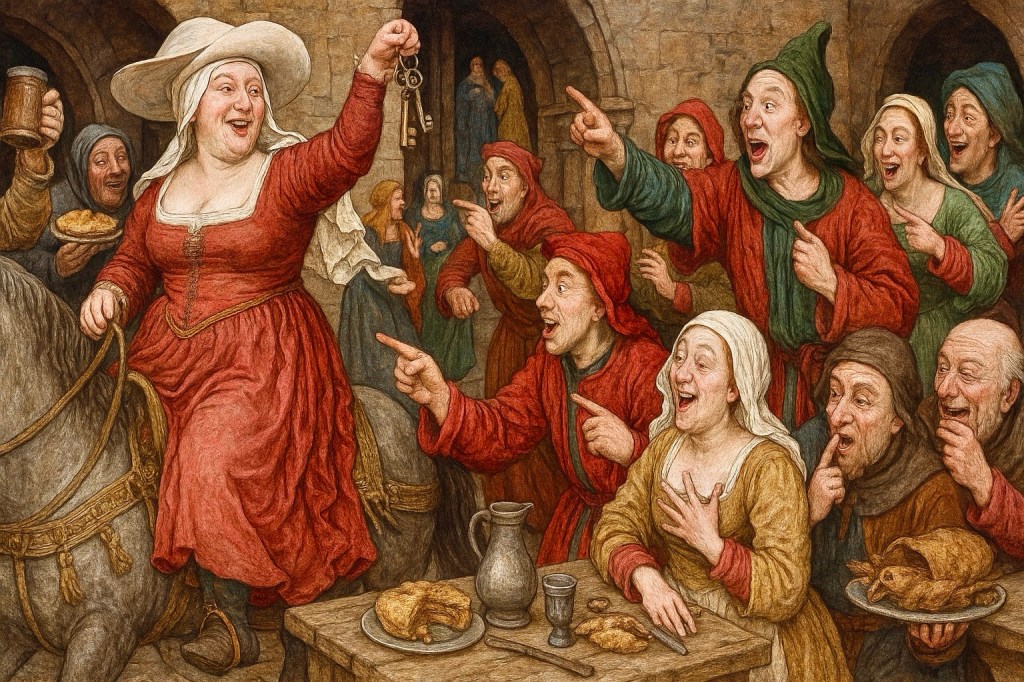
First things first, the Wife of Bath starts her Preamble with a bang – or rather, with a brag – a marriage manual with a side of chaos, declaring that she’s been married five times. This immediately signals that she’s either the ultimate relationship guru or that she’s an enthusiast of the trial and error method in matrimony. In modern terms, think of her as the Elizabeth Taylor of medieval England, but with fewer diamonds and more medieval discourse on virginity.
Her Preamble reads like a combination of a confessional blog post and a stand-up comedy routine. She drops the bombshell that she’s used her ‘experience’ (a.k.a. extensive matrimonial record) as her primary guide in life. “Who needs biblical scholars when you’ve got a personal track record like mine?” she seems to ask rhetorically. And speaking of the Bible, she takes some creative liberties with scripture, interpreting and, at times, outright bending it to justify her marital escapades. This is like citing Wikipedia in a scholarly paper but doing so with such confidence that no one dares to question it.
As she recounts the specifics of her marriages, it’s clear she views men through a lens of pragmatism seasoned with playful manipulation. Her first three husbands were ‘good, and rich, and old,’ a trio of adjectives that could easily headline a dating profile in the Middle Ages. Here, the Wife reveals her tried-and-true method for domestic bliss: psychological warfare. Her tales of berating and misleading her husbands are delivered with the same casualness as someone sharing a recipe for apple pie. She’s the 14th-century patron saint of gaslighting, only with fewer hashtags. Oh, there’s that word again, gaslighting! And, goodness do I know what that means!
But it’s not all fun and games. When she turns to her fourth and fifth husbands, things get a bit darker. The fourth was a philanderer, and the fifth – a man much younger than herself – was a real piece of work who loved quoting misogynistic literature at her. In a delightful plot twist, she turns the tables on him, literally knocking him into submission with his own book. This moment is both hilariously poetic and slightly terrifying – a reminder that if you play games with the Wife of Bath, you’d better be ready to lose.
The Wife of Bath’s Tale is essentially her thesis on what women really want, which, according to her, is sovereignty over their own lives – and probably a healthy dose of male obeisance. In the story, a knight is sentenced to death for, let’s call it, a serious lapse in chivalric judgment. He’s given one chance to save himself: find out what women most desire. This quest, as you might imagine, is not without its comedic undertones. Imagine a burly knight going around asking medieval women their deepest desires – awkward, right?
After a fruitless search, he stumbles upon an old hag who gives him the right answer: women want sovereignty. This nugget of wisdom, while profound, is treated with all the subtlety of a hammer to the head. The knight saves his life by sharing this knowledge, but there’s a catch – the old hag demands marriage in return. Cue the knight’s internal scream. Marrying an old, unattractive woman is a fate worse than death in his eyes, which, let’s face it, reflects more on him than on her.
In a final twist, the hag gives him a choice: she can either remain ugly but faithful or become young and beautiful but with no guarantee of fidelity. Here, the knight wisely opts to let her decide, thereby granting her sovereignty. Lo and behold, she transforms into a beautiful and faithful wife, proving that a little bit of respect can go a long way. The lesson here? Happy wife, happy life – a concept the Wife of Bath probably coined herself.
The Wife of Bath is not just a character; she’s a force of nature, a woman who understands that in a world dominated by men, sometimes the only way to get ahead is to bend the rules – or at least interpret them creatively. Her Preamble and Tale are as much about the battle of the sexes as they are about marriage itself. Through humour, satire, and a dash of absurdity, Chaucer uses the Wife of Bath to critique medieval society’s gender dynamics, leaving us with a story that’s as entertaining as it is enlightening.
So, next time someone tells you that wisdom comes with age, remind them of the Wife of Bath. She’s got five marriages under her belt, a Tale that could out-fable Aesop, and a Preamble that could double as a medieval relationship advice column. And if nothing else, she’ll certainly make you laugh while making you think.

 Wording
Huh, sovereignty. I think the hag was right.