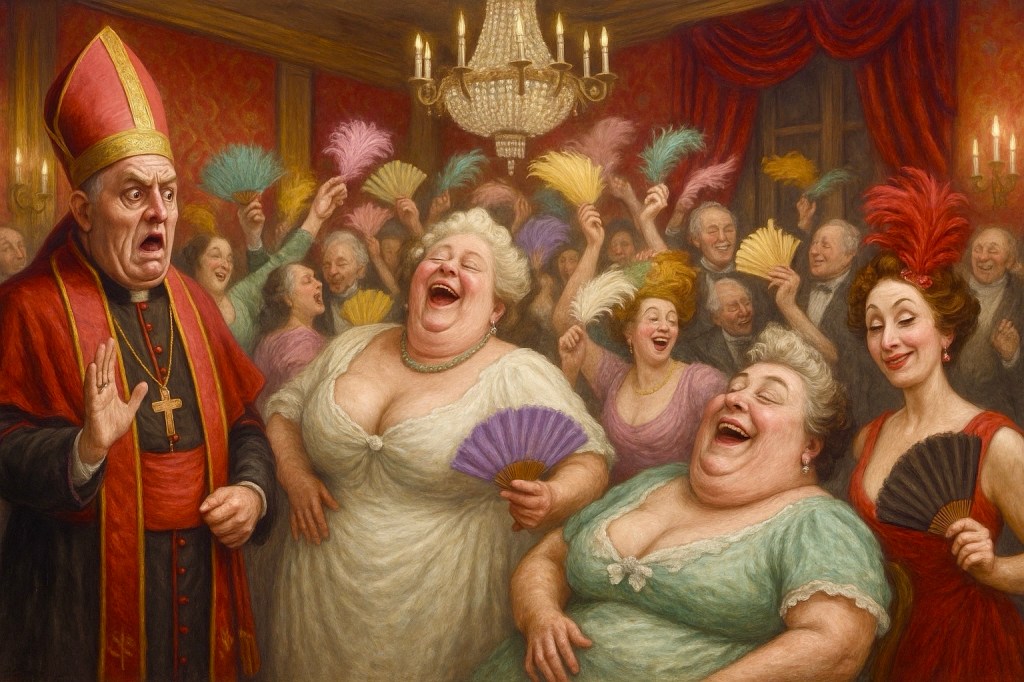
There are books that whisper. Books that purr. And then there’s Valmouth – a novella that arrives on the literary stage dressed in ostrich feathers and screaming “darling” before it’s even found its seat. If novels were guests at a country house, Valmouth would be the one caught kissing the butler, flirting with the vicar, and insisting that everyone join in an impromptu séance before sherry.
Ronald Firbank, its author, writes not so much in sentences as in arch sighs. Every phrase is a painted eyelash; every paragraph a fan flutter. His prose is like rococo architecture got drunk on vermouth and started gossiping about its neighbours. He does not describe – he intones. He does not construct – he embroiders. And the result is so decadent it should come with a health warning for those allergic to irony or whimsy.
In Valmouth, language is the leading lady, and she demands your attention. The characters? Mere figments. The plot? Secondary. The real star is the style, and oh, what style. It teeters on the brink of nonsense like a duchess in dangerously high heels, yet never quite falls. It’s all a bit like being invited to a tea party where the cakes are made of lace, the tea is laced with something scandalous, and no one can quite recall why they came – but they’re terribly glad they did.
The atmosphere Firbank conjures is part decaying seaside resort, part mythic Arcadia, and part drag revue held inside a retirement home for Grecian urns. And though he writes with all the gravity of a helium balloon, don’t be fooled. Beneath the glitter and chiffon lies something oddly sincere: a reflection on ageing, desire, race, faith, and the social theatre of propriety so absurd it practically trips over its own hem.
To read Valmouth is to be seduced by syntax. It’s Wilde after three too many sherries, Austen in a feather boa, the Book of Common Prayer rewritten by someone who’s never said a prayer in their life but has certainly been to all the best garden parties. It’s not so much camp as a fully fortified hamlet of rococo queerness, perched on the edge of satire and hallucination.
Let’s put it this way: if you like your prose served dry as a communion wafer and twice as solemn, go elsewhere. But if you’re the sort of reader who likes to be tickled, teased, and occasionally scandalised by the mere placement of a semi-colon – this is your book. You won’t understand all of it. You’re not meant to. Understanding is secondary to the experience, which is equal parts salon, pantomime, and reverie.
In short?
Valmouth is what happens when English literature eats too many fondant fancies, sees God, and then invites Him to an orgy. It’s pure, uncut Firbank: frothy, fearless, and entirely unbothered by your need for linearity or restraint.
Take it with a cocktail and a raised eyebrow. That’s the only way.
I’m sure you enjoyed this? If you didn’t, you can still Buy Me a Coffee. It won’t hurt. Much.

 Wording
Is this writer still alive?
Sadly no. He died in 1926. Only forty years old too. Very sad.