“Great Pan is not dead, but sleeping; and the reed shall sound again at the hour of need.” – Adapted from Plutarch
It’s a curious feature of English children’s literature that its most enchanting works are often its most subversive. Carroll slipped logic puzzles and ontological riddles into Alice; Tolkien smuggled Catholic theology into hobbit burrows; and Grahame, in the middle of his anthropomorphic frolic by the river, inserted a chapter of pure pagan revelation. The Piper at the Gates of Dawn is the chapter of The Wind in the Willows that doesn’t quite belong – and therefore belongs most of all.
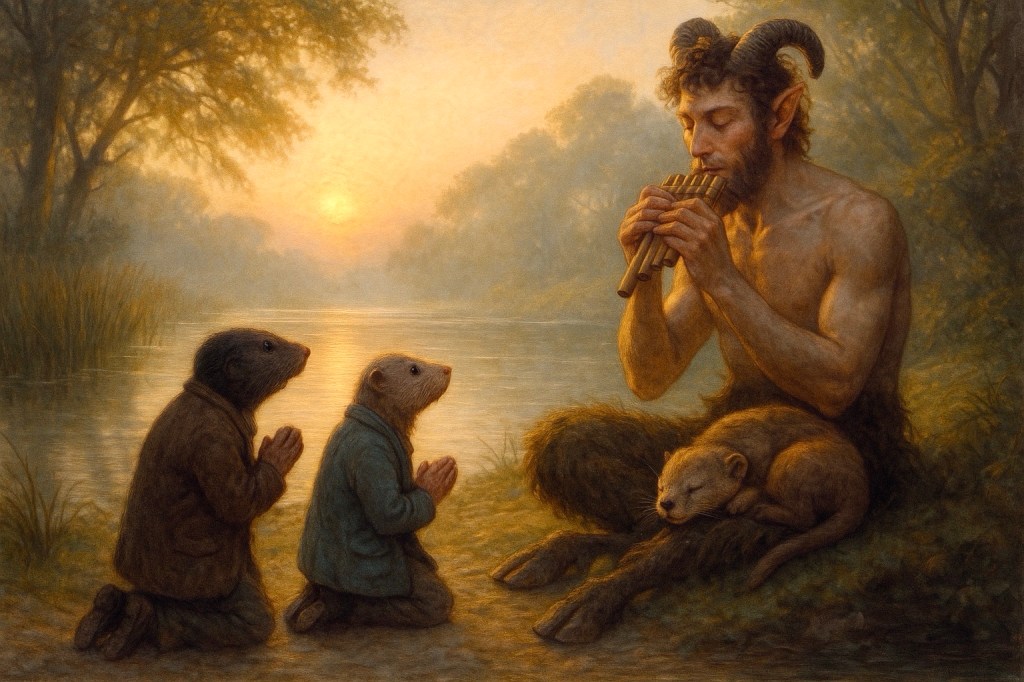
On the surface, it’s about a lost otter cub, Portly. Rat and Mole set out to find him. Yet in their search, they encounter not merely a lost child but the god of lost children. In the glade by the river they see Pan – ‘The Friend and Helper’ – playing his pipes, the otter asleep at his feet. The prose is heavy with biblical cadence: awe, fear, reverence. Mole and Rat are overcome, fall down in trembling joy, and afterwards forget, as if struck with holy amnesia.
Why Pan? And why here?
Pan’s the most ambivalent of gods. He’s half-man, half-goat, dwelling not in Olympus but in the wild margins – the reeds, the caves, the untamed forests. He’s both protector and terror. From his name we inherit our word panic – that sudden, irrational fear said to seize men who wandered into his territory. To encounter Pan was to experience the uncanny: the heart racing, the knees trembling, the inexplicable dread of something greater than oneself. Yet Grahame transforms this terror into tenderness. His Pan isn’t frightful but consoling. Instead of sowing panic, he brings peace. This is a theological sleight-of-hand – Grahame baptises Pan into a Christlike figure.
And yet, the ambiguity remains. If Pan’s the protector of the small, he’s also the one who erases memory. Rat and Mole can’t carry the revelation back into the daylight. Like the disciples dazzled at the Transfiguration, they descend the mountain unable to retain the glory. As with Proust’s madeleine, the eternal flares up, then vanishes. Memory itself becomes porous; transcendence leaves no trace but longing.
Here lies the chapter’s kinship with William Blake, who held that childhood was the realm of vision, when angels perched in trees and lambs were sacred emblems. Grahame’s Portly – the otter child – sleeps soundly in the arms of divinity, while the adult Rat and Mole must strain to comprehend, only to forget. It’s Wordsworth’s Intimations of Immortality once more: the child’s nearer the eternal, while the grown-ups struggle under ‘shades of the prison-house.’
But Hardy, that old Dorset fatalist, lurks too. Hardy often filled his novels with pagan echoes – Egdon Heath in The Return of the Native being a character older than Christianity, a landscape still loyal to forgotten gods. Grahame’s Pan is cut from the same cloth: a survival of old faiths, lurking beneath Anglican respectability. One half expects the village parson to come bustling in, declaring it all ‘unsound.’ Perhaps this is why publishers omitted the chapter: its theology was neither Sunday-school nor strictly mythological, but something unsettlingly in between.
Why then was this chapter removed in so many editions? Because it was too much – too strange, too overtly mystical. Edwardian parents and publishers wanted motorcars and picnics, not goat-footed gods in moonlit glades. To give Pan a holy tenderness was, to their ears, perilously close to blasphemy: after all, the horns and hooves of Pan had long since been co-opted into Christian iconography as the Devil’s. Better, they thought, to excise the unsettling chapter than risk letters to the editor.
There was also the problem of tone. The rest of The Wind in the Willows is bucolic comedy: picnics on the river, pompous toads in tweeds, Badger’s gruff common sense. Suddenly, in Chapter Seven, we are confronted with biblical cadences, visionary light, and a revelation that dissolves into forgetfulness. For children eager to see what calamity Toad would cause next, this mystical interlude must have seemed slow and baffling. Adults recognised its weight; children often skipped ahead.
So the chapter wasn’t omitted for weakness, but for excess. It was too numinous, too rich, too far beyond the Edwardian nursery. The irony is that this very excess is what makes it indispensable – the jewel in the crown of Grahame’s riverbank kingdom.
And if we press further, we find Spengler’s shadow. The Wind in the Willows was published in 1908, just before Europe shattered itself in war. Spengler, in The Decline of the West, would later argue that civilisations exhaust their sacred visions, descending into mechanised pragmatism. How striking, then, that in Grahame’s book the numinous erupts in the middle of bourgeois Edwardian gentility – only to be forgotten! The Piper at the Gates of Dawn is precisely the kind of fleeting, twilight revelation Spengler believed haunted civilisations before their decline: the last flare of myth before the motorcar and the factory drown it out.
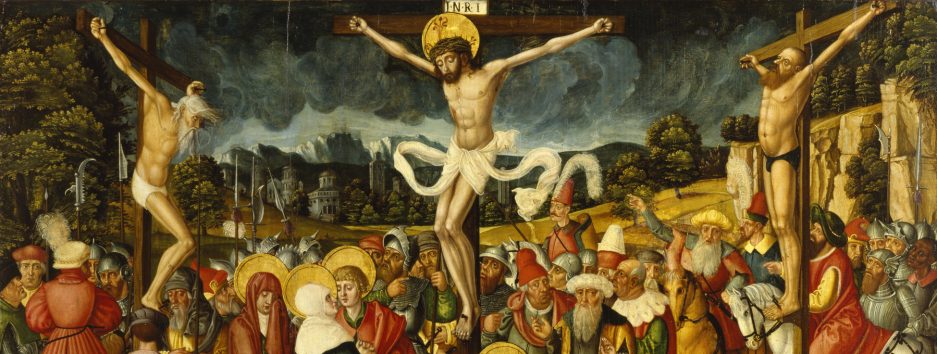
The chapter also touches upon that strange Christian rumour: the Great Pan is dead. Plutarch tells the story of a sailor who heard a divine voice proclaiming Pan’s demise at the time of Christ’s crucifixion, as though the birth of the Gospel meant the death of the old gods. Yet here’s Grahame, centuries later, resuscitating Pan not as rival but as companion to Christ. His Pan is no enemy but a shepherd, a bridge between the old and new. He’s both pre-Christian and post-Christian, slipping between categories, half-remembered and half-forgotten, like the dream itself.
So what are we left with?
Without The Piper at the Gates of Dawn, The Wind in the Willows is delightful but shallow – a comedy of animal society, charming as tea and crumpets. With it, the book is transfigured. Suddenly the riverside isn’t merely English landscape but holy ground. Suddenly Rat and Mole aren’t just comic friends but pilgrims. Suddenly the tale of Toad becomes framed by a deeper rhythm: folly below, mystery above.
And we, the readers, are made like Rat and Mole. We glimpse the divine, but it fades. We close the book, smile at Toad’s antics, and half-forget that for one chapter we were in the presence of a god. Yet the forgetting itself is part of the design. Grahame knew that revelation is never permanent. It’s a tune heard at dawn, before the clamour of the day.
If Blake taught us to see eternity in a grain of sand, Grahame showed us Pan in the fur of an otter cub. And if Hardy muttered that the old gods never quite died, Grahame smiled and proved him right. The Piper still plays by the river, though we forget the melody.
And perhaps that’s the deepest truth of the missing chapter: that we’re always one step away from panic – in both senses of the word. One step from terror, one step from transcendence. One heartbeat from dread, one heartbeat from awe. The difference is only in the tune the piper chooses to play.


