Tolstoy was always the moralist disguised as a storyteller. He couldn’t so much as describe a hayfield without planting in it a parable, and How Much Land Does a Man Need? is among his most ruthless little lessons. At its heart, it’s an absurdly simple tale: a peasant named Pahom believes that with just a little more land, he could at last rest content. The devil overhears this boast and, like all good tempters, need only sit back while human folly digs its own pit.
The story advances as steadily as Pahom’s footsteps. First, he buys a little land, then a little more, then quarrels with neighbours, then travels farther afield, always convinced that this next field, this next pasture, will finally silence the gnawing hunger within. There’s a bitter comedy here, for Pahom isn’t driven by necessity – his barns are full enough, his belly content – but by envy, that ancient weed which choked Cain’s heart long before it grew in the steppes of Russia. He’s the archetype of man who mistakes acreage for assurance, forgetting that death has no use for boundary stones.
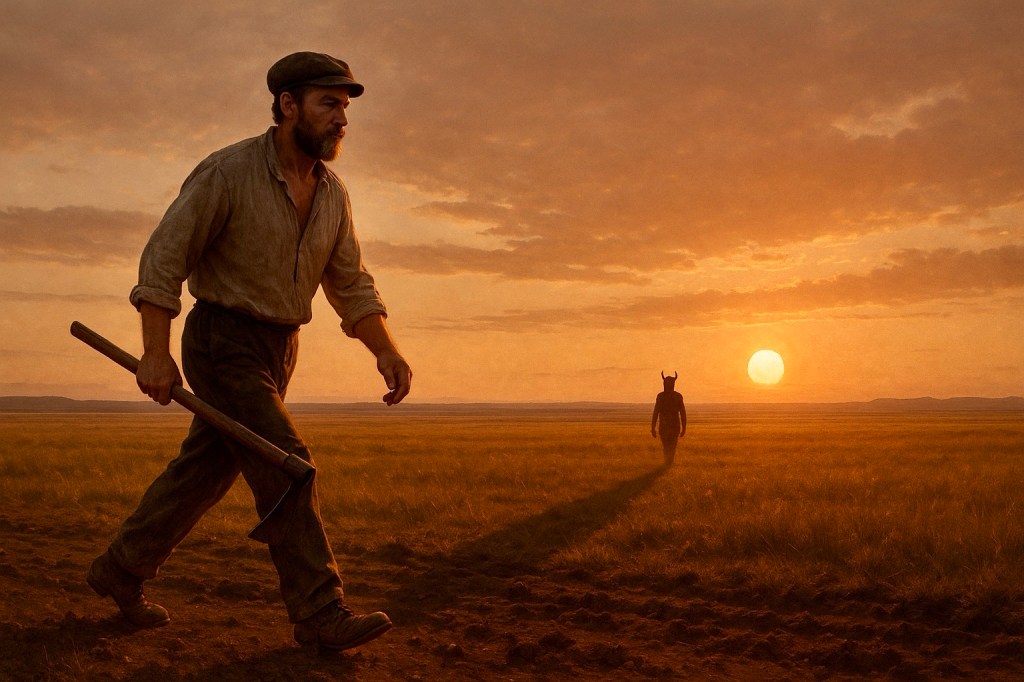
Tolstoy leads us to the Bashkirs, who promise Pahom as much land as he can encircle in a single day’s walk. The conditions are almost laughably generous: set out at dawn, mark your circuit, and return before sunset. I can almost hear the reader muttering: ‘Surely he’ll be satisfied with a modest square.’ But no, for greed is a treadmill; every step forward is but an invitation to the next. Pahom strides out further, each horizon promising fertility, each step mortgaging his strength. By noon, his greed has drawn a line far too wide for his body to redeem.
And so the tragic punchline arrives: he reaches the starting point at sunset, staggers, and falls dead. His servant digs him a grave – six feet from head to heel. That’s all the land he needs. Tolstoy closes the book on him with the finality of a coffin lid.
What does the tale tell us? That the human condition isn’t measured in hectares but in heartbeats. The Stoics would nod grimly: Seneca warned that ‘it is not the man who has little, but he who desires more, that is poor.’ Scripture is no less blunt: ‘For what shall it profit a man, if he shall gain the whole world, and lose his own soul?’ (Mark 8:36). Even Shakespeare, no stranger to vaulting ambition, might look upon Pahom and think of Macbeth, striding towards a horizon of crowns only to meet his own six-foot fate.
There is, too, a note of comedy in Tolstoy’s parable. The devil never needs to lift a claw; he simply watches Pahom self-destruct. It’s a Russian variation on the cosmic joke: that man’s quite capable of damning himself by sheer appetite. Pahom runs himself to death chasing what he already had – security, sufficiency, a home. It’s as if one set out to find paradise and perished in the orchard behind one’s cottage.
Tolstoy himself, by this time, was abandoning the grand estates of Yasnaya Polyana for the simple shirt and sandals of a Christian ascetic. He was already a man disgusted with wealth, with privilege, with the glittering disease of the modern world. How Much Land Does a Man Need? was his whispered epitaph for civilisation itself: we build empires, dig canals, buy railroads, and annex continents, only to be finally contained by six feet of earth.
In the end, Pahom is us, and the Bashkirs’ bargain is the same one whispered daily in supermarkets, stock markets, and social media feeds: ‘Take more, it’s yours if you can only carry it.’ And we, like fools, shoulder more than we can bear until the sun dips and we collapse. Tolstoy’s parable isn’t a tale of land but of limits – the ultimate limit being the grave.
How much land does a man need? Just enough to lie down in when all the striding is done. The rest is vanity, acreage measured in dust.

 Wording
I plan on being cremated, so I don’t need even that much 😉
Ah, but you may want your ashes buried? 😁
I’ve already instructed Mrs B to flush me. Whether she’ll do that is another matter 🙂
Mrs B may find flushing easier said than done – you’ll probably haunt the U-bend for eternity. 😁
Considering we’re 7th day adventists and believe in soul sleep, we don’t have to worry about that haunting bit 😀
Fair point! Though if Hamlet’s father had been a Seventh-day Adventist, Shakespeare would have been robbed of a ghost. 👻