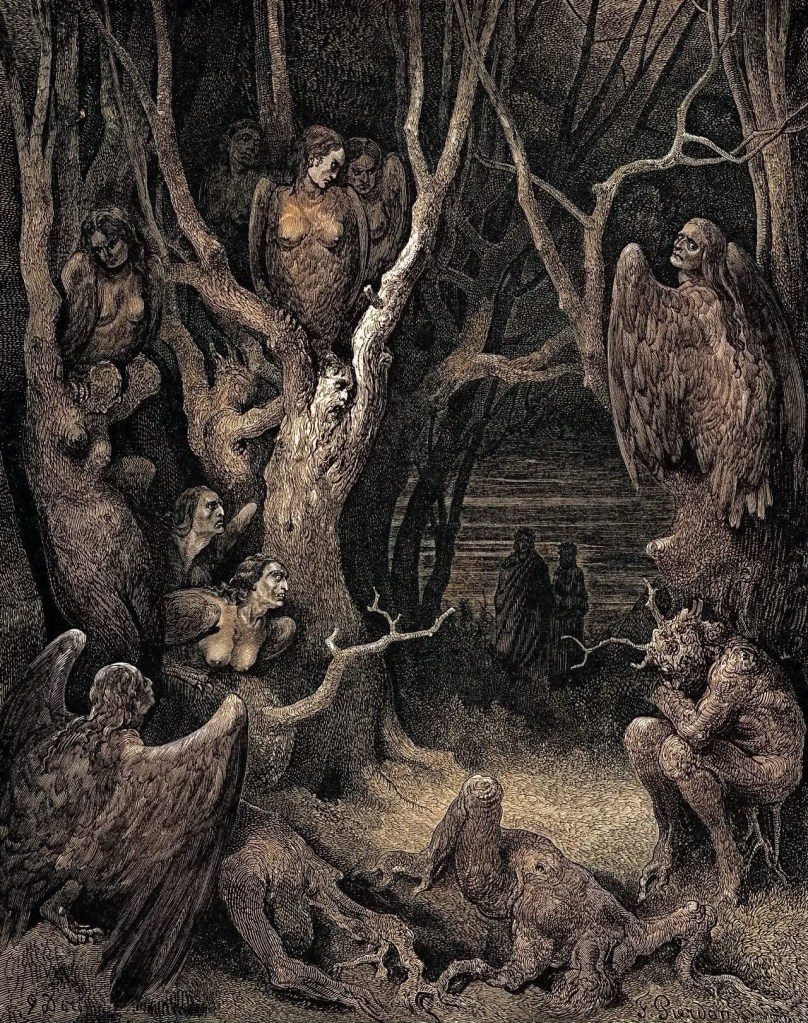
Gustave Doré, Inferno, Canto XIII: The Forest of Suicides, 1866.
Wood engraving for Dante Alighieri’s The Divine Comedy (public domain image).
When I first looked at Doré’s Forest of Suicides, I thought of winter trees after a storm – those half-living skeletons that creak when the wind passes through, as if remembering they were once alive. But in Doré’s forest the trees don’t merely remember; they bleed. Each trunk is a person who denied their own body, and so was forced to keep it – in arboreal parody – for eternity.
Dante’s Inferno, Canto XIII, is one of the few places in literature where metaphysics and flesh share the same wound. The damned haven’t been stripped of form but transfigured into it, and Doré renders this idea with almost surgical pity. The boughs twist like sinews, their bark as thin as skin, and from their knots emerge faces in the act of recognition – those dreadful seconds before a scream. It’s as though the forest itself has grown nervous tissue.
The harpies – those miserable hybrids of woman and vulture – perch on the branches, tearing at the souls below. Their wings are rendered in strokes that seem to rustle; their eyes gleam with an intelligence that’s neither human nor bestial, but punitive. I’ve always found them more tragic than monstrous. They devour not for pleasure but for purpose – like memories that peck at the mind long after the heart has given up. They’re conscience with feathers.
In the right-hand corner sits one of the condemned – Pier delle Vigne perhaps – his face resting on a wooden hand, forever contemplating his own ruin. He’s what happens when despair turns contemplative. And in the far distance, Dante and Virgil stand like two shadows of the living, surveying the slow calamity of souls that couldn’t bear to be themselves. Their silhouettes are the only things untouched by bark or feather, yet they seem out of place in the living world too.
Doré, ever the Romantic realist, gives damnation the texture of empathy. There’s no moral sneer here. His trees suffer as only those who’ve once been human can suffer. Each line is a nerve ending; each knot a confession. The artist, I suspect, saw in this canto something more than medieval theology – he saw psychology. The modern condition before modernity.
When Dante asks one of the trees how he fell into such torment, the reply’s almost domestic in its simplicity: betrayal, envy, honour lost – all the old causes of human ruin. I find it unbearable in its ordinariness. There’s no satanic grandeur, no Faustian flourish. Just the weariness of someone who looked at life and found it a poor bargain.
And that, perhaps, is the true terror of this forest: not that its trees bleed, but that they still care. They still answer questions. They still feel the pain of being broken. To take one’s own life, Dante implies, is to wound nature itself – to drive a stake through the very fabric of being – and nature remembers.
Looking at Doré’s engraving, I’m reminded of something Augustine once wrote: ‘To run from yourself is to chase a fugitive that cannot flee.’ The suicides ran – not into death, but into form. Theirs is the most ironic immortality imaginable: the eternal return of feeling.
And yet, I can’t condemn them. I’ve seen the forest of the mind where these trees grow – I’ve been in that forest. It’s that half-lit region where despair pretends to be philosophy, and silence masquerades as peace. One need not die to walk there; one only needs to lose hope for a while.
Doré shows us that punishment and pity are two branches of the same tree. His harpies are despair’s angels, his trees the anatomy of regret. The entire scene hums with that quiet, inexorable law that no sin is final – for even here, in Hell’s cruel grove, life persists. The bark still bleeds, the heart still stirs, the soul – though damned – still responds to a touch.
Perhaps that’s why I love this picture: it’s the most human image in all of Hell.

 Wording