For years I dreamt of a house that hated me. It wasn’t merely haunted — it was hostile. Its walls bowed with resentment, its staircase groaned in complaint, and the air inside was the colour of rot. Every visit was the same: I would wander through its ruined corridors, knowing instinctively that one door was forbidden. Behind it, something waited — not patiently, but with purpose.
The dread wasn’t cinematic. It was chemical. A low hum in the bones. I would stand before that door and feel my mind recoil as though from heat. Once or twice I tried to turn the handle, and even in sleep I remember the taste of terror — metallic, electric, ancient. Whatever lay beyond that door was no mere ghost. It was malevolence itself, distilled and watching.
I used to wonder what would have happened if I’d stepped inside. Perhaps I’d have found my own reflection, distorted and grinning — my accumulated sins with a key round its neck. Perhaps it was the geography of hell, or worse, the architecture of my own soul.
In time, the dream stopped coming. I don’t know whether the house collapsed or I finally escaped, but I sometimes fear it still stands — somewhere in the fog of the unconscious, waiting for my return. There are nights I sense it calling, faintly, like a dog howling behind distant walls. And then I remember E. F. Benson’s The Room in the Tower, and I realise that the door we fear most to open is often the one that already knows our name.
There are few things more unnerving than the moment one realises a dream has made the first move into reality. Déjà vu may be dismissed as a neurological hiccup, but there’s a deeper chill in the thought that a dream might have been waiting for us — patient, predatory — all along. Such is the quiet horror of E. F. Benson’s The Room in the Tower, a story that doesn’t scream; it simply exhales a breath of dread across the soul.
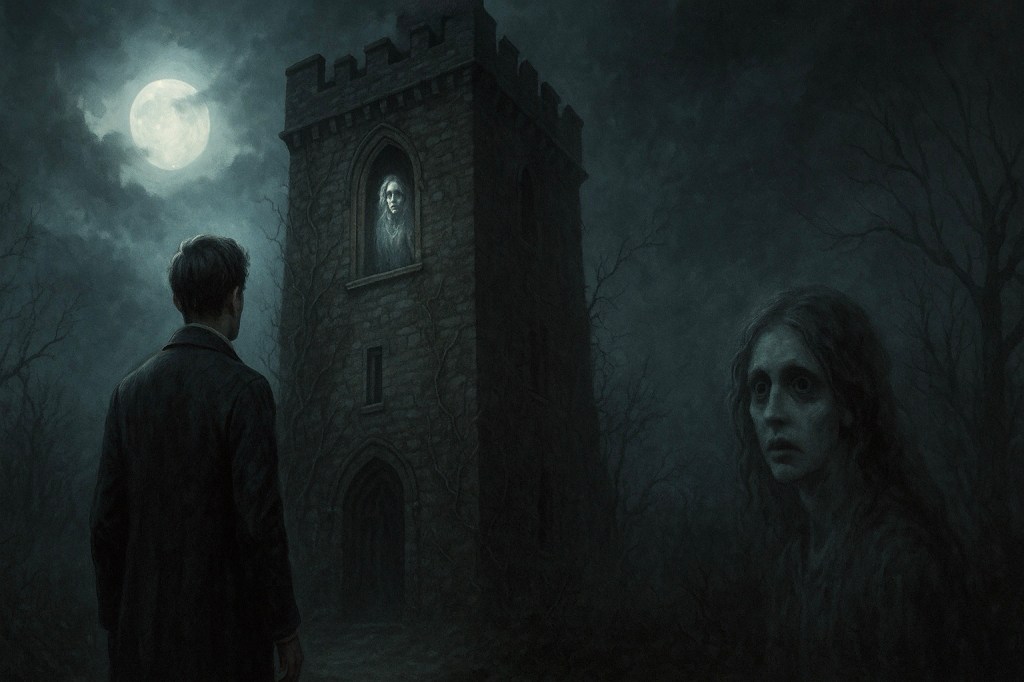
The tale begins in the gentlest of settings: an English country house, all teas and tennis lawns, where one might expect a vicar’s niece to play the piano and the only ghost to be gout. But our narrator has for years been haunted by a recurring dream of this same house — always ending with the words, ‘Jack will show you your room — the room in the tower.’ As the years pass, the dream decays. The faces grow older, the sky darkens, and the laughter thins to silence. By the time he meets the house in waking life, the reader feels the dreadful gravity of destiny: he’s stepping into a dream that’s been rehearsing his arrival.
Benson’s genius lies in restraint. The horror seeps through atmosphere, a brief apparition. A little blood, no screams, no overripe adjectives. Only the cold geometry of inevitability: the tower, the portrait. When the narrator finally lies in that cursed bedchamber, it’s not a ghost that comes for him but a presence that has been waiting — as if the dream itself has teeth.
Unlike M. R. James, whose scholarly phantoms rustle manuscripts, Benson’s ghosts emerge from the psychology of guilt and premonition. The terror isn’t only external but inward — the mind’s own conspiracy against itself. The dream becomes a prophecy, and prophecy a trap. What more exquisite punishment for modern man than to be devoured by his own imagination?
Mrs Stone, the spectral hostess of the tower, embodies a peculiarly English strain of evil: polite, perfumed, and patient. There’s a whisper of vampirism about her — though not the Transylvanian kind, but that domestic sort which drains life with a smile and a cup of weak tea. She’s the revenant of social suffocation, the ghost of drawing-room nicety, pressing her cold kiss upon the cheek of reason.
In The Room in the Tower, Benson gives us a theology of dread: the idea that hell isn’t a place, but a repetition. The dream that returns, the house that waits, the room that will always be ready. Eternity, he seems to suggest, isn’t fire but recurrence without release — the horror of having nowhere new to go.
So the next time you wake in a sweat from a nightmare, take comfort: at least it hasn’t yet sent you a formal invitation. And if ever a smiling host says, ‘You’ll be sleeping in the room in the tower,’ my advice is simple — politely decline, and take the sofa instead.
The Dream That Waits for Us All
Perhaps every soul carries a house within it — one built not of brick and beam but of memory and omission. We spend our lives wandering its corridors, unlocking rooms we had long forgotten, dusting off relics of who we once were. Some doors open to laughter; others to the smell of old grief. And somewhere, always, there’s one door that refuses us entry.
In youth we fear that the thing behind it is evil; in age we suspect it is truth. Either way, it waits. Perhaps, when our waking life falls silent, we finally open it and step through — not into punishment, but into recognition. For the soul, like a house, must one day be fully explored.
Benson’s tower is only a model of that greater edifice: the mind itself, haunted by its own unentered rooms. The true terror of The Room in the Tower — and of my own dream — it isn’t the ghostly figure waiting inside, but the possibility that she’s us, long unacknowledged, patiently knocking from the other side of the door.

 Wording