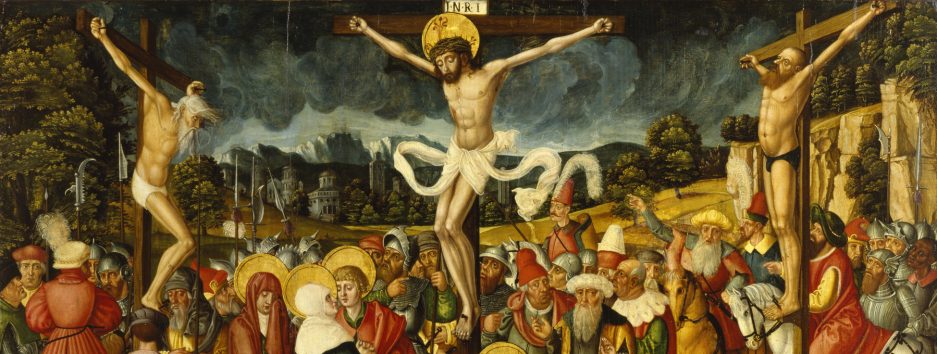
after Helen De Borchgrave’s A Journey Into Christian Art
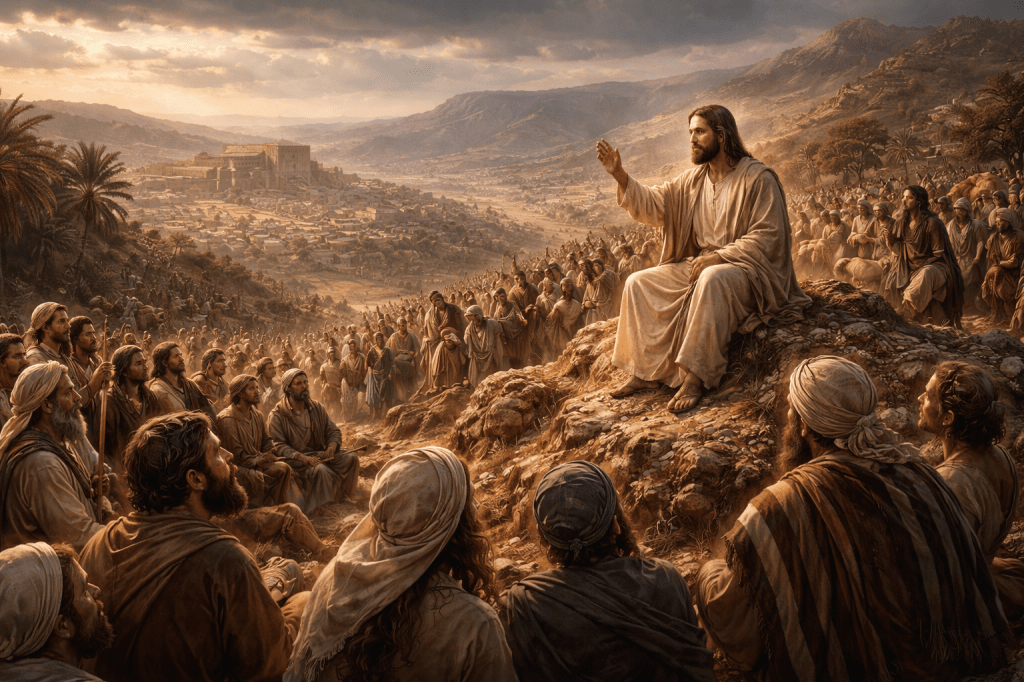
There are some errors, those plush little falsehoods, that sit in the drawing room of the modern mind, sipping tea and nodding along to themselves. They’re not lies, exactly. Lies require intention. These are something worse: assumptions so thoroughly digested that they pass for fact, like a parish rumour mistaken for scripture.
I came across such an error — no, such a bouquet of them — in a passage from A Journey Into Christian Art by Helen De Borchgrave, a work otherwise earnest in its intention, and rather too relaxed in its geography.
We’re told that Christ was born in ‘Palestine.’
Now, I must be careful not to become pedantic — though I confess it’s one of my better sins — but this is rather like saying Napoleon was born in the European Union. It isn’t merely inaccurate; it’s chronologically illiterate. The land into which Christ was born was Judea, a tense and twitching province under Roman oversight, governed in uneasy arrangement with the ghost of Herod’s ambitions still rattling in its bones. ‘Palestine,’ as a formal Roman designation, wouldn’t appear until over a century later, when Emperor Hadrian, in a fit of imperial irritation, attempted to erase Jewish identity from the map following rebellion.
To retroactively baptise Christ into ‘Palestine’ isn’t merely an error — it’s a quiet act of historical vandalism, the past rearranged to suit the furniture of the present.
But on we go.
We’re told that Christ was born ‘into the Graeco-Roman world,’ which is true enough, though it’s the sort of truth that says very little while sounding terribly clever. I imagine it delivered with a slight nod, as though one has just explained the entirety of civilisation with a hyphen. Yes, the world was Graeco-Roman — but Christ Himself was neither. He was a Jew among Jews, speaking Aramaic, living within the dense theological and ritual life of Second Temple Judaism — a world far less interested in Plato than in prophets, far less concerned with Stoic detachment than with covenantal fire.
To place Him vaguely in a ‘Graeco-Roman world’ is to blur Him, like a figure in the background of a Renaissance fresco — present, but curiously diluted.
Then comes the Pax Romana, that favourite darling of textbook historians and dinner-party classicists. We’re told it was ‘accomplished by Augustus,’ and that Christ was cradled within it. There’s a certain poetic appeal here — Rome, having conquered the world, prepares a peaceful stage for the Prince of Peace. A neat symmetry. Almost too neat.
The difficulty, of course, is that Judea wasn’t exactly reclining in a deck chair sipping imperial tranquillity. It was a land bristling with sectarian tension, prophetic expectation, and the ever-present threat of revolt. Rome’s peace was less a lullaby and more a hand on the throat — firm, effective, and always ready to tighten. If this was peace, it was the peace of the graveyard: orderly, silent, and achieved at considerable cost.
And then — ah, then — we arrive at the most modern of habits: the smoothing over of violence with the balm of sentiment.
Christ, we’re told, was condemned on ‘trumped-up charges.’
Now here we must tread carefully, for the temptation to defend Christ by softening His death is a perennial one. But history, like a good undertaker, prefers its facts unembellished. The charge, insofar as Rome was concerned, was sedition. ‘King of the Jews’ wasn’t a theological curiosity; it was a political provocation. Rome didn’t crucify men for abstract philosophy. It crucified them for threatening order.
To call the charges ‘trumped-up’ is to impose a modern courtroom drama upon an ancient imperial machine. Pilate wasn’t presiding over a miscarriage of justice in the contemporary sense; he was performing a calculation. Stability over truth. Order over innocence. The sort of decision, I suspect, that’s never quite gone out of fashion.
And yet — despite all this — we’re told that Christ died ‘for love.’ Which, paradoxically, is the one statement that is both the least historical and the most true.
Here the historian must fall silent, and the theologian — if he has any courage — must step forward. For love isn’t a datum. It can’t be excavated, carbon-dated, or footnoted. It’s either believed or it’s not. And in that sense, the passage redeems itself by accident, like a sinner who stumbles into grace while looking for the exit.
Finally, we’re presented with the Resurrection and Ascension as though they were items on a historical ledger — events to be ticked off alongside the reign of Augustus and the tenure of Pilate. But here again, the tone betrays the tension of the modern religious writer: the desire to sound both faithful and factual, devotional and documentary. The truth is far more unsettling.
The Resurrection isn’t a historical conclusion — it’s a claim that shattered history. It didn’t politely “herald a new era”; it tore the old one open like a veil in the Temple. The earliest Christians didn’t speak of it as a gentle transition into improved spirituality. They spoke of it as an earthquake in reality itself — a dead man who refused to remain so, and in doing so, rendered the entire philosophical architecture of the ancient world rather… provisional. And perhaps this is the real issue with the passage. It’s too tidy. It arranges Christ neatly within categories — geographical, political, cultural — as though He were a figure to be understood rather than a force to be reckoned with. It places Him safely within ‘Palestine,’ comfortably within the ‘Graeco-Roman world,’ gently within the ‘Pax Romana,’ and sentimentally upon the cross ‘for love,’ as though the whole affair were a well-curated exhibition rather than the violent rupture of eternity into time.
But Christ doesn’t sit comfortably. He intrudes. He disrupts. He refuses to belong to the categories we build for Him, just as He refused the kingdoms offered to Him in the wilderness. To misplace Him geographically is almost forgivable; to domesticate Him conceptually isn’t.
For in the end, the greatest inaccuracy isn’t the word ‘Palestine,’ nor the softening of Roman justice, nor the polite handling of resurrection. It’s the suggestion — subtle, almost invisible — that Christ can be explained.
And that, if anything, is the one error history has never managed to correct.


