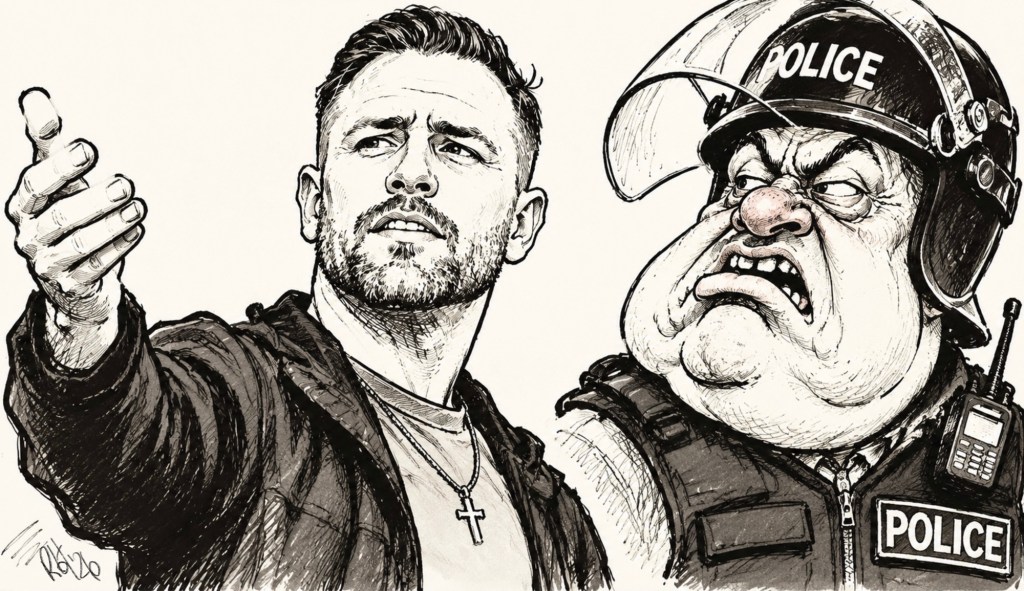
Fifteen months. That’s the sentence handed down to Danny Tommo, and apparently we’re all supposed to nod solemnly, accept that justice has been done, and get on with our lives. Nothing to see here, ladies and gentlemen. Move along. Except I find the whole business deeply troubling and, frankly, it makes me angry.
Before somebody starts sharpening their keyboard and accusing me of defending criminal damage, let me make something perfectly clear. I’m not suggesting that the law should be ignored or that people ought to be exempt from its consequences. If somebody breaks the law, there must be accountability. That much is obvious. But accountability and proportionality are not necessarily the same thing, and I find myself returning to one question that I believe deserves a serious answer: would an otherwise comparable defendant, without Danny Tommo’s political profile, have received the same fifteen-month sentence?
I don’t think that’s an unreasonable question. Danny Tommo is not an anonymous figure who has wandered into a courtroom. He’s a political activist, outspoken, controversial and associated with a movement that provokes strong reactions. His views and activities are well known, and it would be naive to imagine that those involved in the wider proceedings were entirely unaware of his public identity. Whether that identity influenced the outcome is another matter altogether. I cannot know that, and I wouldn’t pretend otherwise. But the possibility is something I believe ought to be examined rather than dismissed simply because it makes people uncomfortable.
There is, after all, an important distinction between justice and punishment. Justice demands proportion, consistency and impartiality. It requires that the person standing in the dock is judged for what he has done, rather than what he believes, whom he associates with or how thoroughly he irritates those in authority. I understand that the court considered the circumstances of the offence, including interference with a rescue operation. Those are serious matters, and I have no wish to minimise them. Nevertheless, fifteen months is a substantial custodial sentence, and I would like to understand how that figure was reached, what comparable cases tell us and whether the punishment is consistent with the treatment of others whose offences involved similar circumstances.
Then there is the familiar insistence that we mustn’t make these things political. Oh, splendid. Apparently declaring something non-political is sufficient to make every concern about political influence evaporate. How wonderfully convenient. Yet such concerns cannot be resolved by declarations alone. They are best answered through evidence, transparent reasoning and the consistent application of the law. Public confidence in justice depends upon more than being told that justice has been done.
There is also a human dimension to this case that I find particularly distressing. Danny Tommo has four children, a partner expecting another baby and, according to his barrister, he is the family’s principal breadwinner, working as a roofer. The implications of his imprisonment therefore extend far beyond the individual standing before the court. There is a family facing the loss of its principal income, children facing the absence of their father and the possibility that another child will enter the world while its father is serving a prison sentence.
I’m not suggesting that parenthood should provide immunity from criminal punishment. That would be absurd, and it would create precisely the sort of unequal treatment that concerns me. But surely the consequences for dependent children and innocent family members deserve careful consideration when determining whether imprisonment, and particularly its duration, is proportionate. His children have committed no offence. His partner has committed no offence. Yet they will inevitably experience the consequences of the sentence, financially and emotionally. The empty chair at the dinner table, the missing presence during ordinary family life and the uncertainty surrounding the birth of a child are not insignificant matters. They are part of the human cost of imprisonment.
Of course, this is not unique to Danny Tommo. Countless families experience similar difficulties when a parent or partner is sent to prison. The courts must weigh such circumstances against the seriousness of the offence, the interests of justice and the need to protect the public. Nevertheless, recognising those competing considerations should encourage a serious discussion about proportionality rather than prevent one.
All of this brings to mind Charles Dickens, whose understanding of the absurdities and occasional cruelties of institutions remains remarkably relevant. In Oliver Twist, Mr Bumble, confronted with what he considers a ridiculous legal assumption, declares: “If the law supposes that, the law is a ass—a idiot.” It’s one of Dickens’ most memorable observations, not least because it captures that peculiarly human frustration of encountering a system whose reasoning seems entirely divorced from ordinary experience.
Dickens explored the relationship between law and justice even more profoundly in Bleak House, where the interminable proceedings of Jarndyce and Jarndyce become a devastating portrait of institutional self-absorption. The machinery of the law continues turning while the lives of those caught within it are gradually consumed. I’m not suggesting that our contemporary courts are equivalent to Dickens’ Court of Chancery, but the underlying warning remains important. The administration of justice must never become an end in itself, detached from the people whose lives it affects.
And perhaps this is what troubles me most. It is not simply the sentence in this particular case, but the wider question of public confidence in the institutions that are supposed to uphold the principles of fairness and equality. I have no desire to see judges bending to political pressure or popular opinion. Indeed, an independent judiciary is essential to a free society. The last thing we need is a legal system that takes its instructions from politicians, newspapers or angry crowds. What I want is something considerably more old-fashioned: the same law, the same standards and the same consideration, regardless of who happens to be standing before the court.
The same principle must apply to Tommy Robinson when he is sentenced. His case involves different allegations and different legal considerations, and it would be wrong to presume an outcome before the court has reached its decision. Nevertheless, the underlying expectation remains unchanged. No individual should receive special treatment because of political popularity, nor should anybody receive additional punishment because their opinions are unpopular or controversial. Justice must be independent of both favour and hostility.
I love this country. Its history, its literature, its churches and its long traditions of liberty and justice are things I value enormously. They are part of the cultural inheritance that has shaped my understanding of what it means to live in a free society. Yet loving one’s country does not require unquestioning acceptance of everything done in its name. On the contrary, I would suggest that genuine affection for a country sometimes demands a willingness to question its institutions, particularly when confidence in them begins to weaken.
There’s an ancient biblical warning that seems especially appropriate here. Proverbs 20:10 tells us: ‘Divers weights, and divers measures, both of them are alike abomination to the Lord.’ It’s a wonderfully simple image, drawn from the everyday business of buying and selling. One set of weights for one customer, another set for somebody else. The injustice lies not merely in the outcome but in the dishonesty of applying different standards according to whom one happens to be dealing with.
The principle extends naturally to the administration of justice. The scales must not change according to the identity, reputation or political opinions of the person standing before them. They must remain balanced, consistent and impartial. That is not simply a legal aspiration but a moral obligation.
I’m not claiming to know that Danny Tommo’s political identity influenced his sentence. Such a conclusion would require evidence, and suspicion alone isn’t proof. Nor am I claiming that the circumstances of his offence were insignificant. But I am saying that a fifteen-month prison sentence, with all its consequences for the individual and his family, deserves careful scrutiny. If an examination of the sentencing guidelines, the judge’s reasoning and comparable cases demonstrates that the punishment was entirely consistent and proportionate, then that evidence should be acknowledged. If it reveals inconsistency, however, the public is entitled to an explanation.
Respect for the law cannot reasonably mean that the law is beyond criticism. Respect for the judiciary cannot mean that citizens must surrender their right to question judicial decisions. Indeed, a legal system worthy of public confidence ought to be sufficiently robust to withstand precisely that sort of scrutiny.
And so I return to where I began. Fifteen months. A family facing the consequences of imprisonment. An unborn child whose father may not be present at the birth. And a question that seems to me both reasonable and necessary.
Would an otherwise comparable defendant, without Danny Tommo’s political profile, have received the same sentence?
I don’t know the answer. But I believe we are entitled to ask, and entitled to seek one.
Because justice must not only be done. It must be seen to be done.
And the scales, above all else, must weigh equally for everyone.


