I’ve always liked old churches. There’s something about them that appeals to me. Perhaps it’s the history, or the sense that generations of people have passed through their doors, each with their own worries, ambitions, little triumphs and occasional disasters. And then, of course, there’s the churchyard. I can spend ages wandering around one, reading inscriptions, looking at the monuments and wondering about the people buried beneath them.
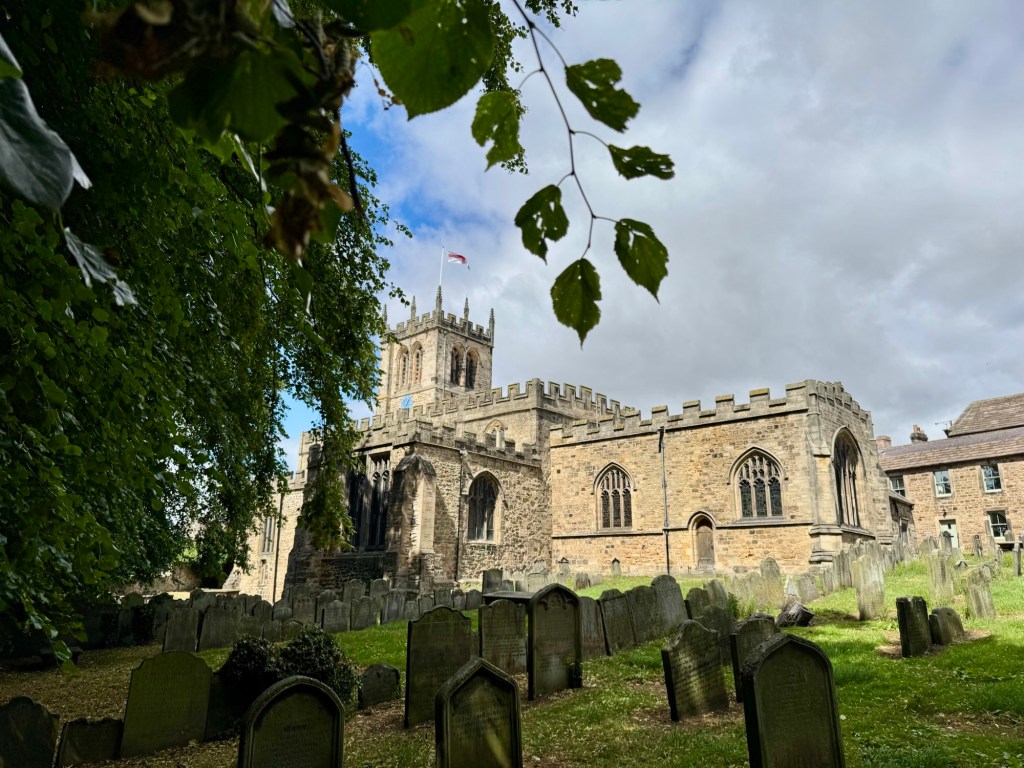
Which brings me to St Mary’s in Barnard Castle. Now, at first glance, it’s a perfectly ordinary-looking North-East market-town church. Lovely old stonework, a few trees, the usual collection of gravestones. The sort of place that’s probably witnessed more christenings than controversies. But this one has quite a history.
It was founded around 1130 by Bernard de Balliol, who was also responsible for establishing the castle that gave the town its name. Quite a busy fellow, really. Build yourself a castle, put up a church, and you’ve pretty much got the beginnings of a respectable medieval town. Although I imagine the planning permission was considerably easier to obtain in those days. Anyway, the church went about its business for the next few centuries. Baptisms, weddings, funerals, the odd disagreement in the churchyard, and all the usual comings and goings of parish life.
Then along came Richard, Duke of Gloucester. Yes, that Richard. The future Richard III. Now, Richard was Lord of Barnard Castle, and during the 1470s and 1480s he decided that St Mary’s could do with a bit of attention. And he didn’t just pop down to the medieval equivalent of B&Q for a tin of emulsion. Oh no. He had the walls heightened, introduced a clerestory to let more light into the nave, and commissioned a new chancel arch. He even had carved heads of himself and his brother Edward IV incorporated into the stonework. Which I suppose is one way of making sure everyone remembers who paid for the renovations.
He also left his famous white-boar badge on the south transept. Richard had rather ambitious plans for the place, including a college of twelve priests and a choir who would pray for the Yorkist family. Unfortunately, the Battle of Bosworth in 1485 rather spoiled those arrangements. It’s funny, isn’t it? All that power, all that money, all those grand plans for the future. And then along comes history and pulls the rug from beneath your feet. Richard’s been dead for more than five hundred years, but his alterations to this little church are still here. And I find that rather wonderful.
Although it does make me think about our present monarch, Charles III, and how much the role of kingship has changed. Richard lived in a world where the monarchy and Christianity were practically inseparable. Charles, on the other hand, has spoken about being a protector of the space for faith in a multi-faith country. Which is all very modern and accommodating, I suppose. But I do sometimes wonder whether the traditional title of Defender of the Faith has been given rather more of a makeover than Richard ever gave this church. Still, that’s another discussion.
Because the thing that really caught my attention wasn’t Richard’s handiwork at all. It was a tomb. And what a tomb it is.
Just outside the south door stands this enormous stone chest, the resting place of a young gentleman called George Hopper, of Black Hedley. George died on 30 March 1725. He was just twenty-three years old. Now, on one side of the tomb, there’s George himself. Or rather, a carving of him as he was in life. He’s wearing a rather splendid coat and a cocked hat, holding a rose, and looking every inch the fashionable young gentleman. Apparently, the figure was originally painted. Blue coat, yellow breeches, rosy cheeks. Quite the handsome young fellow, by all accounts. You can almost imagine him strolling around town, feeling rather pleased with himself.
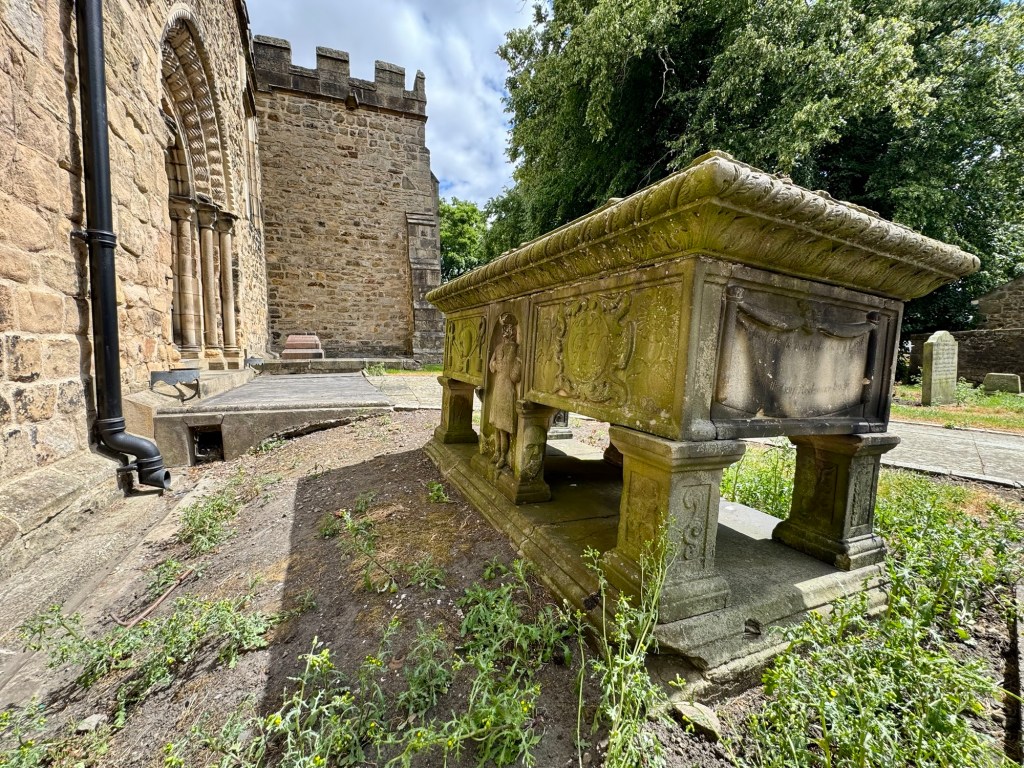
But then you walk around to the other side, and things take a turn. Because there, where the fashionable young gentleman ought to be, is a skeleton. Not just any skeleton, either. This one’s holding a scythe. The rose has gone. The fine clothes have gone. And George, for all his youthful elegance, has become a rather grim reminder of what awaits us all. The inscription makes the point perfectly clear: ‘Death cuts down all, both Great and Small.’ Well, there’s no arguing with that, is there? No exemptions. No special arrangements for the wealthy. No loyalty scheme where you collect enough points and get another twenty years. Death, it seems, is remarkably fair-minded.
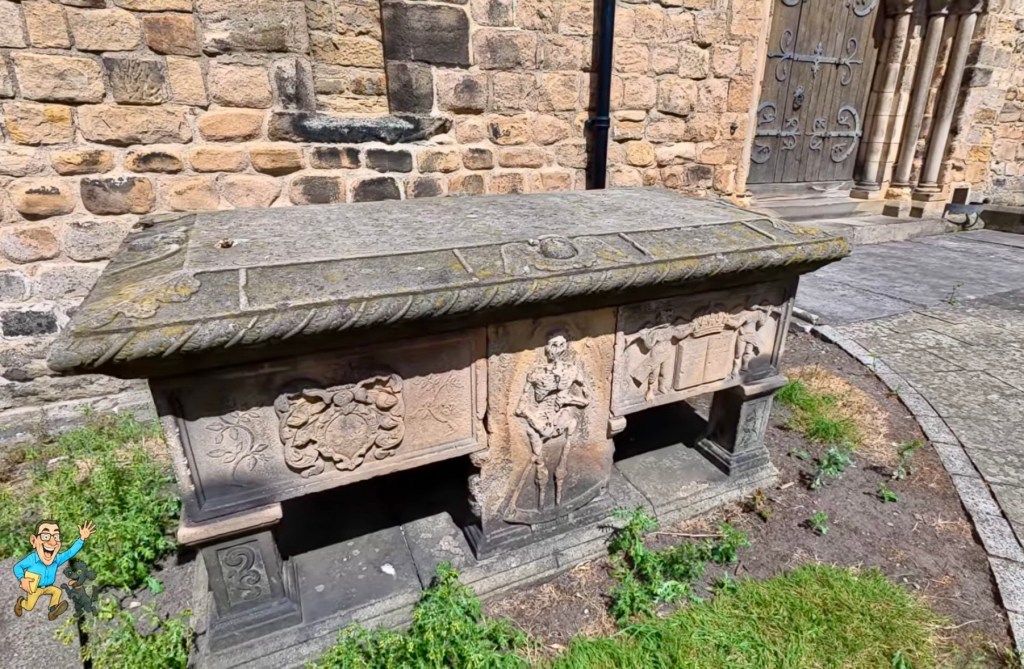
And this is what the old Christians called memento mori. Remember that you must die. Now, I know that sounds terribly gloomy, especially in an age when we’re all supposed to be thinking positively, eating blueberries and doing whatever exercises are currently fashionable to keep ourselves alive until we’re a hundred and twenty. But I’ve never really thought of memento mori as something depressing. Quite the opposite, actually. I think there’s something rather liberating about it. Because once you accept that your time here is limited, perhaps you begin to appreciate it a little more.
And I think that’s what George Hopper’s tomb is trying to tell us. On one side, you’ve got youth, fashion, confidence, the whole business of being alive. And on the other? Well, the inevitable. It’s almost as though the living George is saying, “Look at me. Look how splendid I am.” And the skeleton simply replies, “Aye. And look at you now.” Rather brutal, but effective.
Of course, there’s a Christian message here too. The monument includes angels and the crown of life, reminding us that death, in Christian understanding, isn’t necessarily the end of the story. And that’s an important distinction. The tomb isn’t simply saying that we’re all going to die, so we might as well give up. It’s asking us to think about what we’re doing with the life we’ve been given, and perhaps what lies beyond it.
Which brings me, rather unexpectedly, to philosophy. Because standing there looking at George and his skeletal alter ego, I found myself thinking about Martin Heidegger. Now, Heidegger wasn’t exactly known for his cheerful little observations about life. But he did write about something called being-towards-death. Essentially, the idea is that we only really begin to live authentically when we acknowledge that our lives are finite. And I think there’s something in that.
We spend so much of our time putting things off. I’ll do that next year. I’ll go there when I’ve got more money. I’ll tell that person how much they mean to me when the time feels right. I’ll start enjoying myself when I’ve sorted everything else out. And before you know it, another year has disappeared. Then another. And another. It’s extraordinary how quickly time passes, particularly as you get older. When I was twenty, sixty seemed practically prehistoric. Now that I’ve reached it myself, I find I’m not nearly as ancient as I once imagined. Although my knees occasionally disagree.
And then there’s Albert Camus, who approached life from a rather different direction. Camus was interested in the absurdity of human existence, and the problem of finding meaning in a world that doesn’t necessarily provide us with any obvious answers. But he wasn’t suggesting that we should simply surrender to despair. Quite the opposite. There’s something rather defiant in his philosophy. The idea that, even knowing how things end, we should continue living, experiencing, creating and finding whatever happiness we can. And I rather like that.
Because there’s something wonderfully absurd about George Hopper’s tomb. Here’s a young man, dressed in his finest clothes, holding a rose, looking as though he’s about to enjoy a very pleasant afternoon. And just around the corner, literally, is a skeleton waiting to spoil the occasion. It’s almost comical. Darkly comical, admittedly. But then, much of life is.
And that brings me to a poem. Andrew Marvell’s To His Coy Mistress. There’s a wonderful couple of lines in it:
‘But at my back I always hear Time’s wingèd chariot hurrying near.’
Now, Marvell was using the passing of time as part of a rather elaborate attempt to persuade a young lady into bed. So his motives weren’t entirely philosophical. But the point remains. Time is passing. And it’s passing whether we’re doing something worthwhile with it or not. I think George Hopper’s tomb is almost a stone version of Marvell’s poem. The rose, the fine clothes, the youthful confidence. And then the scythe. Time’s winged chariot has arrived, and it isn’t stopping for refreshments.
But here’s the thing. I don’t find any of this particularly frightening. Perhaps it’s because I spent so many years working with death that I’ve become accustomed to its presence. Not indifferent to it, certainly, but aware that it’s part of the ordinary business of being human. And perhaps that’s why I enjoy wandering around old churchyards. They remind me that the people buried there were once every bit as alive as we are.
They had their plans, their loves, their disappointments, their silly arguments and their little moments of happiness. They worried about money, wondered what the future might bring, and probably spent far too much time fretting over things that never happened. Just like us. And then, one day, their time was up.
I sometimes wonder what George Hopper would make of us standing around his tomb three hundred years later. Would he be pleased that we’re still talking about him? Would he find the skeleton rather amusing? Or would he be horrified to discover that his splendid blue coat and yellow breeches have long since lost their colour? I suspect he’d be rather surprised by the whole business. But what I find most interesting is that, despite having been dead for three centuries, George still has something to say. And it’s something worth listening to.
Life is short. Not necessarily tragically short, although sometimes it is. But short enough that we ought to be paying attention. There’s a tendency, I think, to spend so much of our lives waiting for things to improve that we forget to enjoy what’s already here. We wait for the right circumstances, the right amount of money, the right relationship, the right moment. And all the while, life is happening. The seasons are changing. The birds are singing. There’s a lovely old church waiting to be explored, a book to be read, a dog to be walked, a cup of tea to be enjoyed. Nothing particularly grand. Just life. And perhaps that’s enough.
I don’t mean that we shouldn’t have ambitions or make plans. Of course we should. But perhaps we ought to be a little more careful about sacrificing the present for some imagined future that may never arrive. After all, Richard III had some rather impressive plans for St Mary’s. And look what happened to him.
So I left Barnard Castle thinking about all of this. About Richard and his ambitions, George and his extraordinary tomb, Heidegger and his mortality, Camus and his absurdity, and Marvell trying to talk his way into a young lady’s affections. Quite a collection of characters to have rattling around in your head on an ordinary afternoon. But I think they all have something in common. They’re reminding us that time is precious.
And perhaps the point isn’t to spend our lives worrying about death. Perhaps it’s to spend a little more time actually living. Enjoying the ordinary things. Noticing the beauty around us. Being grateful for the people and creatures who share our lives. And occasionally laughing at the sheer ridiculousness of it all.
Because one day, like George Hopper, we’ll have reached the other side of the tomb. But until then, there’s still a world out there worth exploring. And I, for one, intend to enjoy as much of it as I can. Even if my knees have other ideas.
And should you ever find yourself at St Mary’s in Barnard Castle, do have a look at George Hopper’s tomb. It’s quite extraordinary. Although I’d suggest approaching it from the living side first.
Just in case.


