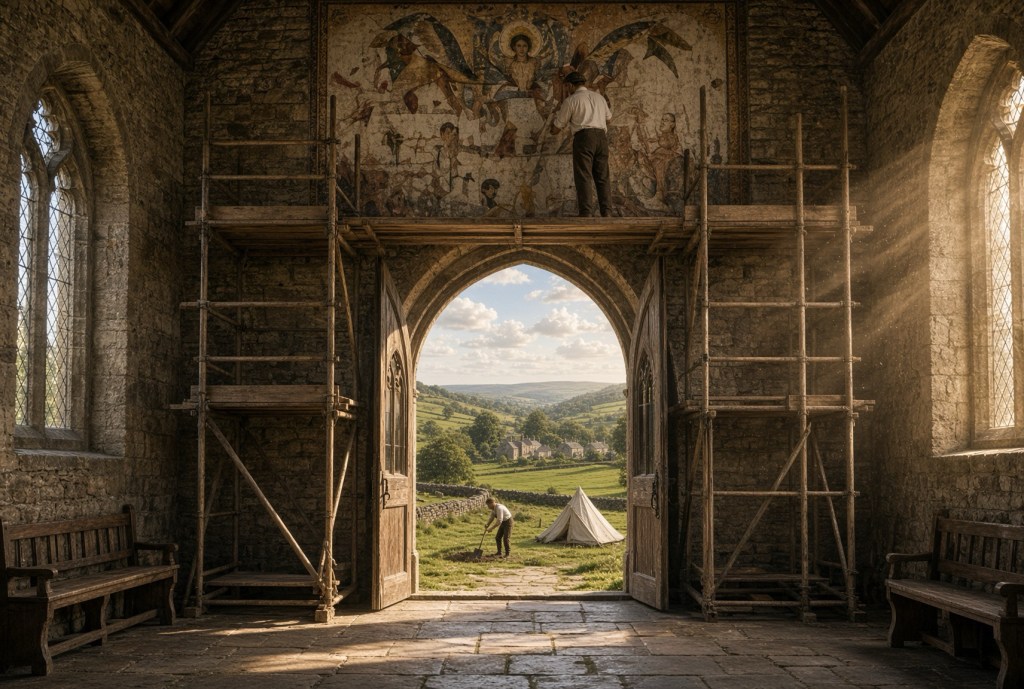
You pick up J. L. Carr’s A Month in the Country expecting a quiet little story about a man scraping paint off a wall, and then the wall itself starts answering back. It’s a Last Judgment, of course. Angels and the damned, the whole medieval works, coming out from under centuries of whitewash. Birkin doesn’t believe in any of it. He says so, more or less. Yet there he is, day after day, inches from faces that were painted to scare people into living better, or at least into fearing the end. You catch yourself wondering whether the book is quietly suggesting that the painting still works, even on him. Not as doctrine, but as a kind of pressure. Judgment doesn’t need you to sign up for it; it just needs you close enough to see the faces.
It sits in that awkward place a lot of modern English writing ends up: after the faith has mostly drained away, but while the buildings and the pictures are still standing. The vicar is there, grim and correct, and Alice is there, beautiful and stuck. The church isn’t empty, but it isn’t full either. What fills the space, for Birkin at least, is the work. There’s something almost sacramental about the way the book treats competence—the steady hand, the right tool, the refusal to rush. Not holy, exactly, but not nothing. Like the old idea that grace arrives through ordinary means, only here the means are lime and scaffold and patience, and the person receiving it doesn’t have the language for it anymore. You don’t have to force a conversion story onto it. The restoration is real whether or not he ever steps inside the theology.
It keeps circling the same hard question: what do you do with a stretch of time that was genuinely good when you know it can’t be repeated? Birkin never pretends the summer can be extended. He finishes the job, packs up, and leaves. Decades later the memory is still brighter than most of what followed. That isn’t nostalgia in the soft sense; it’s closer to the recognition that some experiences have a completeness other experiences lack, and that completeness is partly made of their ending. You can call it existential if you like—the confrontation with finitude, the refusal to paper over it with ‘everything happens for a reason’—but in the book it just feels like a man telling the truth about what he had and what he chose not to chase again. He could have written to people. He didn’t. The choice sits there, unexplained and un-excused.
The war damage is handled without the usual drama. No long trench scenes. Just the twitch, the startle, the way ordinary kindness lands harder because of what came before. The recovery isn’t a breakthrough; it’s accumulation. Regular hours. Someone bringing food. The body learning, slowly, that the next noise isn’t a shell. Moon is the mirror that makes this clearer—another veteran, another set of silences, another way the war marked a man and then left him to get on with a job in a field. Their friendship doesn’t fix anything outright, but it makes the damage less solitary. You notice, too, how little the book needs to explain the almost-affair with Alice. The restraint itself feels psychological: desire that stays mostly unspoken because both of them already know the cost of acting on it, and because the summer is already doing the work of keeping them upright.
It’s a snapshot of a rural England that was already thinning. The village still has its rhythms—chapel, harvest, stationmaster, the big house that used to matter—but the war has taken men and money and a certain kind of certainty. Birkin arrives as an outsider with a London accent and a ruined marriage; Moon is another. They are useful, and they are temporary. The book doesn’t lecture about class or modernity, but you feel the edges: who still has land, who preaches, who digs, who paints, who gets to leave when the season ends. Alice’s position is the sharpest of these. Married to the vicar, watched by the village, intelligent enough to see the limits of her life and still bound by them. The attraction between her and Birkin is real and also impossible inside the social frame they both understand. Nothing explodes. The frame holds. That quiet holding is part of what the book is recording.
It lands hardest in the decision not to return. Birkin could have made the summer into a story he kept visiting. Instead he treats it as finished. The older voice that tells us this doesn’t sound defeated so much as clear-eyed: some goods are real precisely because they were bounded. To go back would be to test whether the thing still existed, and he already knows the answer. There’s a kind of courage in that refusal, or at least a refusal of self-deception. The painting is uncovered. The month is over. What remains is the memory of having been, for a while, equal to the work and equal to the place. Not saved, not transformed forever, just briefly less damaged and more awake. The book doesn’t offer a larger meaning than that. It simply shows you a man who received it, recognised it, and then let the calendar take it away.
You put the book down and the ordinary light outside looks a little more specific than it did an hour ago. Not because anything mystical happened, but because you’ve spent time with someone who was paying attention while he still could. The attention didn’t last. Neither did the summer. Both were enough to be worth remembering accurately. That’s the scale the book works at, and it turns out to be large enough.


