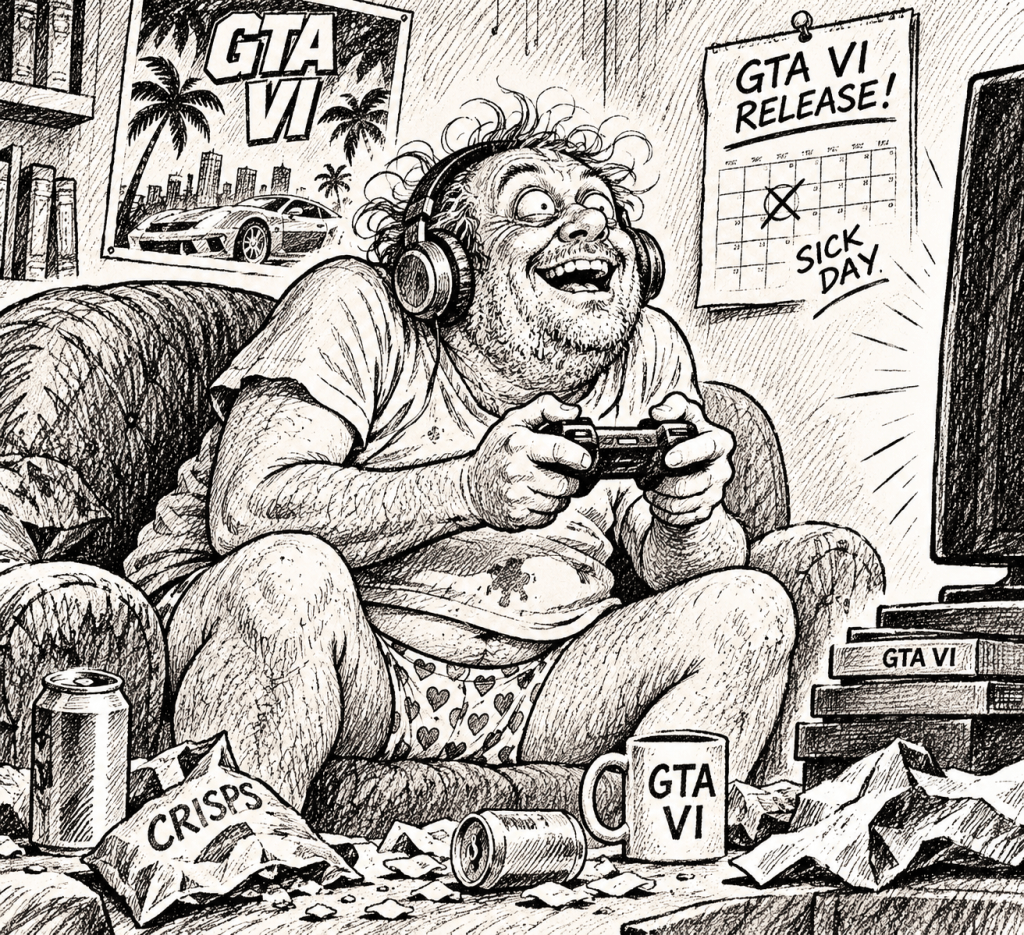
Well, it’s finally happened. Grand Theft Auto Six has arrived. Thirteen years of waiting for a computer game. Good grief, that’s longer than some marriages last. And judging by the excitement surrounding the whole business, you’d think somebody had discovered the cure for death, brought about world peace, or announced that politicians were finally going to start telling the truth. But no. It’s a computer game. And apparently, grown men have been beside themselves with excitement at the prospect of stealing imaginary motorcars and generally behaving like complete hooligans in a place that doesn’t actually exist. Wonderful.
Now, before anybody gets their knickers in a twist, I’m not suggesting there’s anything inherently wrong with enjoying a computer game. People have their hobbies, and fair enough. Some collect stamps, some go fishing, some wander around old churches, and some apparently prefer spending fourteen hours shooting virtual policemen while sitting in their underpants eating crisps. Each to their own, I suppose. But what fascinates me is the extraordinary importance some people attach to these things. We’re talking about grown adults here. Men in their thirties, forties, fifties, perhaps even older, and yes, a few women too. People talking about taking time off work, staying awake half the night, and rearranging their lives around the opportunity to pretend they’re somebody else.
And I can’t help thinking, really? Is this where we’ve arrived as a civilisation? We’ve put men on the moon, split the atom, composed symphonies, built cathedrals, and now we’ve got grown adults worrying about whether their imaginary sports car has the correct reflection in its wing mirrors. It’s extraordinary. Mind you, there’s something rather amusing about a man ringing his employer to say he’s too poorly to come into work, only to spend the next twelve hours committing armed robbery in Vice City. A remarkable recovery.
But joking aside, I think there’s something rather more interesting going on here, because this isn’t really about Grand Theft Auto. It’s about us, and our peculiar modern obsession with being entertained. For years, people have been waiting for this thing, watching trailers, analysing screenshots, and discussing every little detail as though they were examining the Dead Sea Scrolls. The anticipation becomes almost as important as the game itself. The next big thing. The thing that’s going to make everything wonderful. And then it arrives. Some people love it, others find fault, somebody complains about the graphics, somebody else doesn’t like the storyline, and before long, the novelty begins to wear off. Because that’s what novelty does. It wears off.
Which reminds me of Goethe’s Faust. Now, there’s a cheerful little tale. Faust is a man dissatisfied with ordinary human existence. He’s intelligent, educated and accomplished, but none of it seems quite enough. He wants more knowledge, more pleasure, more experience, and eventually enters into a bargain with Mephistopheles, the Devil, essentially. Now, I’m not suggesting that buying Grand Theft Auto is equivalent to selling your soul to Satan, although, looking at the price of computer games, there may not be much difference financially. But there’s something recognisable about Faust’s predicament. That restless dissatisfaction. The belief that fulfilment is always waiting somewhere just beyond our reach, if only we could have this one more thing. And I sometimes wonder whether modern consumer culture has turned us all into little Fausts, forever chasing the next purchase, the next experience, the next distraction, and never quite satisfied.
Then there’s the question of growing up, because I keep thinking about something St Paul wrote in his first letter to the Corinthians: ‘When I was a child, I spake as a child, I understood as a child, I thought as a child: but when I became a man, I put away childish things.’ Now, Paul wasn’t talking about PlayStations, obviously. He was speaking about spiritual maturity, but his words do raise an interesting question. What exactly does it mean to grow up? Because growing older and growing up aren’t necessarily the same thing. You can be fifty years old, have a mortgage, a pension, a respectable job and a wardrobe full of sensible trousers, and still possess the emotional maturity of a twelve-year-old who’s just been told he can’t have another biscuit.
And perhaps that’s one of the peculiarities of modern life. We seem increasingly reluctant to leave childhood behind. Not childhood in the sense of wonder, imagination or curiosity, because those are wonderful things, but childhood in the sense of needing constant amusement, of expecting to be entertained, and becoming thoroughly miserable when we don’t get precisely what we want. I sometimes think we’ve confused having fun with having a life. They’re not quite the same thing, are they?
Now, I’m not against escapism. A good novel can transport us into another world, as can music, a film or a play, and thank goodness for that. Sometimes the real world is so utterly ridiculous that escaping it for a couple of hours seems a perfectly reasonable response. But there’s a difference between taking a holiday from reality and emigrating from it altogether. In a game, you can be somebody else. Rich, powerful, dangerous, successful. You can drive expensive cars, live in extraordinary houses, and behave in ways that would get you arrested before lunchtime in my country. And if everything goes wrong, you simply start again.
Real life isn’t quite so forgiving. You can’t reload yesterday because you said something hurtful. You can’t restart a marriage because you made a mess of it. You can’t bring somebody back because you suddenly realise how much you loved them. Real life has consequences, and perhaps that’s precisely what makes it so valuable. The things that matter most generally require something of us: patience, responsibility, commitment, sacrifice. All those terribly inconvenient qualities that don’t come with a trophy popping up in the corner of a screen.
And there’s a theological dimension to this, too. Christianity has a word for things we allow to occupy a place in our lives that they don’t deserve: idolatry. We tend to imagine ancient people bowing before golden calves or peculiar-looking statues, but an idol doesn’t necessarily have to be made of gold. Sometimes it’s made of plastic, comes with two little joysticks, and requires an internet connection. I’m not suggesting that playing Grand Theft Auto is an act of pagan worship. That would be a bit much, even for me. But anything can become an idol when we give it more importance than it deserves. Money, possessions, status, entertainment, even our own opinions, if we’re not careful.
And perhaps that’s the real issue. Not whether grown adults should be allowed to enjoy computer games. Of course they should. But whether we’ve become so preoccupied with being entertained that we’ve forgotten how to be content. Because contentment is a very different thing from excitement. Excitement comes and goes, but contentment is quieter. A good book, a walk in the countryside, a conversation, a piece of music, a quiet church on a rainy afternoon. Things that don’t promise to change your life, but somehow enrich it anyway.
So, Grand Theft Auto Six is finally here. The neon lights are glowing, the engines are roaring, and countless imaginary criminals are no doubt having a thoroughly marvellous time. And fair enough. Enjoy it. But eventually, the excitement will fade, the controller will be put down, and what remains is the life you’ve been living while you were holding it. And that, I think, is worth considerably more than any computer game, even one that’s taken thirteen long years to arrive.


