
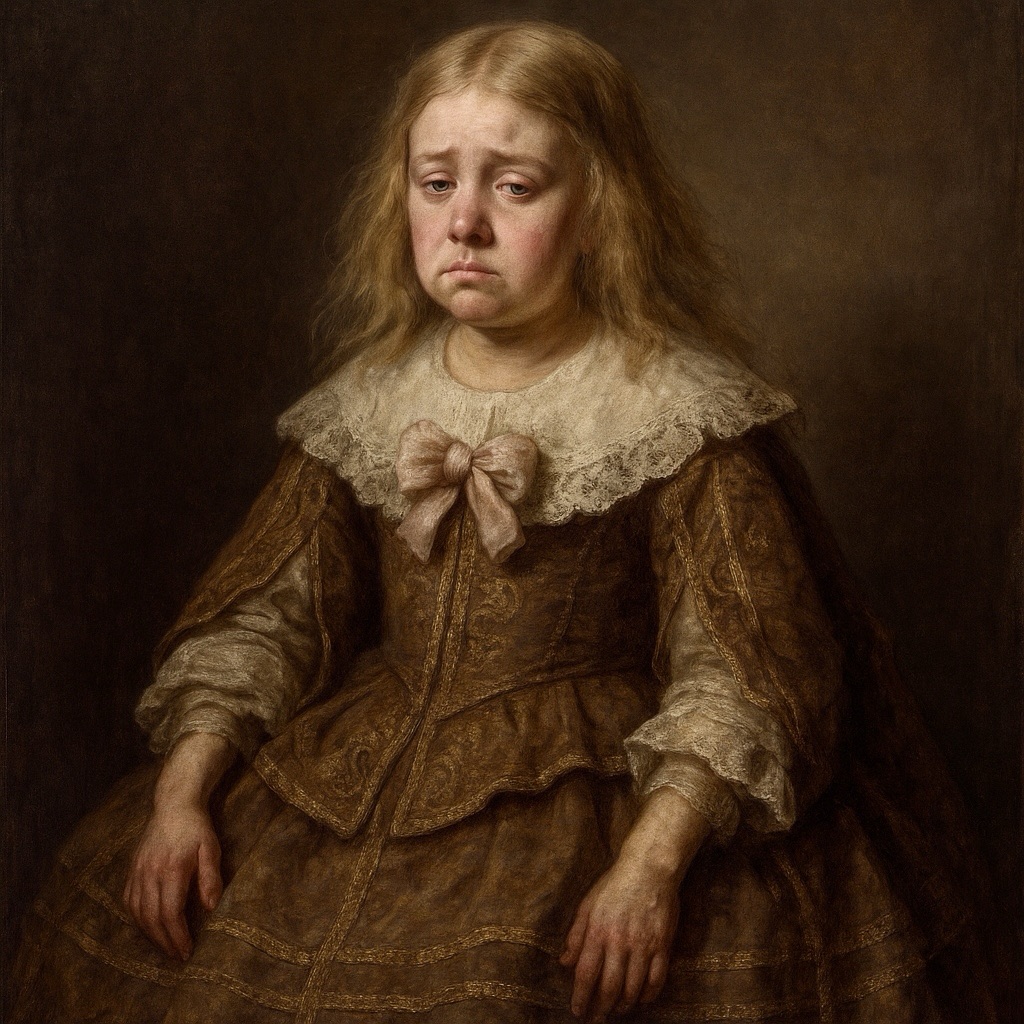
Velázquez paints her as an angel of empire; the nose might have told a different story.
“For we are unto God a sweet savour of Christ… and to the other the savour of death unto death.”
– 2 Corinthians 2:15–16
Few things are so deceptive in art as cleanliness. And few things so tragic in history as a child with a crown. I was thinking about both while gazing, once again, at Velázquez’s haunting portrait of Princess Margaret Teresa of Spain, that flaxen-haired spectre at the centre of Las Meninas, propped up by courtiers, dogs, and mirrors. She looks, to the untrained eye, like a doll dressed for a festival – a little imperial Venus in silk. But behind that image lies a truth far less fragrant.
They say she smelled. That this poor girl, born of royal blood and entombed in brocade, carried with her an odour that lingered long after the courtly bows had ended. A pungency noted at the Austrian court, whispered in corners by perfumed diplomats and eunuch-tongued maids. And I, for one, believe it. Not because she was dirty, but because her life was.
Let’s consider the facts. Margaret Teresa was the product of Habsburg breeding – a niece married to her uncle, a dynastic knot so tight it could throttle the soul. She was born into a world that confused sanctity with sterility, and piety with power. Her body was not her own – it was a treaty in petticoats, promised to secure the Holy Roman Empire’s spiritual backbone. And like all sacrifices, she had to be dressed for the altar.
The Spanish court wasn’t known for its freshness. While the Enlightenment tickled the fringes of Paris and the Dutch bathed in tulip water, the court of Philip IV remained cloaked in austere Catholicism, its rooms dark with incense, its servants silent, and its daughters layered like onions. Bathing, to them, was considered not just unseemly but a medical risk. To open the pores, you see, was to invite death in.
Instead, they masked their humanity with lace and perfume, with citrus oils and rose waters. Linen shifts were changed with ritualistic precision, not for cleanliness but for appearance. Even the dying were propped up in wigs and lace cuffs so they might pass as paintings.
So no, Margaret Teresa did not bathe often. She didn’t frolic in lavender fields or scrub with carbolic soap. She lived as one of the last perfumed corpses of a decaying age, embalmed while still breathing.
And yet – what if her odour was not the result of filth, but of flesh itself? There’s something deeply poetic in the idea. Her body, straining under the weight of inbreeding, pregnancies, and political expectation, may have simply rebelled. Perhaps her scent was the only honest thing about her. A kind of olfactory heresy against the myth of noble purity.
The courtiers might sneer, but they too were rotting in powdered silence. Only Margaret bore it with unwitting honesty – a child who smelled not of death but of something more primal: life constrained.
What do we make of it, then – that a princess should be remembered not for her mind, nor her art, nor even her tragedy, but for her smell?
We remember Nero’s fiddling, not his fiscal reforms. We remember Caligula’s horse, not his brief flirtation with diplomacy. History isn’t a courtroom but a circus. And Margaret, poor child, is its scented clown.
It reminds me, oddly, of the Old Testament sacrifices. Sweet-smelling offerings, burnt not for utility but for symbolism. And Margaret was offered. Offered to Austria, to God, to her own bloodline. And in the end, she perished aged just twenty-one – spent, stained, and canonised in canvas. Still we look at her, forgetting the stench of her short existence, remembering only the silks.
But sometimes, when I stare long enough at her painted form, I swear I can smell it. Not foulness. Not decay. But the scent of something more terrible: innocence betrayed.
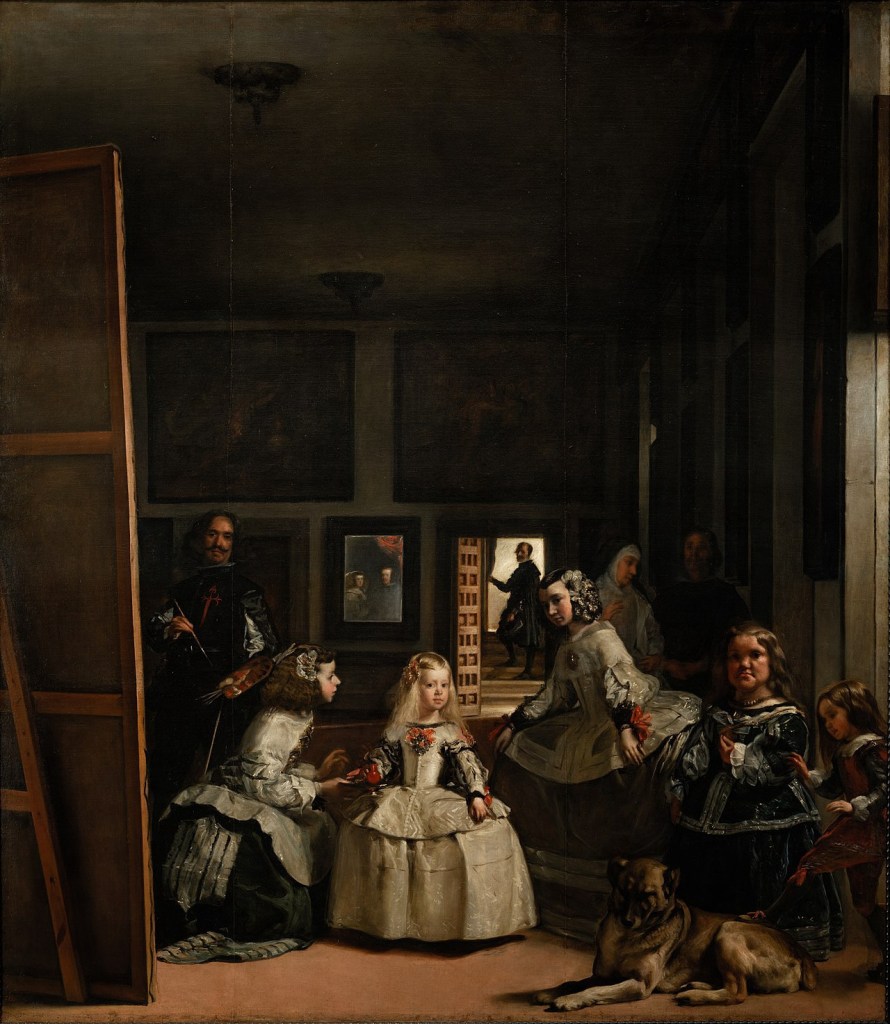
Velázquez’s Las Meninas (1656) captures Margaret Teresa at the very apex of her symbolic power – bathed in light, wrapped in the stiff splendour of brocade, flanked by ladies-in-waiting, court dwarfs, and a docile mastiff. She stands as the immaculate pearl of Spain’s Habsburg dynasty, her image carefully staged within a web of mirrors, shadows, and gazes. Yet the brilliance is an illusion: a painted mask over a fragile, living body. The viewer sees perfection, but history records a girl plagued by frailty, hemmed in by the suffocating etiquette of the Spanish court, and – if court whispers are to be believed – carrying a scent far less divine than her painted likeness suggests. Las Meninas thus becomes an emblem of the gulf between image and reality, the perfumed façade of empire and the human truth beneath the silk.

 Wording
Sweet-smelling offerings
I’ve been reading my Bible nigh on to 35 years now and I STILL don’t understand that. They weren’t cooking or bbq’ing those meat parts. They were burning them to ash. As an American, I’ve seen enough bbq’s gone wrong to know that burnt meat is not a pleasant smell 😀
I guess that is why God is God and why I’m not!
I think the difference is that God isn’t sniffing with a mortal nose like ours. In Leviticus 1:9, it says it was a ‘pleasing aroma to the Lord’ – not because God fancies a burnt brisket, but because the smell represented obedience, repentance, and a heart turned toward Him.
To us, it’s burnt meat. To Him, it’s the scent of covenant faithfulness.
Think of it like incense: nobody burns frankincense because they’re hungry – unless they’re a very confused chef.
And who knows? Maybe heaven has a different barbecue setting entirely. If God can part the Red Sea, I’m sure He can make burnt goat ribs smell like a Michelin-star feast. 😉
😀