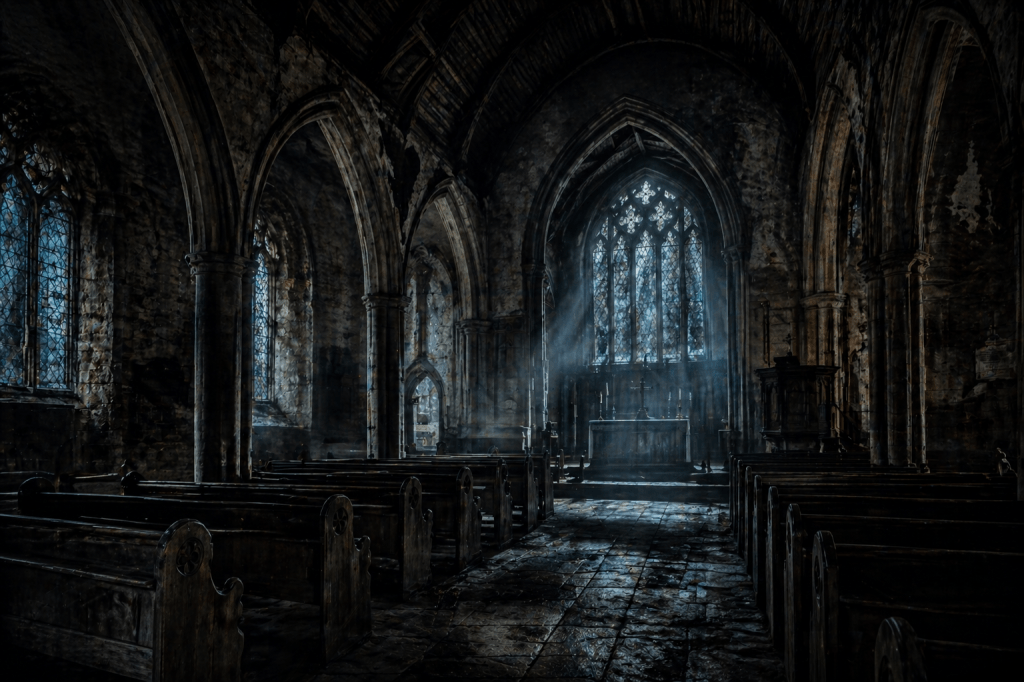
There’s a peculiar kind of illness that has nothing to do with the body. It creeps in behind the eyes and presses down behind the ribs. It isn’t caused by lack of fresh air or poor hydration or an overlong breakfast. It’s spiritual, or at least — if that’s too much for polite company — atmospheric. And I had it full force in the chancel of Cartmel Priory last year.
The moment I stepped near the altar, I felt it: a sudden wave of nausea, like I’d stumbled into an unseen miasma. My stomach turned; my chest tightened. And not the poetic kind of tightness that stirs awe in ancient places, either. This was closer to revulsion — like I’d walked through something that didn’t want to be walked through. Something that lingered.
I don’t go hunting for ghosts. I’m not one of those oddball thrill-seekers who waft incense and chant into pub cellars for YouTube views. But I know what I felt, and I’ve walked through enough ruined chapels and roadside shrines to distinguish between ‘odd vibes’ and what I can only call spiritual uncleanness. This wasn’t a chill of awe or the echo of long-forgotten chant. It was sickening. And it clung.
Curiously, as I moved away from the altar, the sickness lifted — like passing through a cloud into open air. I didn’t feel fear, exactly, but something deeply out of place. Something spiritually wrong. Something — or someone — who shouldn’t be there.
The Priory has had its guts ripped out before. Founded by Augustinians in the late 12th century, it thrived for centuries before Henry VIII’s godless gardening began — pulling up monasteries by the roots, scattering monks and relics like so much compost. But Cartmel didn’t go quietly. Ten villagers and several canons were hanged, drawn, and quartered for standing against the dissolution. Executed for the crime of fidelity.
Imagine the rage. Imagine the fear. Imagine sacred ground desecrated, blood spilt within holy walls. There’s theological precedent, from Genesis to Revelation, that the spilling of innocent blood defiles the land. What, then, of the sanctuary? What residue might remain?
Cartmel’s altar was once the beating heart of the monastic body. But when that body is torn apart — when the Mass is halted, the sacraments defiled, and murder made an instrument of reform — can we really expect that the spirit of the place remains whole?
And then there are the carvings.
Cartmel’s misericords — wooden seats carved in the 15th century — are beautiful, yes, but disturbing. Among them aren’t angels or saints, but Green Men. Carven faces split with foliage, grimacing with leafy mouths and thorned brows. These symbols, long associated with pagan fertility cults and woodland spirits, were carved into the choir stalls by craftsmen who surely knew the uneasy tension they introduced.
The Green Man isn’t a quaint botanical cherub. He’s a cipher. Sometimes pagan deity, sometimes devil, sometimes echo of the horned god. A leafy remnant of older faiths that Christianity tried to absorb — or suppress. Some interpret him benignly, but let’s not be naive: the placement of such imagery within the choir — the very seats of liturgical authority — is theologically dissonant, at best.
In medieval times, the grotesque was often used as a spiritual decoy — a way of saying, “We see you, darkness. We name you. We mock you.” But what if the mockery became mimicry? What if, instead of repelling, it invited? Wouldn’t it be like hiding a serpent in the tabernacle?
Christ speaks of unclean spirits in terms disturbingly anatomical: they enter, they dwell, they make their home in people and places left ‘swept and garnished’ but empty of the holy (Luke 11:24–26). These spirits aren’t horror film ghouls — they’re disordered presences. Restless, manipulative, joyless. They loathe prayer. They cling to desecration. And they have a taste for thin places where the veil between flesh and spirit wears most sheer.
The altar, as the axis mundi — the meeting point of heaven and earth — is precisely such a place. It’s meant to be spiritually saturated. But if the holy is expelled or forgotten, what then rushes in to take its place?
Something ancient? Something angry? Something defiled?
I don’t pretend to know. But I know what I felt. And I know it lifted when I left the altar behind.
Perhaps some would call this sensitivity a curse — an over-attuned imagination, a flare-up of gothic romanticism. But I’d call it discernment. Not of moral purity, but of imbalance. A place where something’s gone wrong.
Cartmel Priory remains a beautiful place. But I no longer trust beauty on its own. The devil, after all, was an angel of light. And sometimes, beneath the stone and stained glass, something grins.
Not everything that hides in the choir is holy.


