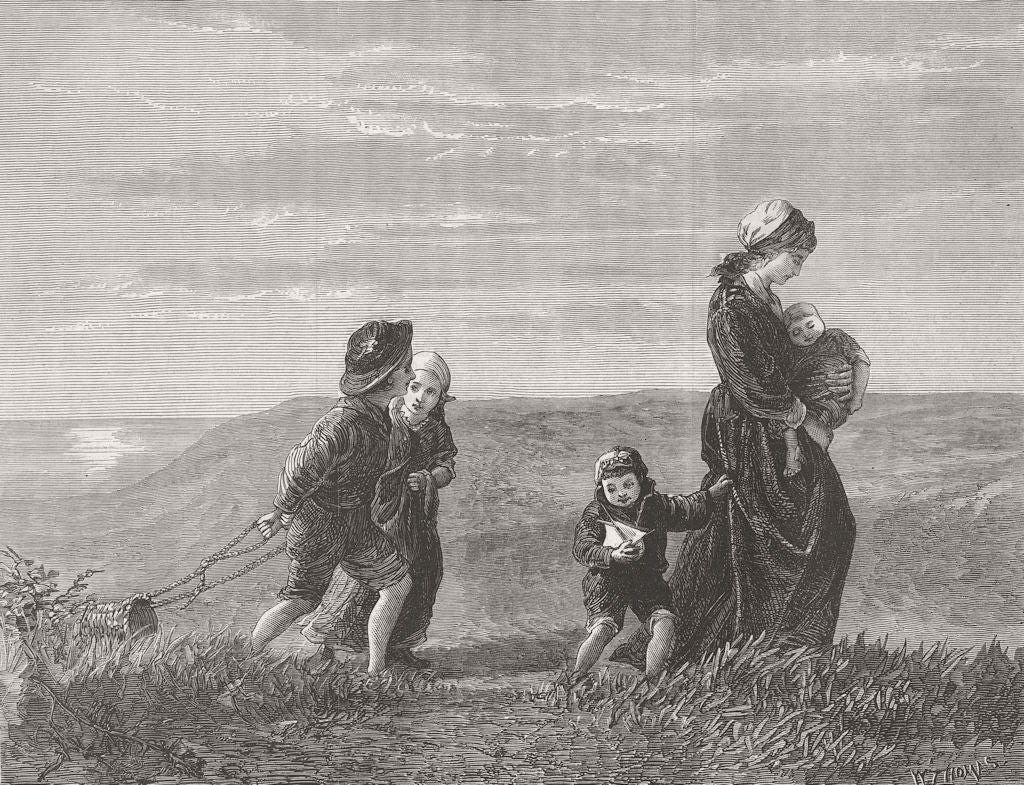
When I first came across the story of that engraving – The Fisherman’s Widow – hanging in Mary Jane Kelly’s poky little room at 13 Miller’s Court, it hit me like a punch to the gut. Here was this cheap print, nothing more than a mass-produced wood engraving from The Illustrated London News back in 1868, stuck above the mantelpiece in the very spot where Jack the Ripper tore her life to shreds on that foggy November night in 1888. The room itself was no palace – twelve feet square, furnished with landlord’s cast-offs, a tin bath shoved under the bed – yet that picture stared down at the horror like some silent witness who’d seen it all before. It got me thinking, not in some dusty academic way, but in the raw, gut-level sort of pondering that keeps you up at night. What does a picture of a grieving widow, eyes fixed on stormy seas, say about a woman who ended up murdered in the East End slums? And why does it pull me into bigger questions about theology, sociology, psychology, philosophy and existentialism? It’s like the engraving became a cracked mirror, reflecting not just Mary’s short, brutal life, but the whole messy human condition – much as the storm-tossed widow in Thomas Hardy’s Tess of the d’Urbervilles watches her own fate unravel against the indifferent Wessex landscape.
It paints a picture as bleak as a winter’s day in Spitalfields. Victorian London was a place where the rich got richer and the poor were left to sink or swim – or in Mary’s case, drown in gin and desperation. She wasn’t some romanticised fallen angel; she was a working-class woman scraping by in a world that treated her like yesterday’s fish and chips wrapper. The engraving, belonging to her landlord rather than her own choosing, symbolises how the underclass lived surrounded by someone else’s sentimental dreams. It’s the classic ‘haves and have-nots’ divide: while posh folks in Mayfair hung oil paintings of sunlit landscapes, Mary’s walls held a mass-produced reminder of loss at sea – cheap as chips, yet heavy with irony in a city where women like her were one bad night away from the workhouse or worse. That print wasn’t decoration; it was a sociological snapshot of how poverty traps you in cycles of grief, much like the fog-bound slums Dickens described in Bleak House, where characters drift through endless legal and social mazes with no escape, their lives as trapped as fishermen’s families watching empty horizons.
It cuts deeper – like a knife to the heart of how we cope with trauma. Mary Jane Kelly had already buried one husband and watched her life unravel into prostitution and drink. Staring at The Fisherman’s Widow every day must have been like living with your own shadow self: a woman frozen in mourning, waiting for news that never comes. Psychologists talk about how images can trigger unresolved grief or act as a sort of emotional anchor in chaos. For Mary, perhaps it was a quiet comfort, a simile for her own stormy existence – battered by loss but still standing, chin up against the gale. Or maybe it stirred something darker: the sort of quiet despair that Freud might have called repressed mourning, where the picture becomes a stand-in for all the men who’d left her high and dry, or the life she might have had if fate hadn’t dealt her such a rotten hand. In a room that small, with the Ripper’s shadow already lengthening outside, that engraving could’ve been the psychological equivalent of a security blanket – or a constant prod at old wounds that never healed, echoing the brooding introspection of a Brontë heroine wandering the moors.
It makes me wrestle with the big ‘why’ questions, the ones that have kept vicars and philosophers up at night since time immemorial. Why would a benevolent God allow a young woman like Mary to meet such an end, with a sentimental picture of widowhood watching over the carnage? It reminds me of the biblical widows – think of the one in Zarephath who fed Elijah and still faced starvation, or Job’s wife scraping by after everything went pear-shaped – and calls to mind Milton’s Paradise Lost, where fallen humanity grapples with divine justice amid a world of pain and exile. Theology often frames suffering as a test or a mystery, but in Mary’s case, it feels more like divine indifference, a cold shoulder from above. The engraving, with its stoic widow gazing seaward, is almost a prayer in visual form: ‘Lord, why hast Thou forsaken us?’ Yet it also whispers of redemption through endurance, like the Christian idea that grief can forge saints out of sinners. It makes me wonder if that picture was God’s quiet way of saying, ‘I see you,’ even as the Ripper’s blade proved otherwise. It’s a bitter pill, isn’t it – faith clinging on like a barnacle to a sinking ship.
The whole thing screams stoicism to me – the ancient idea that you brace yourself against life’s tempests because that’s all you can do. Seneca or Marcus Aurelius might’ve nodded at that widow’s calm resolve, urging us to accept what we can’t change. But in Mary’s world, philosophy feels almost cruelly abstract. Her life wasn’t a thought experiment; it was a daily grind where philosophy met the pavement. The engraving, hung there like a philosophical footnote, suggests that even in the slums, people reached for meaning through art – however cheap and second-hand. It’s the human itch to make sense of suffering, to turn raw pain into something you can frame and live with. Yet it also highlights the limits of philosophy: no amount of wise words could have saved Mary from the knife, just as no engraving could shield her from the world’s indifference, much like the futile quests in Hardy’s tragic tales where characters rail against a universe that barely notices.
And it all gets properly existential – absurd, even. Think Camus or Sartre staring into the void: life’s a meaningless roll of the dice, and we’re all just Sisyphus pushing our boulders uphill for no good reason. Mary Kelly’s room, with that Fisherman’s Widow print as its centrepiece, feels like the perfect stage for that drama. Here she was, a woman whose existence was defined by randomness – born poor, widowed young, murdered horribly – yet that picture offered a sliver of shared humanity: one widow’s grief mirroring another’s quiet desperation. It’s like the engraving whispered, ‘You are not alone in the absurdity,’ even as the Ripper proved the universe doesn’t give a damn. It’s the ultimate simile for the human condition: we’re all fishermen’s widows in our own way, scanning the horizon for meaning that may never arrive, clinging to cheap prints and small comforts while the waves crash in – not unlike the ancient mariner in Coleridge’s poem, forever telling his tale of woe to indifferent listeners. Mary didn’t choose that picture, but in her final hours it became a silent companion in the theatre of the absurd – a reminder that existence precedes essence, as Sartre would say, and sometimes essence gets carved up in Whitechapel.
Looking back, that engraving in Mary Jane Kelly’s room isn’t just a Ripper footnote; it’s a thread that ties the personal to the profound. It’s like a single drop of seawater that hints at the whole ocean of human suffering, with echoes of Hardy, Dickens, Milton and Coleridge woven through it all. It exposes the class chasm, it mirrors inner turmoil, it questions divine fairness, it calls for stoic grit, and it dares us to find meaning in the madness. In the end, it leaves me with a quiet ache – not academic detachment, but the sort of heartfelt wonder that says, ‘There but for the grace of God go I.’ Mary’s story, framed by that widow’s gaze, reminds us that life’s storms come for us all, and the best we can do is hang our own little pictures of hope on the wall and keep watching the sea.


Robert I am confused. The print you describe bears no relation to the ‘Fisherman’s Widow ‘ in Mary Kelly’s room.
Hi, thanks for the comment.
You’re right to be cautious — the print in Mary Kelly’s room has never been definitively identified. Contemporary reports only name it ‘The Fisherman’s Widow’ and note that it hung above the fireplace; no detailed description or photograph of the image itself survives. Several candidates have been proposed over the years (including Frank Bramley’s A Hopeless Dawn and others), but none can be confirmed.
I chose the 1868 wood engraving by J.H. Burgers (published in The Illustrated London News) because: it carries the exact title reported at the time, and, it was a mass-produced, inexpensive illustration of the kind commonly found in working-class rooms, and
it was already circulating for twenty years by 1888.
That said, it remains only a plausible candidate, not a proven one. If you have a source that links a different image more securely to the room, I’d be genuinely interested to see it. Happy to update the post if stronger evidence turns up.
Best,
Robert
Many thanks for your reply Robert.
My confusion lies in the description of the widow looking bravely out to sea and the image being related to by Mary Jane because of her own bravery in the face of adversity. This widow has her head bowed, retreating away from the sea and holding her children close. I think it looks much more like Bramley’s ‘The Hopeless Dawn.’
Another small thing I would like to mention is that Mary Jane’s surname was Davies, as she had married a man called Davies , a carpenter or woodworker , and he had died and for her own reasons she had reverted to her maiden name.
This interests me as my maiden name was Davies and my father was a carpenter who died at 47 .
Enjoying talking to you,
Jilly Tambanhabay.
Dear Jilly,
Thank you for the thoughtful follow-up — I’m glad we’re talking about this.
You’re quite right about the visual tone of the Burgers engraving. Looking at it again, the widow’s head is inclined, she is holding her children close, and the overall feeling is more protective and withdrawn than boldly facing the sea. My earlier description leaned into an interpretive reading of quiet endurance rather than a literal depiction of the pose. That was more my own projection than a precise match to the image itself. Bramley’s A Hopeless Dawn does convey a stronger sense of open grief and despair, and many people have preferred it for that reason. As we both know, though, neither painting can be confirmed as the one that actually hung in the room — the contemporary reports only give us the title.
On the name point: according to Joseph Barnett’s inquest testimony, Mary told him she had married a collier (coal miner) named Davis or Davies when she was about sixteen, and that he was killed in a mining explosion a year or two later. After that she seems to have reverted to using Kelly. The carpenter detail doesn’t appear in the main contemporary accounts, though of course details of her early life remain very patchy.
I’m touched by the personal connection you mentioned — your maiden name being Davies and your father a carpenter who died at 47. These small overlaps across time can feel strangely resonant when we’re looking at these cases.
Thank you again for the careful reading and the conversation. It’s a pleasure.
Best wishes,
Robert